

TL;DR: A product configurator lets a buyer build a made-to-order product online, with the rules, pricing, and stock resolved as they select. This guide explains how a configurator works, the four types, the industries that need one, what Shopify, BigCommerce, Magento, and WooCommerce can and cannot do natively, when to build custom, what it costs, and how to vet the firm that builds it.
Some products can be listed. Others have to be configured. A shirt is described by color, size, and fit. If your team already keeps a spreadsheet open next to the store to hold product data the platform cannot, is that spreadsheet a stopgap, or has it quietly become the real configurator? An industrial door answers for itself: it is specified across ten dependent dimensions where the frame profile you pick decides which hinge preparations are still legal, and a mattress is a core, a layer stack, a cover, a size, and a firmness valid for only some of those combinations.
At that point the question stops being which ecommerce platform to buy. It becomes what has to be built on top of whichever platform holds the catalog, who can build it, and what that work costs. Ecommerce product configurator development is the discipline that answers those questions, and it is a different engagement from theme work or app installation.
This guide is written for manufacturers, distributors, and wholesale operators selling made-to-order or highly configurable products. Optimum7 is a Shopify Plus Partner and BigCommerce Elite Partner that builds custom configurators, rules engines, and complex catalog systems, and the examples throughout are real client builds. Read it in order to understand the mechanics, compare your platform options, and scope the work with the right questions.
What is an ecommerce product configurator?
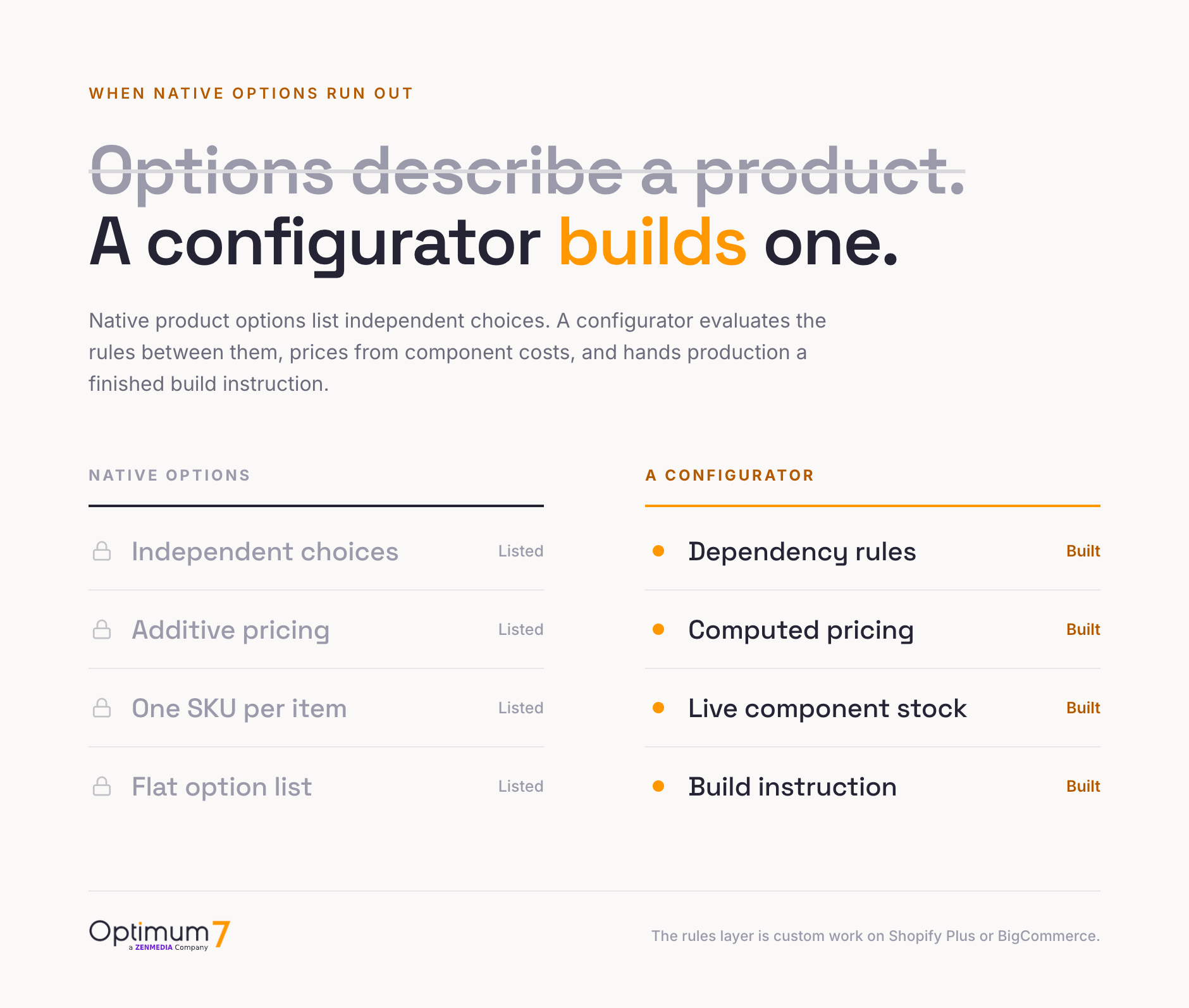
Native product options describe a fixed catalog: a set of independent choices, additive pricing, and one stock record per sellable item. A configurator describes a buildable catalog. Each selection is passed to a rules engine that decides what options remain valid downstream, prices the configuration from component costs, checks it against real stock, and resolves it into a specification the floor can act on. The difference is dependency: in a configurator, one choice changes what other choices even exist.
How does a product configurator work?
A configurator runs a short decision loop on every selection. The buyer clicks, and behind the screen the system re-checks what is still valid, recomputes the price, and re-renders the result before the next click. Five moving parts make that possible.
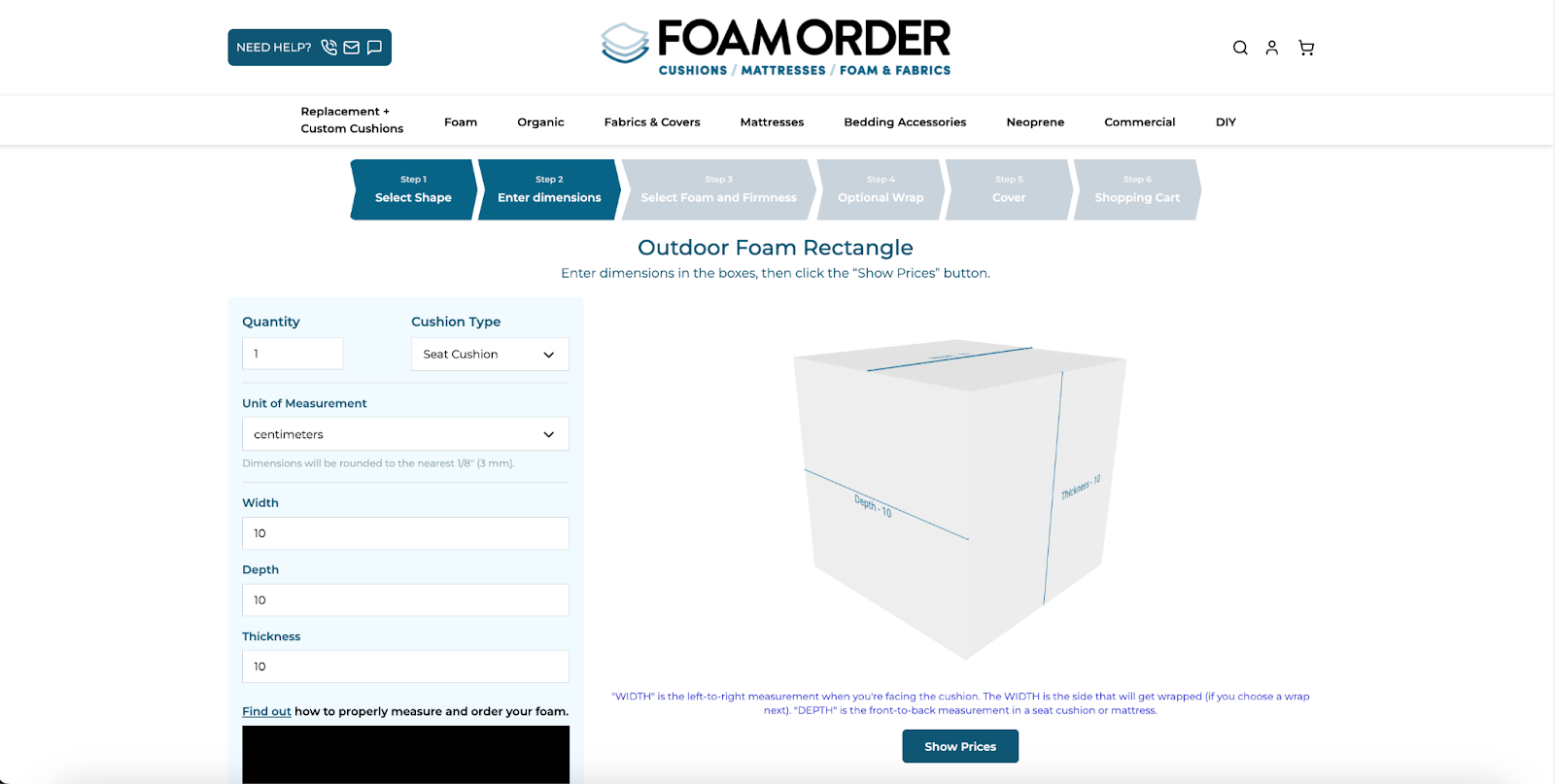
Optimum7 build for FoamOrder: dimension inputs drive a live 3D preview and a running total.
The option model. Every dimension a product can vary by, and the values each can take, held as structured data instead of a flat variant list. This is what a spreadsheet is standing in for when a catalog has outgrown the platform.
Constraint rules. The logic that says which combinations are legal. Picking a frame profile may remove three hinge options and force a specific lockset. Good configurators evaluate these at selection time, so an invalid build never reaches the cart.
Computed pricing. Price is calculated from component costs, dimensions, or a formula, not added up from static option surcharges. A banner priced by area and a shutter priced across seven variables are the same idea: the number is derived from the build itself.
Component resolution. The finished configuration is resolved into a bill of materials, the list of parts and quantities the build consumes. This is the bridge between what the buyer sees and what the floor makes.
Validation and output. The resolved build is checked against live stock, then written to the order as a specification production can act on. The Hurricane Shutters Wholesale build shows the loop end to end: the buyer sets shutter type, opening, construction, and dimensions, and the price resolves live, replacing a quote that used to take days.
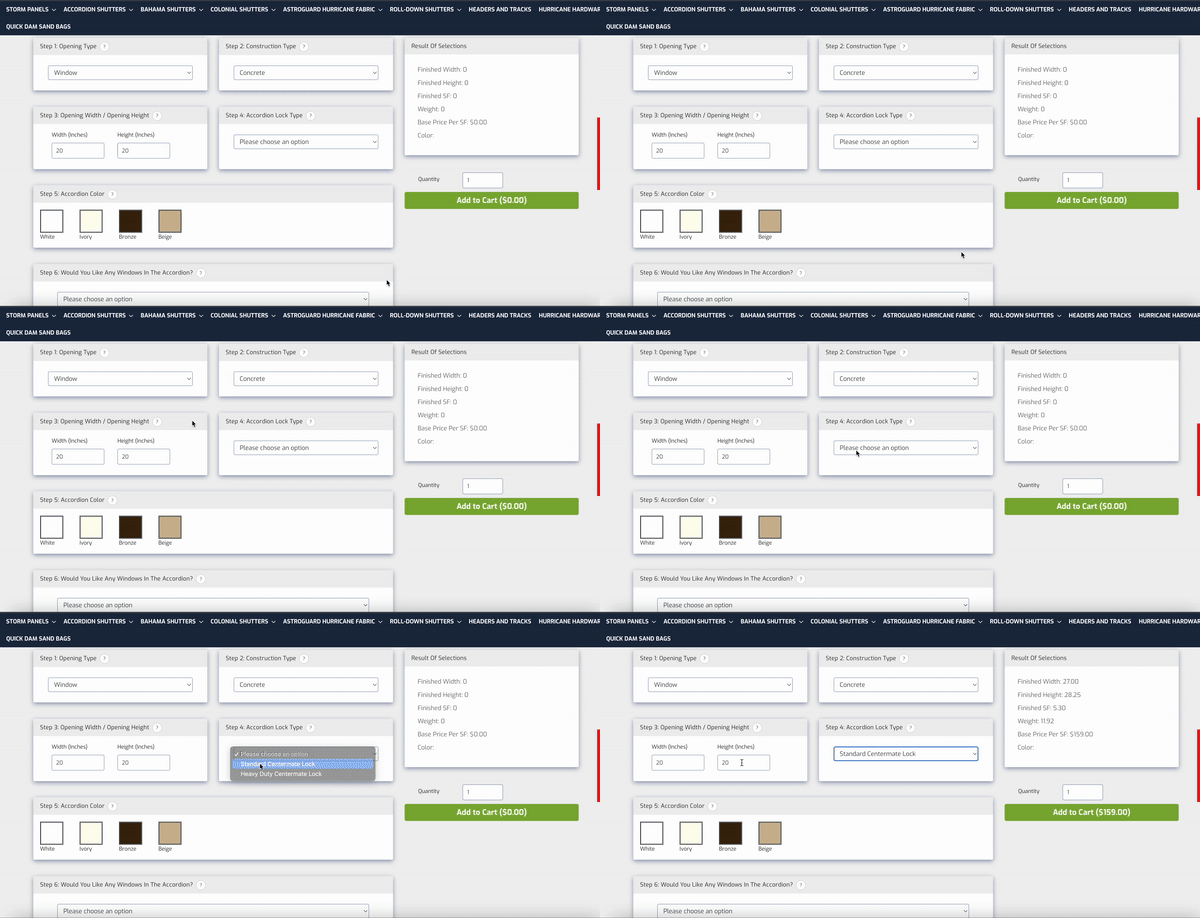
Optimum7 build for Hurricane Shutters Wholesale: price resolves live from the configuration.
The four types of product configurators
Configurators generally fall into four patterns. A single store often combines them, but knowing which pattern your product needs is the first scoping decision, because each carries a different build cost.
Option builders handle step-by-step selection of independent or lightly dependent options with additive pricing. A foam cushion configured by shape, size, firmness, and cover is the classic case, and it is the type an off-the-shelf product-option app is built for.
Visual and 3D configurators render a live preview or 3D model that updates as the buyer configures, so they approve the exact product before they buy. A personalized plaque previewed on the canvas while the text is typed is a visual configurator; a cushion shown as a dimensioned 3D shape is a 3D one.
CPQ and quote configurators compute price from a formula or component costs and return it instantly, replacing a manual quote. A shutter priced live from type, opening, construction, and dimensions is the pattern, and it is what turns a days-long quoting cycle into a self-service checkout.
Guided selling journeys walk the buyer down a structured path that narrows a large option catalog to a valid build, often with faceted filtering at each step. A fabric picker filtering hundreds of covers by use, color, and brand is a journey step that keeps a deep catalog navigable.
FoamOrder runs all four at once. Its guided journeys narrow the catalog, a fabric picker filters hundreds of covers, computed pricing returns a live quote, and a 3D preview shows the build. The fabric step below is the guided-selling pattern in production, faceted by application, color, pattern, brand, and price.
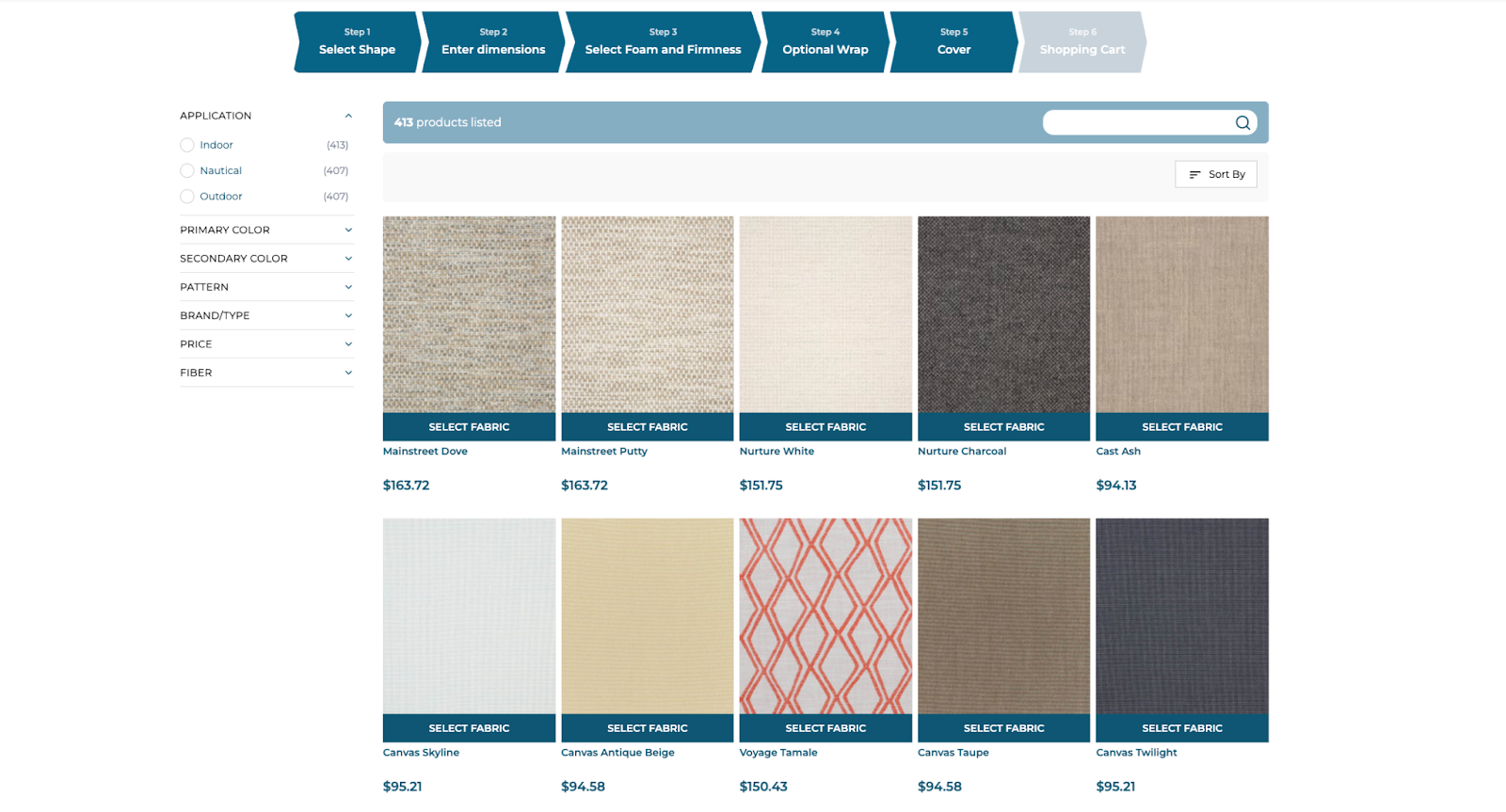
Optimum7 build for FoamOrder: guided fabric selection with faceted filters and live pricing.
3D and visual product configurators
For personalized and made-to-visual products, the preview is the product. A buyer will not commit to a custom plaque, a framed print, or a cut cushion they cannot see first, and a wrong guess becomes a return the merchant usually cannot resell. A visual configurator closes that gap by rendering the exact configuration in real time.
American Registry sells recognition plaques that are made to order, so every unit is unique and non-returnable. Optimum7 built a live HTML5 Canvas preview that renders the buyer’s name, specialty, and city onto the plaque as they type, with material variants and text-length guardrails, on a custom Shopify app. The buyer approves exactly what production will make.
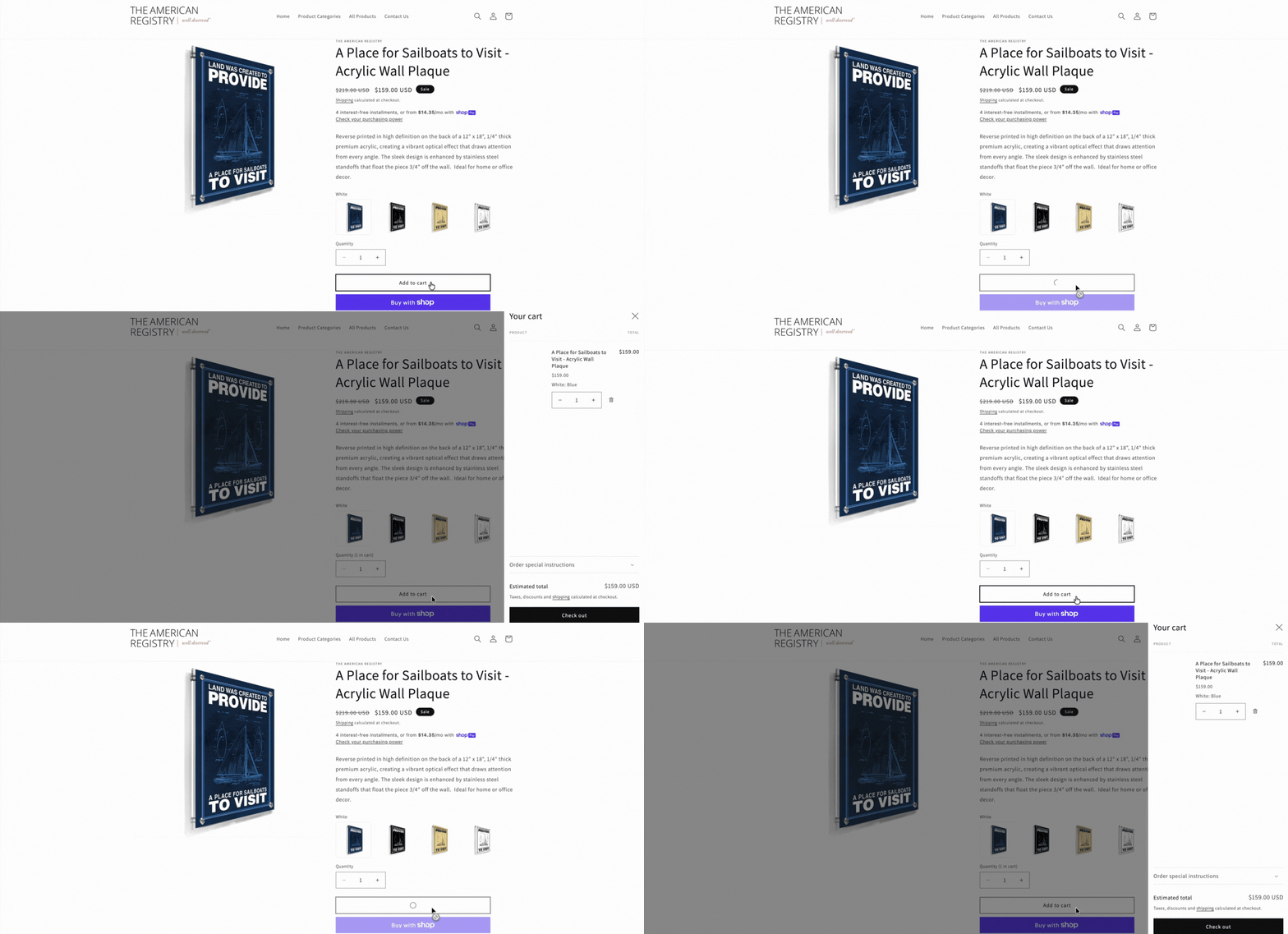
Optimum7 build for American Registry: live canvas preview of a personalized, made-to-order plaque.
Visualization also lifts confidence on standard-catalog products sold in many finishes. For Posterazzi, a store with a very large print catalog, the product page pairs each poster with framing options and room-scene mockups so the buyer sees the piece in context before adding it to the cart. The heavier the personalization, the more a real-time 3D preview earns its build cost.
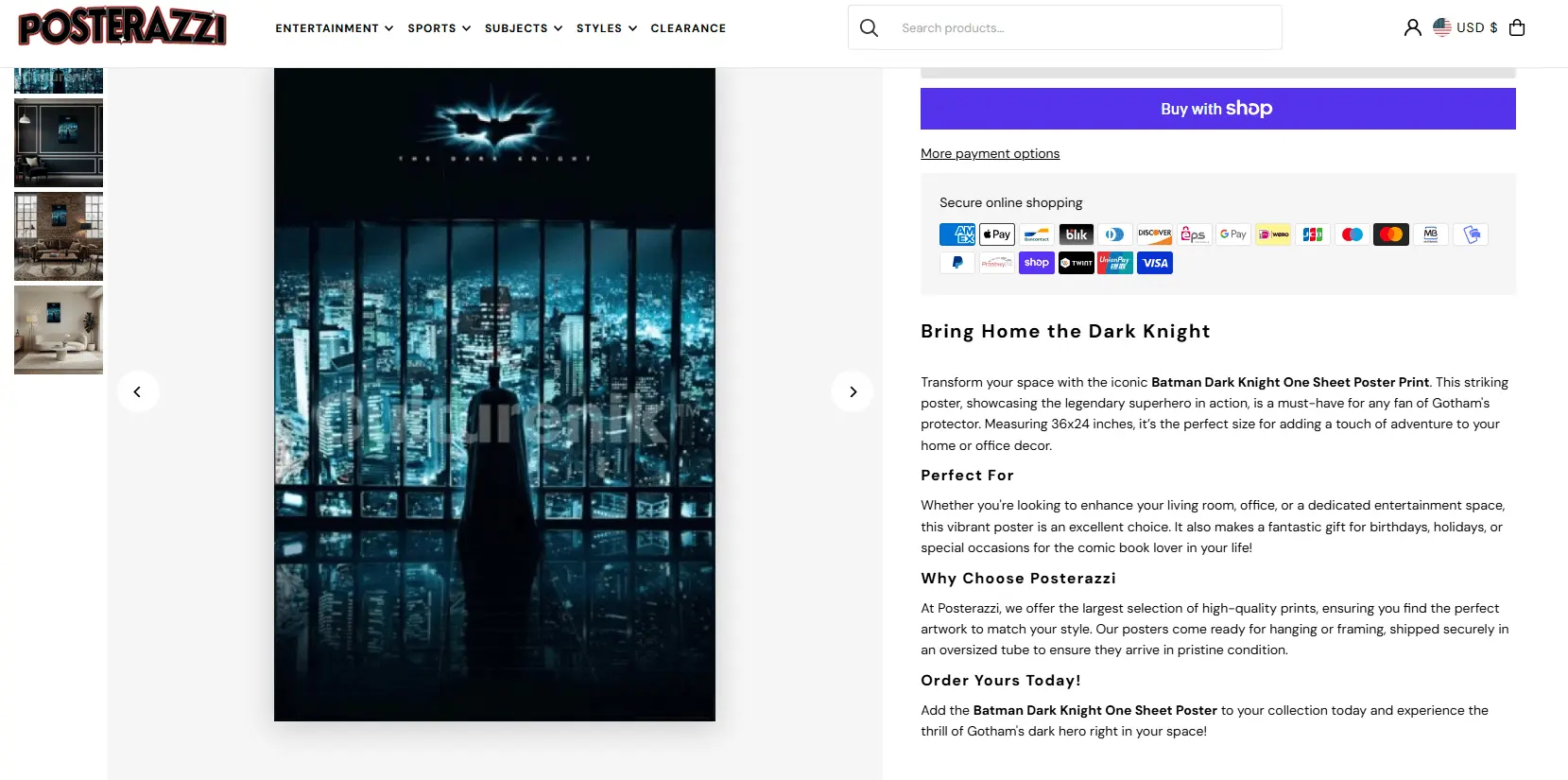
Optimum7 build for Posterazzi: framing options with room-scene mockups on the product page.
Which industries and products need a configurator
Configurators show up wherever a product is built to order, not picked off a shelf. The pattern crosses industries that look unrelated but share one trait: the sellable item is defined at order time, not stocked in advance.


Furniture and fixtures show the composite-product pattern most clearly. DGS Retail productized its build as a Gondola Shelving Layout Maker, so a retailer designs a shelving unit and gets an instant quote assembled from parts that are in stock.
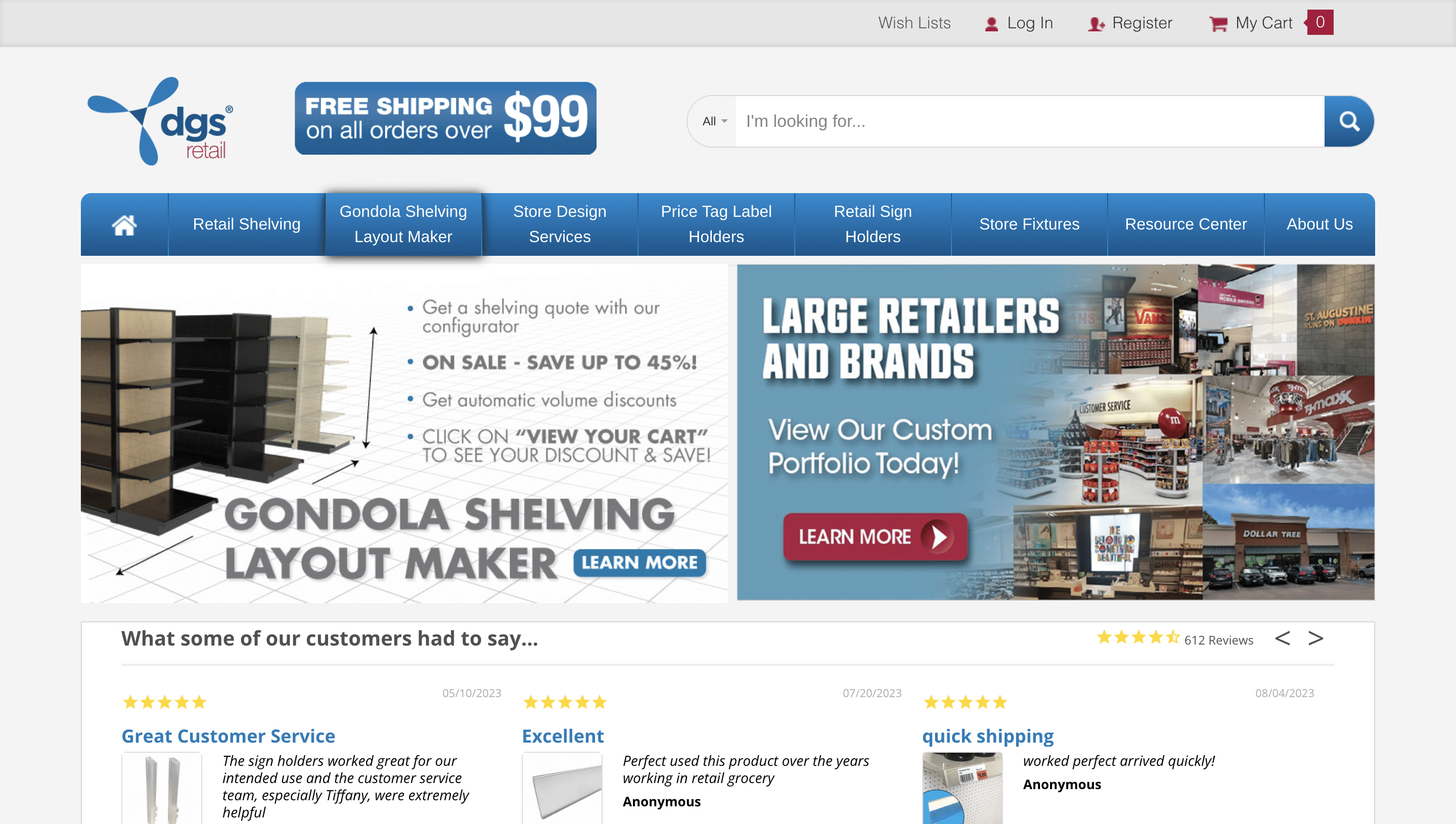
Optimum7 build for DGS Retail: a shelving configurator productized as the Gondola Shelving Layout Maker.
Parts and fitment deserve a closer look, because the configurator there is a compatibility engine, not a price calculator. Boat Supplies buyers do not know a part number; they know the system they are repairing. Optimum7 built a fitting tool that maps an exploded diagram, with numbered reference callouts, to the exact compatible parts, so a buyer identifies the piece visually and adds the right one to the cart.
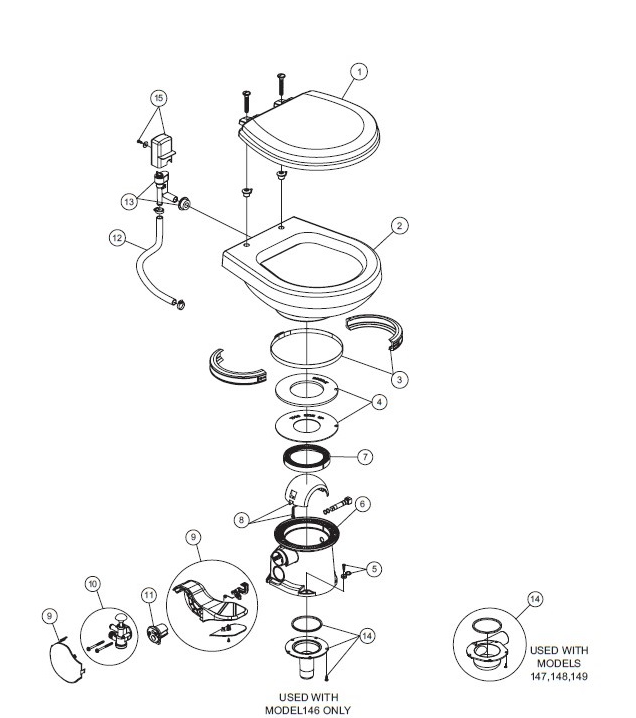
Optimum7 build for Boat Supplies: numbered diagram callouts map to compatible parts.
The selected callouts resolve into a ready-to-order parts kit, each row showing the exact component, a quantity stepper, and an add-to-cart, so the buyer leaves with the right parts instead of a guess.
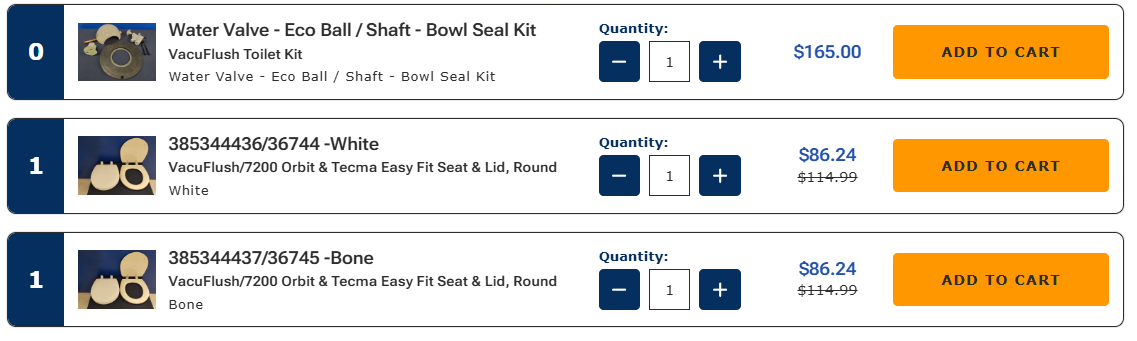
Optimum7 build for Boat Supplies: the diagram resolves into a buildable, add-to-cart parts kit.
Fitment discovery is close kin to advanced search, and the two often ship together. Optimum7 covers the discovery side in its guide to AI-powered search and filter functionality, and the wider distributor context in building a B2B ecommerce platform for distributors.
Four signs a Shopify or BigCommerce catalog needs a custom product configurator
Does any of this describe a normal Tuesday at your company? These conditions are observable without instrumentation, and an operations or ecommerce lead can check them in a single review.
| Observable condition | What it indicates |
|---|---|
| Product data lives in a spreadsheet because the platform cannot hold it | The catalog needs more option dimensions than the platform allows |
| Staff correct configured orders by hand before releasing them | Rules are not being evaluated at the moment of selection |
| Lead times are quoted by hand, not calculated | Nothing reconciles the configuration against live component stock |
| Production receives orders that need a clarifying phone call | No build instruction is generated at checkout |
| Duplicate products exist purely to stay under a variant ceiling | The dimension ceiling has already been reached |
Any single condition indicates the catalog has passed native configuration. In practice the conditions are cumulative, and a catalog showing the third or fourth rarely resolves the problem inside platform settings.
Can Shopify Plus handle complex product configuration?
Shopify handles a large share of configurable catalogs with no custom development. On October 15, 2025 the platform raised its product variant limit to 2,048 variants per product, up from a historical ceiling of 100, and the increase reached all merchants on all plans at no extra cost. If the variant count alone was your blocker, that blocker is mostly gone.
The option ceiling is what stops configured catalogs, and it did not move. Shopify permits three options per product. Three dimensions describe a shirt in color, size, and fit. They do not describe an industrial door in leaf material, core, gauge, frame profile, hinge preparation, lockset preparation, fire rating, glazing, undercut, and finish. A tenth dimension has nowhere to live. The fix is to move the product logic into a rules layer, usually in a headless architecture, with Shopify Plus still running checkout and payments. Optimum7 documents that pattern in its guide to going headless with Shopify.
Can BigCommerce handle complex product configuration?
BigCommerce permits 600 variants per product and treats modifiers as a separate mechanism that does not count against that ceiling. Modifiers carry no SKU and no tracked inventory, and there is no fixed limit on how many you attach. That separation gives BigCommerce more native room for optional add-ons than a pure variant model provides, and it is one reason the platform is frequently chosen for B2B catalogs.
| Capability | Shopify Plus | BigCommerce |
|---|---|---|
| Variants per product | 2,048 | 600 |
| Option dimensions | 3 per product | Variants plus unlimited modifiers |
| Optional add-ons without a SKU | Limited natively | Modifiers, no inventory tracking |
| Dependency rules between options | Not native | Not native |
The same boundary applies to both platforms. Modifiers extend what can be offered. They do not evaluate dependency between dimensions, compute price from component costs, read live component stock, or generate production output. BigCommerce is well suited to serving as the commerce system underneath a custom rules layer, including headless BigCommerce builds. Choosing between the two is its own decision, covered in the Optimum7 comparison of BigCommerce versus Shopify Plus.
What about Magento, WooCommerce, and headless builds?
The rules-layer principle is platform-independent. Magento (Adobe Commerce) ships more native support for complex catalogs and custom options than Shopify or BigCommerce, which suits large, technical assortments, at the cost of heavier hosting and maintenance. WooCommerce is the most open of the group, so a configurator can be built directly against WordPress and WooCommerce hooks, though the merchant owns more of the plumbing. Across all of them, the deep logic, the integrations, and the production output are still custom work, so the platform decides the plumbing, not whether you need a configurator.
A headless build is the common denominator when the configurator has to do real work. Decoupling the storefront from the commerce backend lets the rules engine, pricing, and preview run in a modern application layer while the platform keeps checkout, payments, and orders. FoamOrder runs this way on BigCommerce Catalyst and Next.js. For a platform-by-platform view of the configurator itself, see Optimum7’s overview of product configurators across BigCommerce, Magento, WooCommerce, and Shopify, and the wider guide to the best ecommerce platform for selling online.
When to build custom instead of buying an app or configurator software
Product-option apps, hosted configurator software, and CPQ tools solve a real range of problems, and they are the correct answer for catalogs with simpler options. At sufficient conditional depth they typically stop being the complete solution, because a hosted tool cannot own your rules, read your ERP, or generate your production files. The test below sorts most cases.
A custom build becomes warranted when any of the following is true:
- One selection has to change which options exist downstream, across several levels.
- Price must be computed from component costs instead of added as option surcharges.
- Availability and lead time must be read from an ERP or PIM at the moment of quoting.
- The order must leave ecommerce as a manufacturing instruction, not an order line.
- The rules that decide what can be built exist only in the knowledge of the staff taking orders.
That last item is the one teams find too late. Writing the rules down is frequently the largest single task in the build, and it happens before any code is written. A team that skips it ships a configurator that produces orders the floor still has to question.
What a custom product configurator build contains
Configurator development is its own discipline, distinct from theme work and app installation. A theme developer builds the storefront presentation. An app installer configures a packaged product within its intended range. A configurator engagement delivers six things in one build.


FoamOrder is these six parts working together. Optimum7 built eight guided configurator journeys on a headless BigCommerce Catalyst and Next.js foundation, one per product family, from custom-shape foam to covers, pillows, and down. A real-time 3D preview renders in Three.js, the rules engine runs validation on every selection, and the dynamic pricing engine caches and revalidates each quote so the journey price matches checkout. The screenshot below is one journey’s step flow, with a live cover-selection summary and a running price.
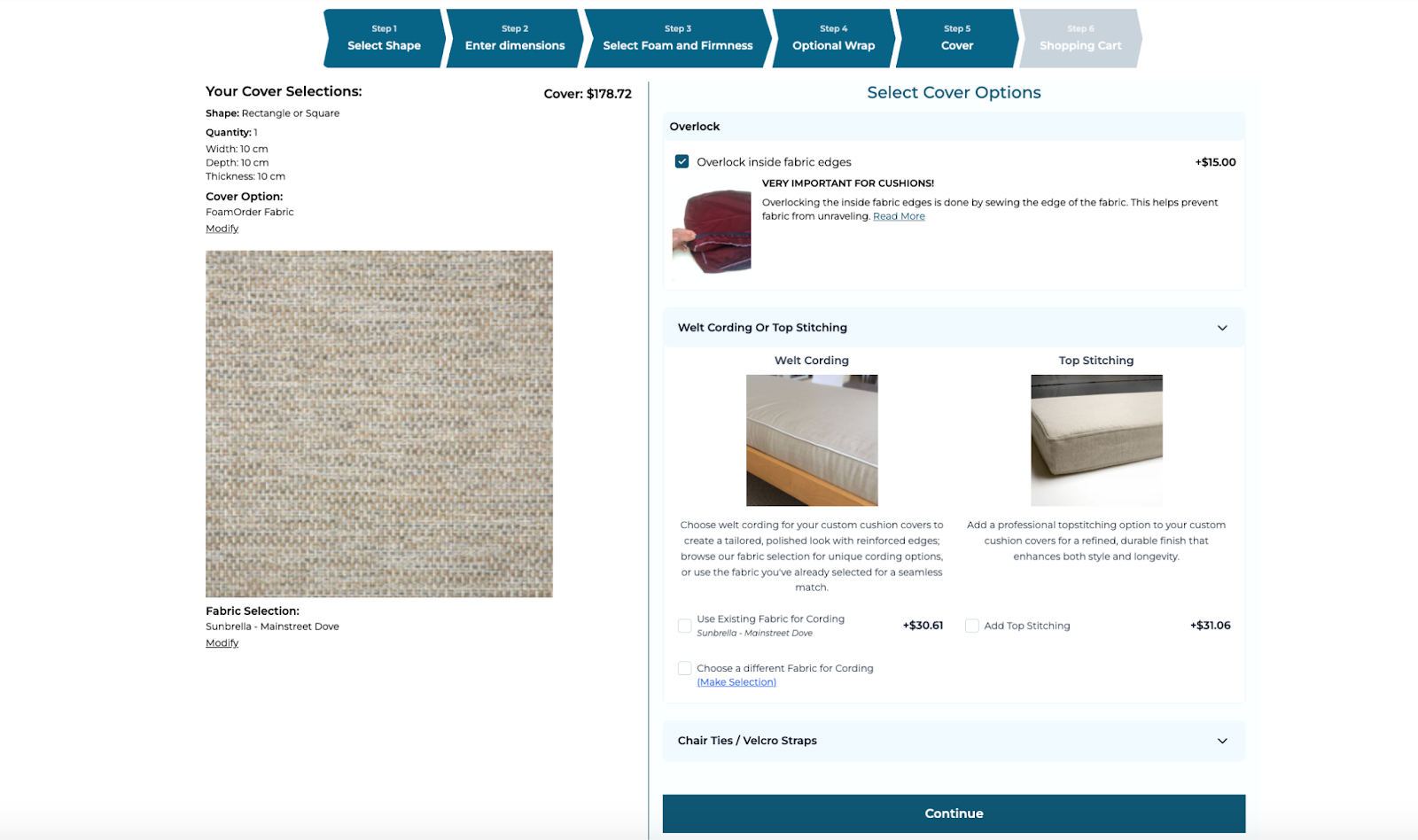
Optimum7 build for FoamOrder: a guided journey with a running price, on headless BigCommerce Catalyst. See the case study.
Connecting the configurator to ERP, PIM, CPQ, and manufacturing systems
Once options are conditional, a configured item stops mapping to one stock record. It consumes several component records at once, in quantities the configuration determines. DGS Retail’s shelving configurator is built exactly this way: each gondola is a composite assembled from many individual SKUs, and the configurator tracks stock for every constituent part so a configured unit is always buildable from what is on hand. Availability and lead time therefore have to be computed against the PIM or ERP at the moment of quoting. Where a CPQ system already governs quoting for the sales team, the configurator should resolve to the same rules instead of keeping a second copy. In a headless build this work sits in a middleware layer between the storefront and the commerce backend, where separate services handle pricing, validation, inventory, shipping, and fulfillment.
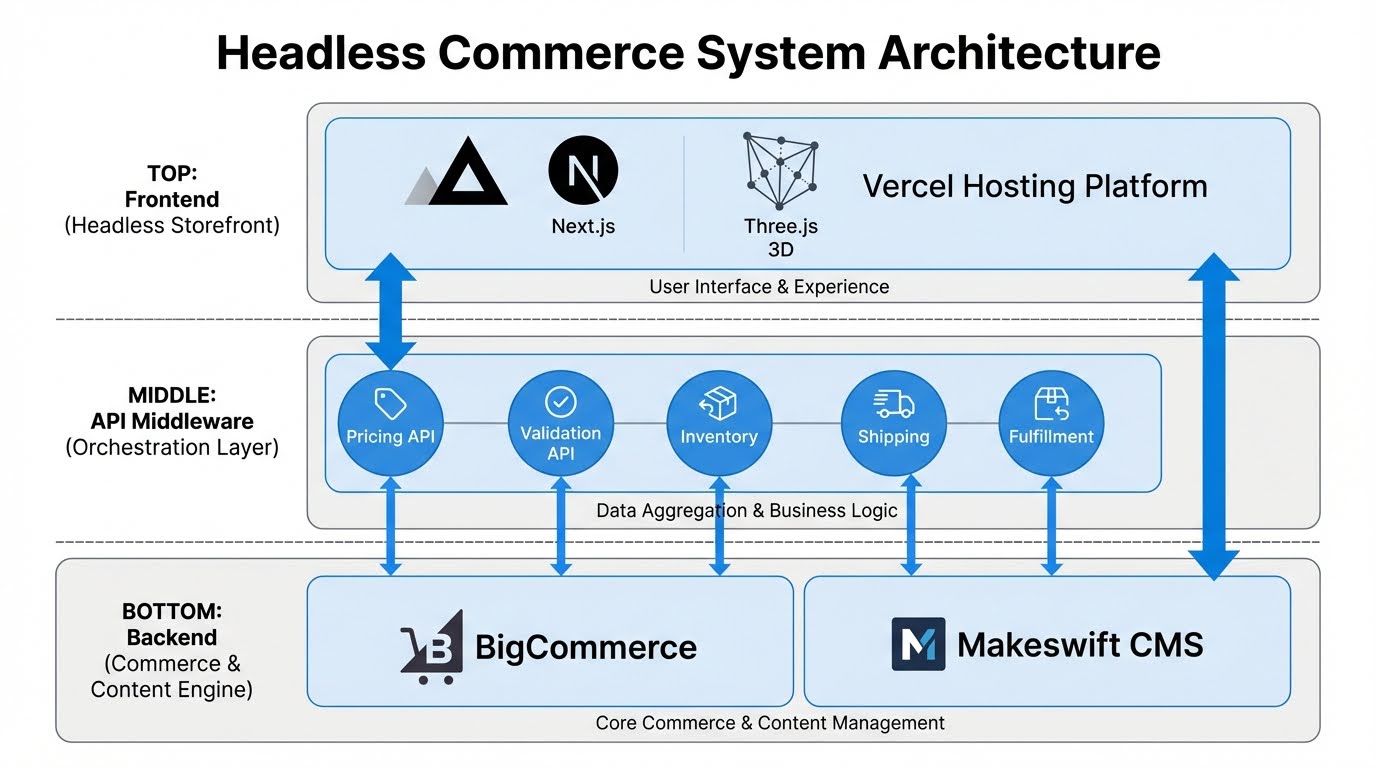
A configured order moves through four stages before it is ready for the floor.
The configured order below is the end of that chain: a custom-cut foam item with its dimensions, wrap, and fabric captured on the cart line, so the specification travels downstream as a build instruction instead of a phone call.
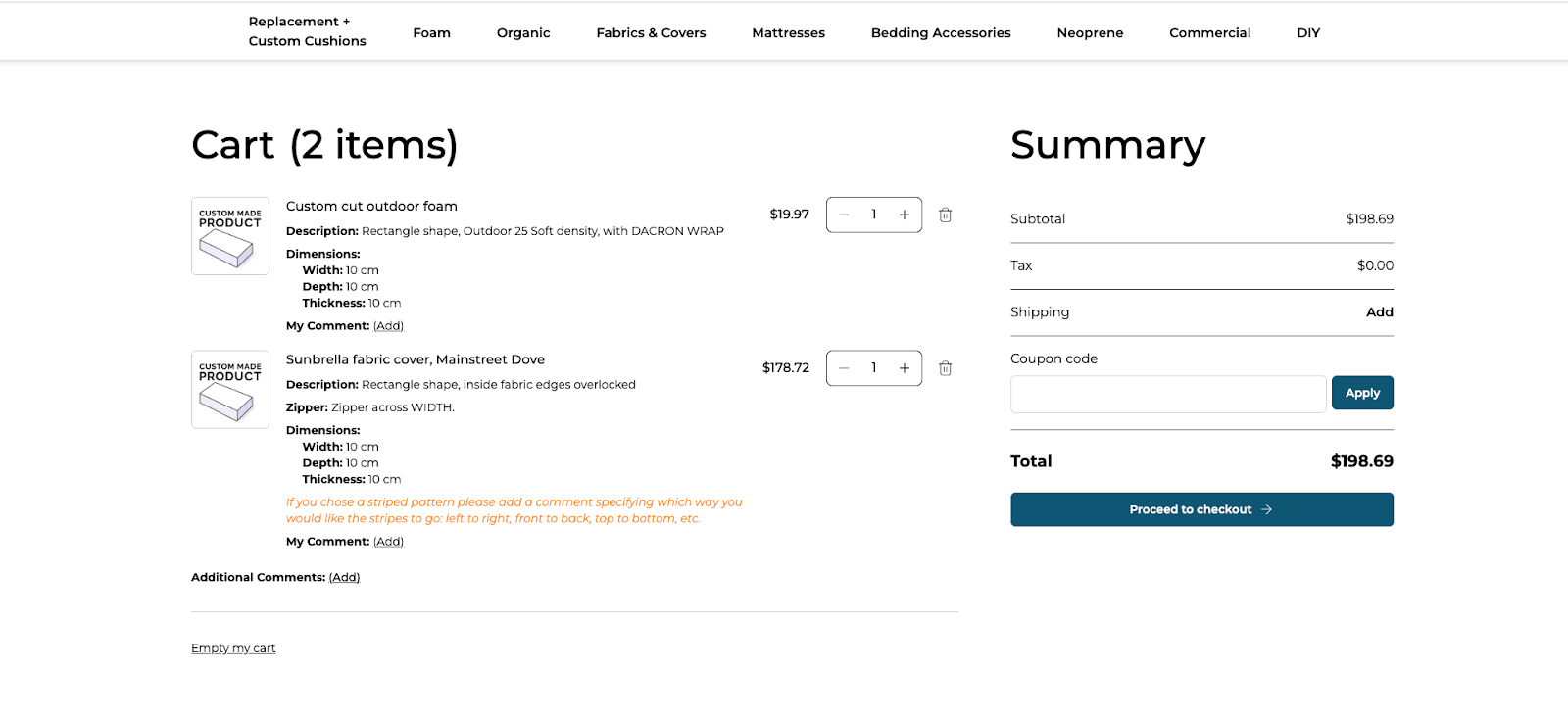
Optimum7 build for FoamOrder: the configured spec captured on the order line.
Treat the integration as part of phase one. Teams that build the selection experience first and defer reconciliation usually find the gap after launch, when quoted lead times stop matching what operations can deliver. Optimum7 covers the wider distributor pattern in its guide to industrial ecommerce automation for B2B companies and distributors.
The business case: benefits and ROI of a custom configurator
A configurator earns its build cost in four ways. It closes invalid orders before checkout, so the floor stops correcting configurations by hand. It turns quoting into self-service, replacing manual back-and-forth with an instant price, which is what Hurricane Shutters gained when a multi-day quote became an instant one. It lifts average order value by surfacing valid upgrades at the moment of choice. And it reduces returns on made-to-order goods, because a live preview means the buyer approves exactly what production makes.
Custom commerce logic drives measurable revenue on the pricing side too. For Bereli, Optimum7 built a membership program with dynamic backend discount rules, price masking for non-members, and webhook-driven customer groups, all custom-engineered because the platform has no native membership engine.
What a custom product configurator costs and how long it takes
Cost and timeline both track the same five factors, and they explain most of the variance between a moderate build and a large one. Ranges depend on your specific catalog, so the honest answer comes from scoping, not from a price list.
A useful early exercise is to price the configured subset separately from the rest of the catalog. Teams frequently find that a small share of products carries most of the configuration complexity, which changes the phasing and often the budget. Documenting the product rules is commonly the longest phase, because those rules have never been written down. If the build sits alongside a platform move, the sequencing interacts with the BigCommerce migration and replatforming plan, and the two should be scoped together.
What to look for in a product configurator development company
Ask for four things before you scope. A partner ready to build a configurator answers all four without hesitation.
Optimum7 builds these systems for manufacturers, distributors, and wholesale operators through its ecommerce development services. To scope a build against your own catalog, talk to the Optimum7 team and bring the configured subset of your products.
Frequently Asked Questions
What is an ecommerce product configurator?
It is a custom selection tool that lets a buyer build a made-to-order product online. As each option is chosen, a rules engine decides what remains valid, computes the price from component data, and resolves the build into a specification production can act on. It does what native product options cannot, because it handles dependency between choices.
How does a product configurator work?
On every selection it runs a short loop: it holds an option model, applies constraint rules to decide what is still valid, computes price from component costs or a formula, resolves the build into a bill of materials, and checks it against live stock. The result is a validated configuration and a specification the floor can produce.
What are the main types of product configurators?
There are four common types: option builders for step-by-step selection, visual and 3D configurators that render a live preview, CPQ and quote configurators that compute price instantly, and guided selling journeys that narrow a large option catalog to a valid build. Stores often combine several, so the type your product needs is the first scoping decision.
What is a 3D product configurator?
A 3D product configurator renders the product in three dimensions and updates the render as the buyer selects options, so they see the exact configuration before buying. It suits personalized and made-to-visual products where a wrong guess becomes a return, such as engraved plaques, framed art, or cut cushions. The heavier the personalization, the more the preview earns its build cost.
Can I add a product configurator to Magento or WooCommerce?
Yes. Magento ships strong native support for complex catalogs, and WooCommerce is fully open to custom development, so both can host a configurator. The rules engine, the system integration, and the production output are custom work on any platform, so the choice affects the plumbing, not whether the configurator has to be built.
What do I do when Shopify variants cannot support my products?
Move the product logic out of the variant system and into a rules layer that evaluates conditions as each selection is made. Shopify Plus continues to serve as the commerce system for checkout and orders. This is a development project, not a platform setting or an app configuration, and it usually runs in a headless architecture.
What is CPQ in ecommerce?
CPQ stands for configure, price, quote: the system that turns a configured product into an accurate price and a quote. In ecommerce, a configurator plays the CPQ role at the storefront, returning an instant price instead of a manual quote. When a sales team already runs a CPQ system, the configurator should resolve to the same rules to avoid a second copy.
Can a custom product configurator prevent invalid orders?
Yes. Invalid combinations are closed before a buyer can select them, instead of being rejected after submission or corrected by staff afterward. Orders reaching production have already been validated against the rules the manufacturer defined, which is what stops the clarifying phone calls between the floor and the order desk.
Should the configurator connect to ERP, PIM, CPQ, or manufacturing systems?
It has to when a configured item draws stock from several component records instead of one SKU. Availability and lead time are calculated against the source system at the time of quoting, and the resolved configuration passes downstream so production receives a build instruction. Treat that integration as part of phase one, not a later addition.
How much does custom product configurator development cost, and how long does it take?
Both track five factors: dependency depth, the number of configured product families, the integration surface, the output requirements, and the condition of the product data. Catalog data condition is usually the largest single variable, and documenting rules that were never written down is usually the longest phase, so an accurate number comes from scoping the configured subset of your catalog.
About the author: Duran Inci is the CEO and Co-Founder of Optimum7, an ecommerce development and digital marketing agency. He helps mid-market and enterprise brands scale revenue through conversion optimization, SEO, and custom ecommerce solutions.