How Optimum7 Built a Headless Commerce Platform for Fully Configurable Products
The Business
Foam Order operates with a product model that is fundamentally different from traditional online retail. Customers do not select from a fixed set of SKUs. Instead, they define dimensions, choose foam types, determine firmness levels, add wrap layers, select fabrics, and finalize detailed specifications before a purchasable item is created.
Every selection influences pricing, manufacturability, shipping calculations, and fulfillment instructions. Accuracy is critical because made-to-order manufacturing carries real operational costs when specifications are incorrect.
Foam Order serves two primary audiences:
Individual customers who need clarity, guidance, and visual reassurance
Trade professionals who expect precise specifications and repeatable ordering logic
As configuration complexity expanded, the legacy platform introduced friction. Adding options required additional workarounds. Pricing logic became harder to manage. Integrations required increasing oversight. Growth placed pressure on infrastructure.
Foam Order needed a platform designed specifically for configurable commerce at scale.
The Objective
Foam Order partnered with Optimum7 to implement a modern headless commerce framework built around fully configurable products. The project focused on:
Dynamic configuration logic that adapts based on customer input, with guardrails that prevent invalid builds before they reach checkout
Real-time pricing updates driven by Foam Order’s pricing logic, with complete capture of configuration details in the final order record
Operational integration readiness, including bi-directional order status updates, tiered pricing for trade customers, and dimension-based shipping calculations
Scalable product discovery for non-configurable catalog areas through advanced search and filtering, with support for Elasticsearch or Meilisearch
SEO continuity through structured redirect planning as part of the migration, protecting existing visibility and traffic
The goal was to support configuration depth while maintaining system reliability, speed, and long-term maintainability.
Key Business Challenges
1. A Product Model That Breaks Standard eCommerce Assumptions
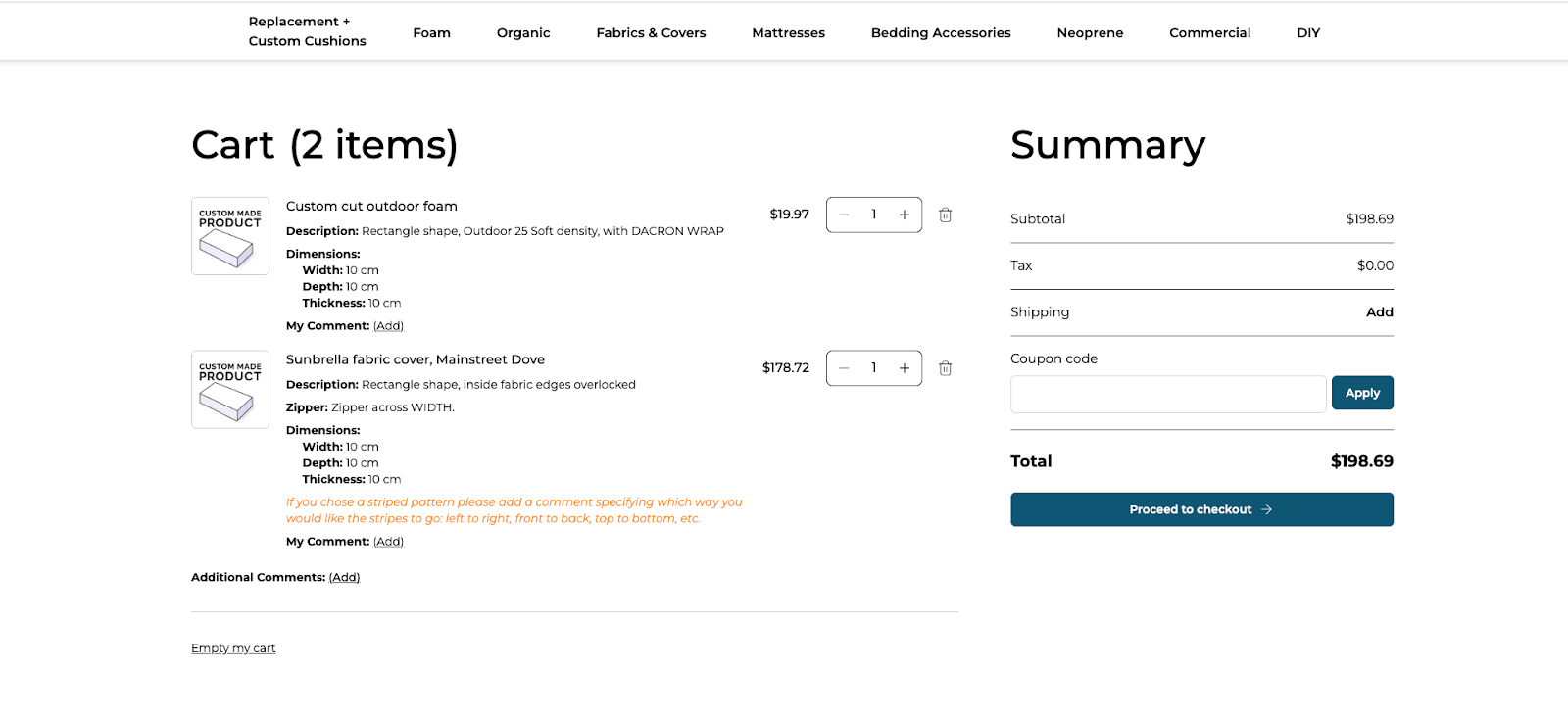
Foam Order often generates the purchasable item only after configuration is complete. That changes how pricing is calculated, how validation works, what gets stored in the order record, and how production receives specifications.
2. Real-Time Pricing and Validation Are Business-Critical
With made-to-order products, mistakes are expensive. The platform needed to guide customers as they build, update pricing as inputs change, and block invalid configurations early, before errors become production problems.
3. Discovery Still Matters Beyond the Configurator
Foam Order also sells items that customers browse and compare: fabrics, accessories, and samples. Those journeys require fast search, deep filtering, and a system that remains manageable as the catalog grows.
4. Multiple Systems Must Behave Like One Storefront
Pricing rules, shipping calculations, tiered pricing, and order status updates must work together without breaking the customer experience, even when integrations are complex and data flows in multiple directions.
5. Migration Introduces Real SEO Risk
A headless build combined with a migration can disrupt rankings if URL history is not preserved. Redirect mapping and 301 implementation were essential to protect continuity and prevent traffic loss.
The Strategic Challenge
This project was not about building something flashy. It was about building something Foam Order could rely on.
The platform had to provide customers with the freedom to configure their orders while allowing Foam Order to maintain control over feasibility, pricing logic, and fulfillment-ready order details. It also needed to stay fast and stable as complexity grew, without turning every new material, option, or product launch into a heavy development cycle.
One constraint shaped the approach: the integration layer depended on Foam Order’s internal APIs being accessible and documented, and changes to those APIs could affect scope and timeline. That made disciplined integration planning, resilient error handling, and clear system boundaries part of the strategy.
The Strategy
Optimum7 built a headless commerce solution around how Foam Order actually operates, not how templates assume commerce should work. The strategy was designed to support configuration complexity while preserving performance, reliability, and long-term maintainability.
1. Headless Architecture for Flexibility and Speed
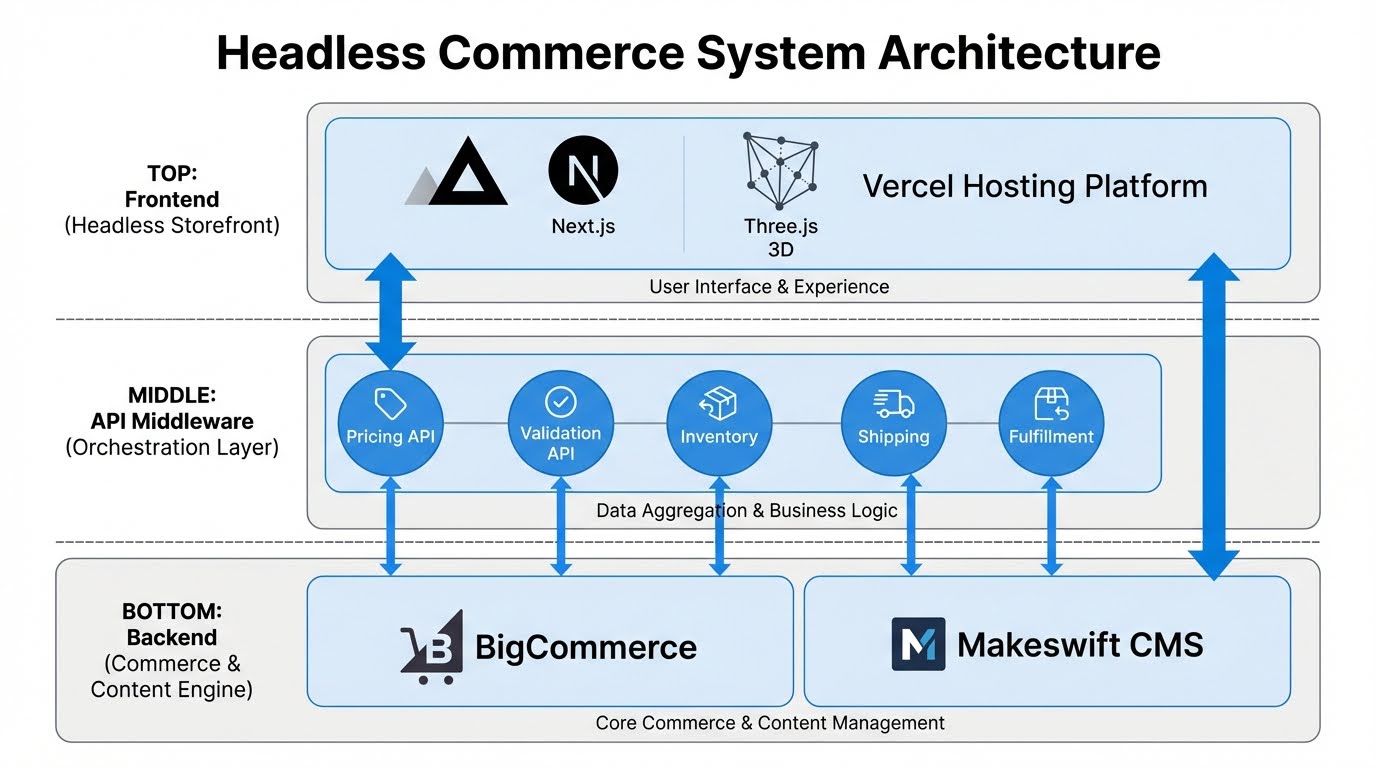
Optimum7 implemented a modern headless stack with a Next.js frontend deployed on Vercel, connected to BigCommerce through GraphQL and Storefront APIs. Foam Order was able to evolve the customer journey without theme limitations due to the separation between experience and commerce operations.
The architecture facilitates continuous iteration, enabling the introduction of UX refinements, performance optimizations, and new configuration flows without compromising the stability of the commerce engine.
2. Configuration Journeys Engineered for Real-World Ordering
Foam Order’s configurator was engineered as a guided specification workflow rather than a simple feature layered onto a catalog. Each journey supports dynamic option logic, real-time pricing updates, and validation messaging that keeps the experience clear for first-time buyers.
Equally important, configuration outputs are structured so that order data translates directly into fulfillment-ready specifications. Every critical selection is captured cleanly in the order record, reducing ambiguity and minimizing avoidable production errors.
3. Custom Product Configuration Journey
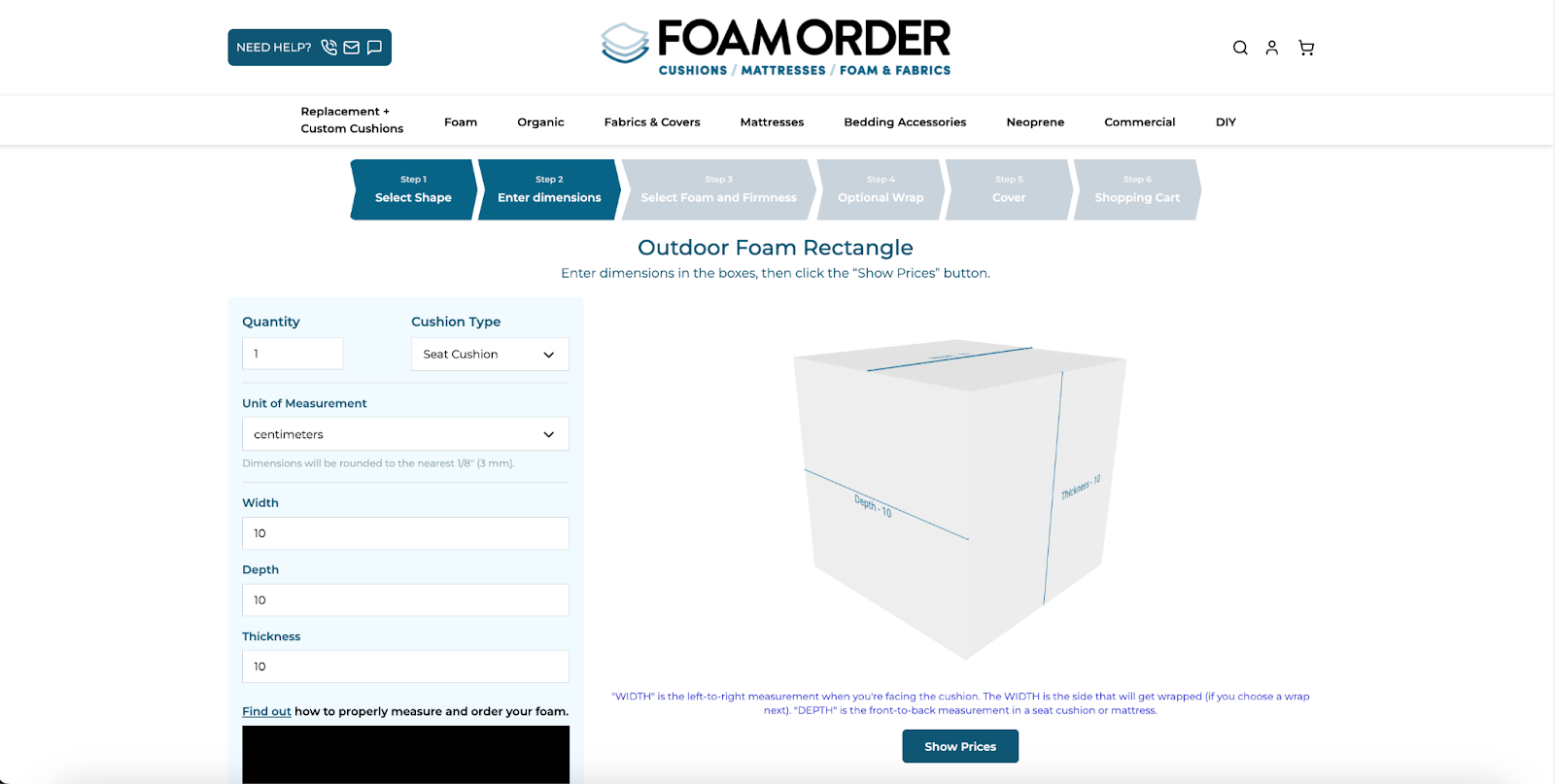
This journey was the heart of the project, translating Foam Order’s made-to-order model into a guided buying experience that customers can complete with confidence. Live 3D visualization powered by Three.js updates instantly as dimensions change, helping customers confirm proportions visually and reducing avoidable dimensional mistakes.
Step 1: Shape Selection With Live Preview Customers choose the starting shape and immediately see a visual preview, establishing the correct configuration path from the first click.
Step 2: Dimensional Input With Real-Time 3D Updates Dimension inputs trigger model changes and validation against constraints, reinforcing accuracy before customers move forward.
Step 3: Foam Type and Firmness Matrix Foam selection is presented as a guided comparison experience, balancing clarity for consumers with technical depth for professionals.
Step 4: Optional Wrap Layer Selection Wrap options are explained in practical language with a clear feel and price impact, so customers understand what changes and why they matter.
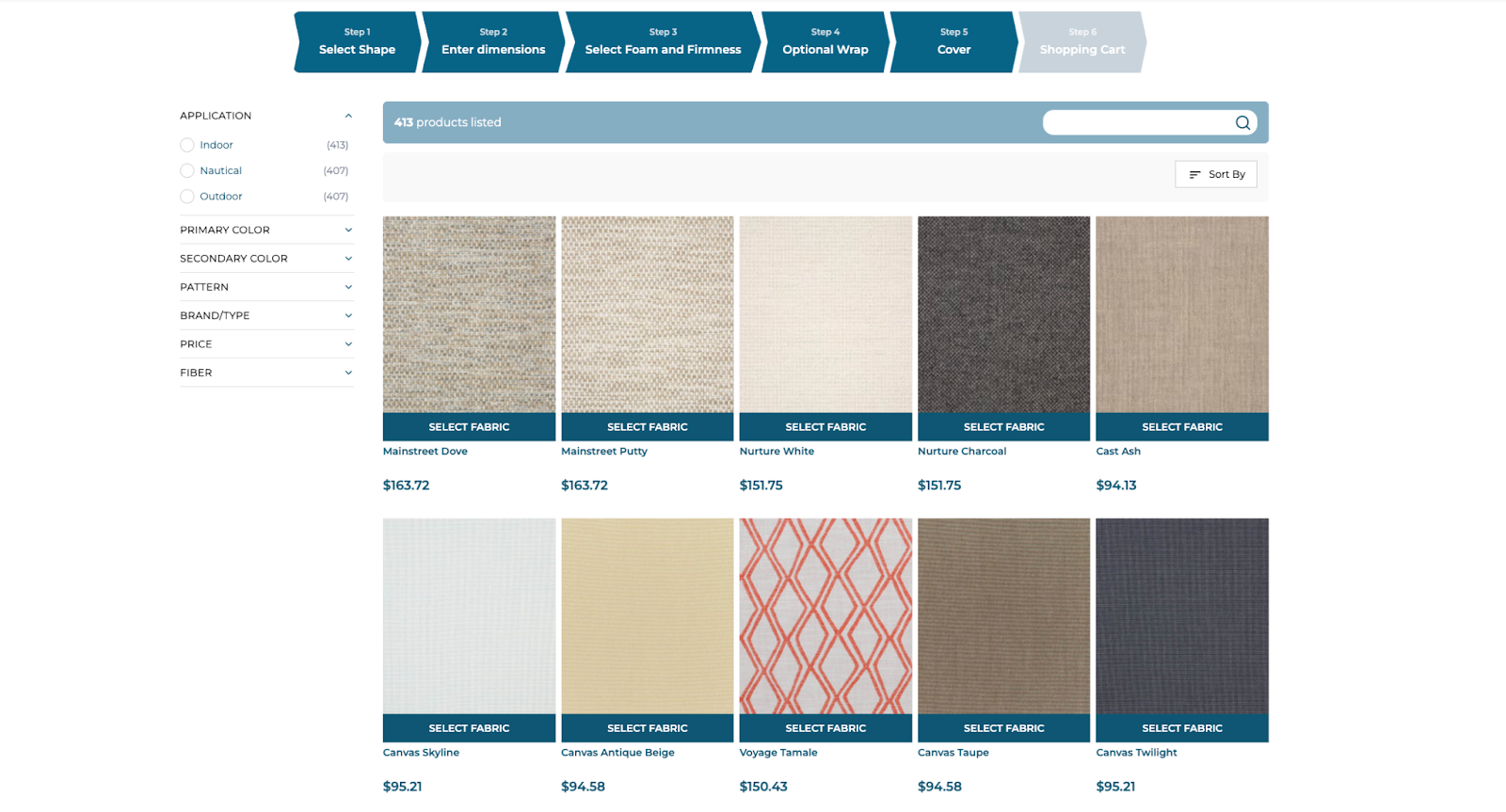
Step 5: Advanced Fabric Selection Interface A faceted filtering experience supports large fabric catalogs, allowing customers to narrow choices quickly without friction.
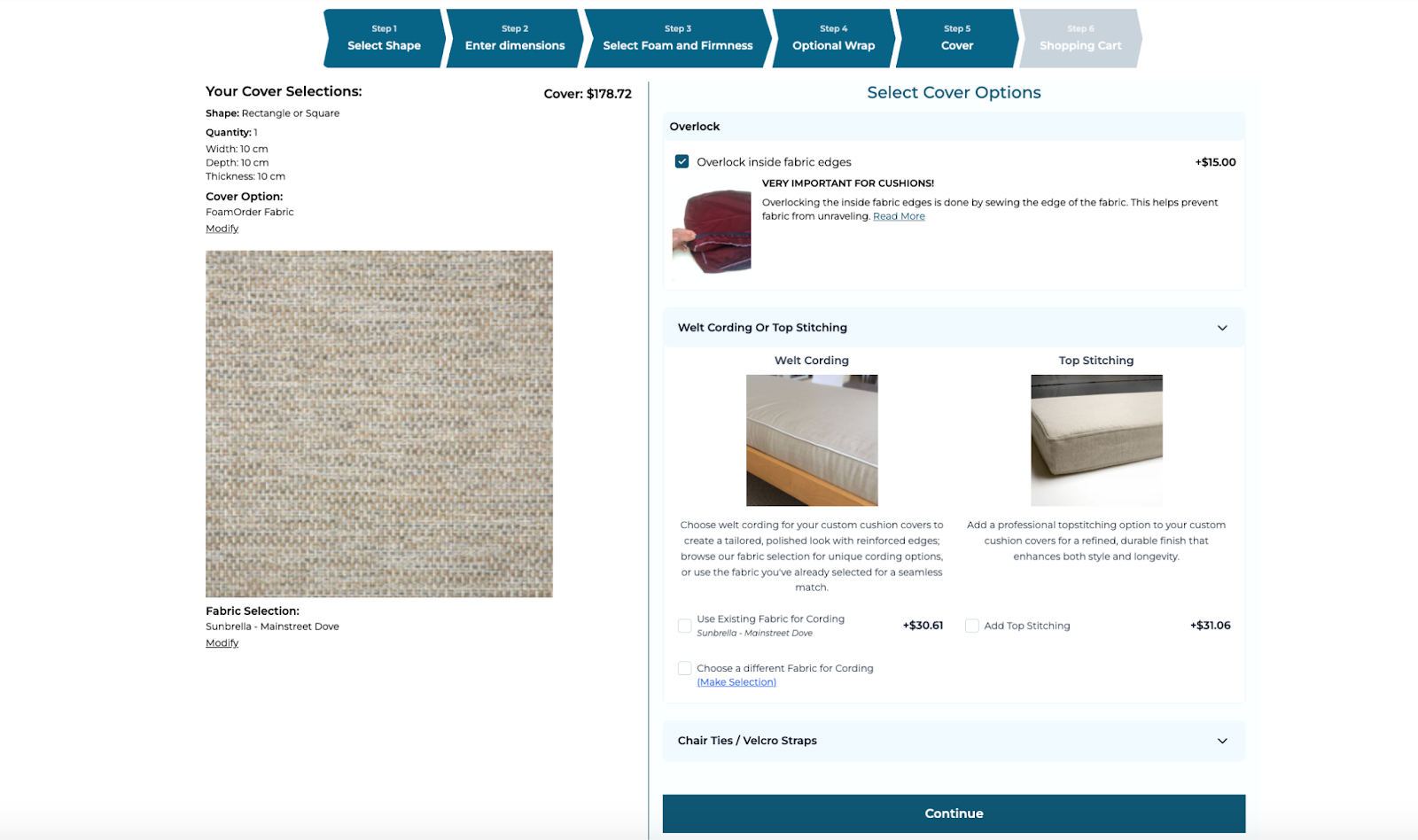
Step 6: Additional Customization Options Final detail selections, zipper style, piping, corner treatments, quantity logic, and labeling are captured cleanly without interrupting flow.
Step 7: Configuration Review and Checkout Customers review a complete, editable summary with a clear breakdown, creating confidence before adding to cart and proceeding to checkout.
4. Checkout Governance Aligned to Foam Order’s Payment Rules
Checkout integration was implemented to align with Foam Order’s operational payment requirements. Conditional authorization logic and capture handling were designed around internal processes, ensuring the transaction flow supports reconciliation and operational control rather than forcing generic platform behavior.
5. Advanced Search and Filtering Where Browsing Matters Most
While configuration is central to Foam Order’s business model, browse-driven experiences such as fabrics, accessories, and samples remain essential. Optimum7 implemented a structured search and filtering foundation built for scale, so large catalogs stay navigable, and decision-making stays fast.
Filter Types Built for How Customers Actually Shop Multi-select filters support narrowing across foam type, material composition, indoor and outdoor rating, and brand. Range sliders refine dimensions and pricing. Color filtering uses swatches rather than text lists, and technical attribute filters support professional-grade needs such as density, firmness, durability, and fire resistance.
Smart Filter Behavior That Prevents Zero-Result Dead Ends Live counts show what remains as filters are applied, helping customers avoid over-filtering into empty results. Applied filters stay visible and removable with one click, and filter combinations can generate shareable URLs that support repeat shopping and collaboration.
The discovery layer was designed to support a dedicated search engine, such as Elasticsearch or Meilisearch, based on Foam Order’s scaling needs, preserving speed and relevance as the catalog grows.
6. Integration Foundation for Operations and Pricing
The platform was architected as an integration-first system, supporting tiered pricing for trade customers, real-time shipping calculations, and bidirectional order status updates. Foam Order’s pricing logic remains the source of truth through documented APIs, ensuring pricing accuracy and consistency across the storefront.
This approach keeps the customer experience stable as business rules evolve, while operational systems continue to receive clean, reliable data.
7. SEO Continuity During Migration
To protect organic visibility, redirect planning and 301 implementation were included as part of the migration scope. This preserved URL equity and minimized disruption to search performance during the transition.
8. Supportability After Launch
Because the platform includes custom development, hosting, and maintenance, expectations were clearly defined from the outset. This ensures Foam Order has a structured path for ongoing stability, performance monitoring, and iterative improvements after go-live.
Results
Foam Order moved from a platform that restricted growth into a headless foundation built for a SKU-less, fully configurable product model. The shift was structural: the business can support complex configuration journeys and fulfillment-ready order data without compromising stability.
1. Key Outcomes Delivered
A headless storefront architecture built to support complex journeys while keeping the commerce engine stable
A configuration experience with real-time pricing updates, validation messaging, and fulfillment-ready specification capture in the order record
Integration capability supporting tiered pricing, shipping calculations, and bi-directional order status flows
Advanced filtering and search support for large catalog areas, designed to scale as catalog depth increases
Migration safeguards through redirect planning to reduce SEO disruption risk
Orders now carry structured configuration data that production can execute without interpretation
2. Strategic Outcome
Foam Order’s platform is no longer a limiter; it’s an operating advantage. The business can support made-to-order complexity at scale while keeping the customer journey fast, the rules enforceable, and the order data production-ready. Instead of fighting constraints with workarounds, Foam Order can evolve configuration logic, expand options, and grow catalog depth without destabilizing checkout, fulfillment, or discoverability.
3. Guided Configuration That Reduces Drop-Off
Foam Order’s customers can now build custom products with clarity. Real-time pricing feedback reduces hesitation during specification, and guardrails prevent customers from reaching checkout with invalid builds. In Foam Order’s category, this matters because buyers are not selecting a standard item; they are authoring a one-off product.
4. Specification Capture That Removes Fulfillment Guesswork
Configuration outputs are captured in the order record in a structured way, so fulfillment receives complete specifications rather than vague line items. That reduces ambiguity, supports cleaner handoffs to production, and lowers the operational cost of errors by catching issues earlier in the journey.
5. A Foundation That Supports New Options Without Rework
Foam Order’s platform is no longer the constraint. The system supports expansion in configuration complexity, new materials and options, and new product experiences without requiring a rebuild of the underlying architecture, keeping commerce operations stable as the storefront evolves.
6. Search and Filtering That Scales With the Catalog
For product areas that rely on browsing and comparison, such as fabrics and accessories, the platform supports scalable search and filtering. This strengthens discovery for large catalogs, improves usability, and keeps merchandising manageable over time through structured attribute management and search tooling.
7. SEO Safeguards That Protect Continuity
Redirect planning and 301 implementation preserved URL continuity and reduced SEO disruption risk. This protects discoverability through the transition and maintains a stable foundation for future optimization.
Fill out the form to request a Custom Marketing or Conversion Optimization Strategy for your Website.
Let's Talk
A digital marketing strategy is the path to profitability. Optimum7 can help you set the right goals, offer and implement creative and technical strategies, and use data and analytics to review and improve your business’s performance.