

TL;DR: 41% of ecommerce sites fail to support 8 key search query types (Baymard Institute, 2024). AI-powered search understands customer intent rather than matching exact keywords, and shoppers who use site search already convert at 1.8–3x the rate of non-searchers. Here is what AI-powered search does differently and how to tell if yours is working.
AI-powered search and filter functionality does one thing standard keyword search cannot: it understands what your shoppers mean, not just what they type. A visitor searching for “comfortable running shoes for wide feet” on a keyword-matching system either gets zero results or gets the wrong ones because the phrase does not match a product title exactly. An AI-powered system understands the intent, maps it to relevant inventory, applies size-range filters automatically, and surfaces the right products in under a second.
This is not a marginal improvement. Site search users convert at 1.8 to 3 times the rate of visitors who do not search. They spend more per order. They abandon at lower rates. The question is not whether to invest in search quality. The real question is whether your current search implementation is capturing that conversion premium or squandering it with exact-match limitations that frustrate the customers most ready to buy.

Why Standard eCommerce Search Fails at Scale
Keyword-matching search operates on a simple rule: the words in the query must appear in the product title, description, or tag. When they do not match, the system returns zero results or irrelevant products. This works adequately for small catalogs where shoppers use precise, pre-defined terminology. It breaks down at scale.
As your catalog grows and your shopper base diversifies, the gap between how shoppers describe products and how those products are indexed widens. A shopper types “cozy winter jacket”; your catalog has it as “insulated parka.” A shopper types “black storage cabinet no legs”; your system searches the phrase literally and finds nothing. Each failure is a conversion handed to a competitor.
The consequence is measurable. 8 in 10 shoppers say they are more likely to leave and buy elsewhere after an unsuccessful search. When a shopper searches and gets irrelevant results, they do not try different keywords. They leave. That exit represents customers who were actively trying to find and buy something and left because the search did not meet them where they were.
How AI-Powered Search Works Differently
AI-powered site search replaces keyword matching with intent recognition. It uses natural language processing (NLP) to parse the semantic meaning of a query, machine learning to rank results by likelihood of conversion, and behavioral data to refine results based on what shoppers like this user have purchased or clicked previously.
The practical result is a system that handles the full range of how real shoppers actually search: abbreviations, misspellings, synonyms, descriptive phrases, and attribute-based queries, without returning zero results or irrelevant products.
| Capability | Keyword Search | AI-Powered Search |
|---|---|---|
| Query understanding | Exact phrase match required | Understands intent and meaning |
| Typo handling | Fails or returns nothing | Auto-corrects and continues |
| Synonym matching | No (requires exact vocabulary) | Yes (maps “sofa” to “couch” automatically) |
| Personalization | Same results for every user | Adapts to each user’s history and preferences |
| Zero-result rate | 10–15% average | Reduced 50%+ with NLP fallback logic |
| Filter intelligence | Static, pre-defined filter sets | Dynamic filters ordered by query relevance |
| Learning over time | No (static index) | Yes (improves with every session) |
The shift from keyword matching to AI search is not a configuration change; it requires a different technical foundation. Optimum7’s AI-powered search and filter functionality is built directly into your ecommerce platform, so the AI layer has full access to your product catalog, inventory data, and shopper behavior rather than operating as a bolt-on overlay that misses half the context.
How Search Personalization Lifts Revenue
Personalization in site search means two shoppers typing the same query see different results based on their individual purchase history, browsing behavior, and demographic signals. A returning customer who has purchased men’s running shoes twice sees men’s options ranked first. A new visitor who has browsed the women’s section sees women’s options prioritized. Same query, same catalog, different ranked output, and significantly higher relevance for both.
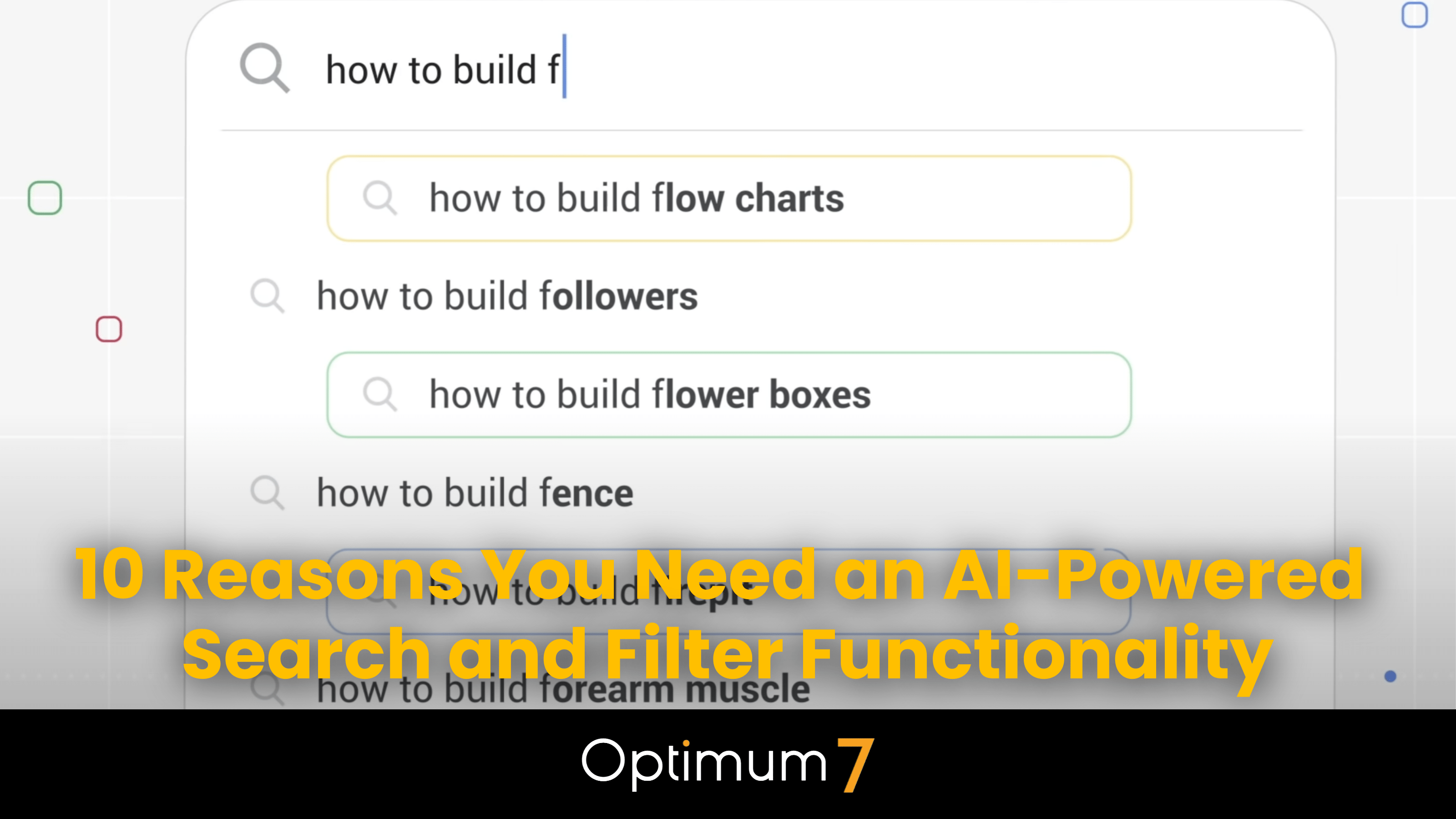
This extends to predictive autocomplete, which surfaces suggested queries as the shopper types based on what customers like them have searched and purchased. Shoppers who engage with autocomplete suggestions complete their sessions faster and convert at higher rates because the system meets them halfway instead of waiting for a complete query to process.
“The shoppers most ready to buy are the ones using your site search. If the search experience does not meet their expectations, the sale goes to whoever’s does.”
Personalization also compounds over time. The more search sessions the system processes, the more accurately it maps query patterns to conversion outcomes and surfaces the product-filter-ranking combinations that actually lead to a purchase. AI search often shows its largest performance gains three to six months after implementation, not in the first week, because the behavioral data needed to personalize accurately accumulates over time.
Semantic Search: Handling the Queries Shoppers Actually Type
Product terminology is specialized. Shoppers rarely know it, and they should not need to. A shopper looking for a “standing desk converter” searches “thing that raises monitor height.” A shopper looking for “nitrile exam gloves” searches “blue rubber gloves.” A shopper looking for “ergonomic lumbar support cushion” searches “back pillow for office chair.” Keyword search fails every one of those queries. Semantic search handles all of them.
Semantic search, the core NLP capability of AI-powered site search, works by converting both the query and product descriptions into vector embeddings, mathematical representations of meaning, and finding matches based on semantic proximity rather than literal word overlap. A query and a product title do not have to share a single word to match, as long as they are talking about the same thing.

This capability is especially valuable for stores with large and diverse catalogs, where the same product may be described differently across supplier feeds, manual entries, and imported data. Semantic search normalizes that variation instead of penalizing shoppers for not knowing which description your catalog uses. Related: custom ecommerce development for stores that need deeper catalog architecture improvements alongside search upgrades.
Real-Time Inventory and Intelligent Filter Logic
Two problems consistently erode trust in ecommerce search: showing out-of-stock products in results, and surfacing filter options that return zero products when applied. Both are solvable with AI-powered search, and both have a measurable impact on conversion and return visit rates.
Real-time inventory integration means search results reflect current stock levels. A product that is out of stock is either hidden from results, ranked lower with a visual indicator, or shown with a back-in-stock notification option, rather than appearing as a primary result that leads to a dead-end product page. Shoppers who select an out-of-stock product mid-session abandon at dramatically higher rates and are measurably less likely to return.
Intelligent filter logic ensures that filter options surface based on what is actually relevant to the current query. When a shopper searches “running shoes,” size and gender filters appear. When a shopper searches “office desk,” dimension and material filters appear. Static filter systems show the same pre-defined options regardless of context. AI-powered systems generate filter options dynamically based on the query and product set, and only shows filter values that return at least one result when applied.
Together, real-time inventory and intelligent filters eliminate the two most common post-search frustrations that send 8 in 10 shoppers to a competitor after a failed search session. See how this has worked for clients: ecommerce case studies.
How to Measure Whether Your eCommerce Search Is Working
Most ecommerce teams track overall conversion rate but do not segment it by search behavior. That gap makes it impossible to know whether your search is performing or costing you revenue. Three metrics, tracked consistently, give a complete picture.

All three metrics are available in Google Analytics 4 with site search tracking enabled. Tracking them monthly creates a baseline. Measuring them after any search implementation change tells you whether the change improved intent matching or made it worse. If you need help interpreting your current numbers, Optimum7 reviews search performance as part of every ecommerce SEO audit.
Frequently Asked Questions About AI-Powered eCommerce Search
Is your ecommerce search costing you conversions?
Optimum7 builds AI-powered search and filter functionality that reduces zero-result rates, eliminates exit-after-search failures, and lifts conversion rates across your entire catalog.
About the author: Duran Inci is the CEO and Co-Founder of Optimum7, an ecommerce development and digital marketing agency. He helps mid-market and enterprise brands scale revenue through conversion optimization, SEO, and custom ecommerce solutions.