TL;DR: A Shopify Plus subscription buys enterprise infrastructure; the development and design work an agency does on top of it decides what customers experience. The 2026 platform changes, from the checkout.liquid sunset to the Shopify Scripts shutdown to headless on React Router, separate agencies whose builds last from those whose builds break within a year.
Two agencies quote the same Shopify Plus build. One comes in at $40,000, the other at $120,000. What is the second one building, and is any of it real? On Shopify Plus the monthly fee is the same no matter who you hire, so the whole difference is development and design: the checkout logic, the storefront, the data model, the integrations, and the design system that a customer touches every second they are on the site.
This guide is for the person evaluating a Shopify Plus agency and trying to tell depth from a sales deck. A Shopify Plus development agency, a Shopify Plus design agency, and a full-service Shopify Plus ecommerce agency all answer to the same capabilities, so the label on the pitch tells you little. It walks through the development and design work that defines expert Plus projects in 2026, grounded in Shopify’s own platform documentation and in builds Optimum7 has shipped, where every cited number is a documented client result.
What Shopify Plus Development and Design Covers
Shopify positions the enterprise plan on raw platform strength: checkout that converts up to 36% better than competing platforms, pages that render up to 2.4x faster, and more than 300 new features shipped a year. Those numbers describe the engine. They say nothing about the car an agency builds around it, which is where a project’s budget goes.
Custom Shopify Plus development spans a predictable set of capability areas, and the Shopify Plus web development and design that sits on top of them follows the same map. Reading it helps you tell a team that does three areas well from one that claims all nine and ships none. The nine areas fall into three tiers: platform and commerce logic, design and experience, and scale and operations. For the plan decision underneath all of it, the Shopify versus Shopify Plus comparison covers which stores truly need the enterprise tier.


For the budget side of this map, the companion guide on how much Shopify Plus costs breaks down the platform fee against the build spend. The rest of this guide stays on the development and design work itself.
Checkout Extensibility After checkout.liquid
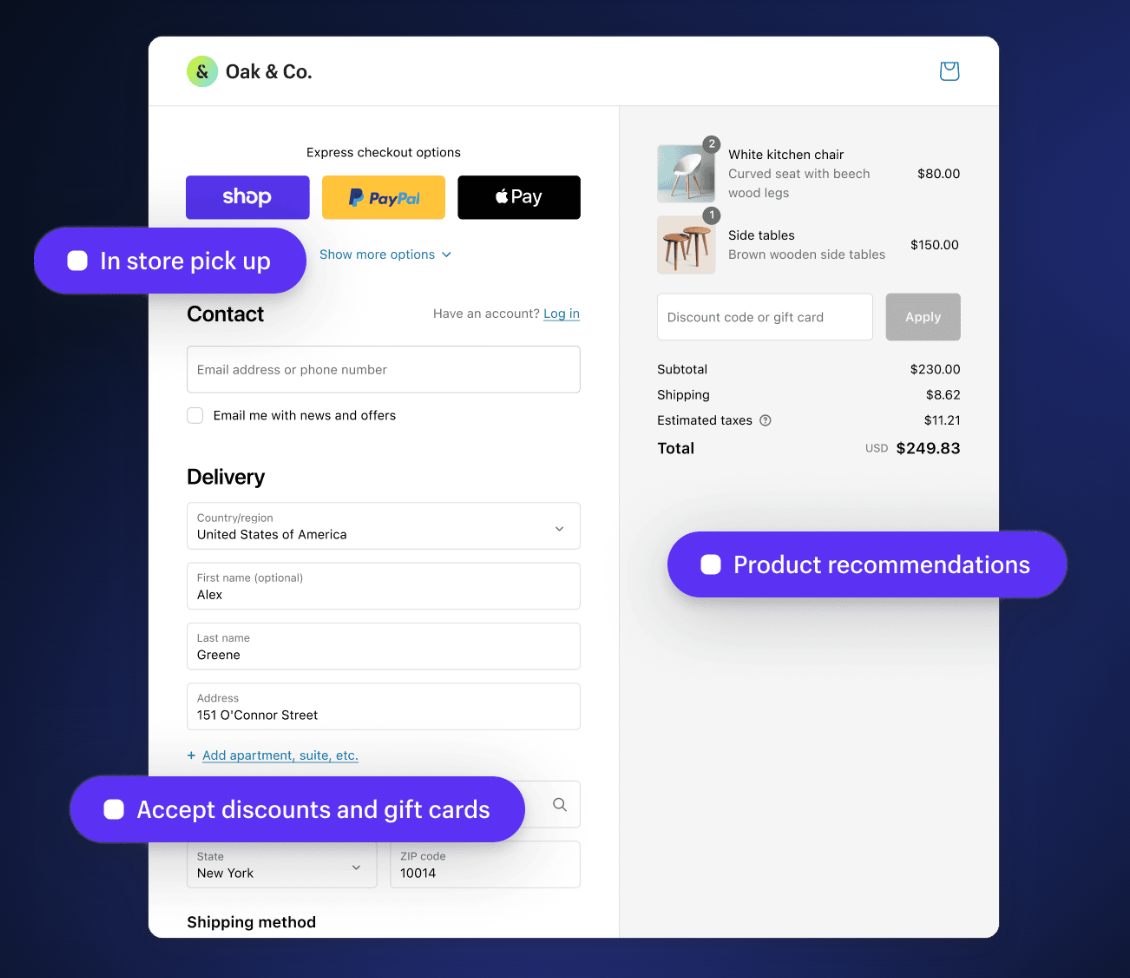
The fastest way to test an agency’s recent Plus work is to ask what replaced checkout.liquid. The answer is Checkout UI extensions and Shopify Functions, and the extensions that modify the information, shipping, and payment steps are available only on Shopify Plus. An agency whose checkout portfolio predates 2024 has not built on the current model.
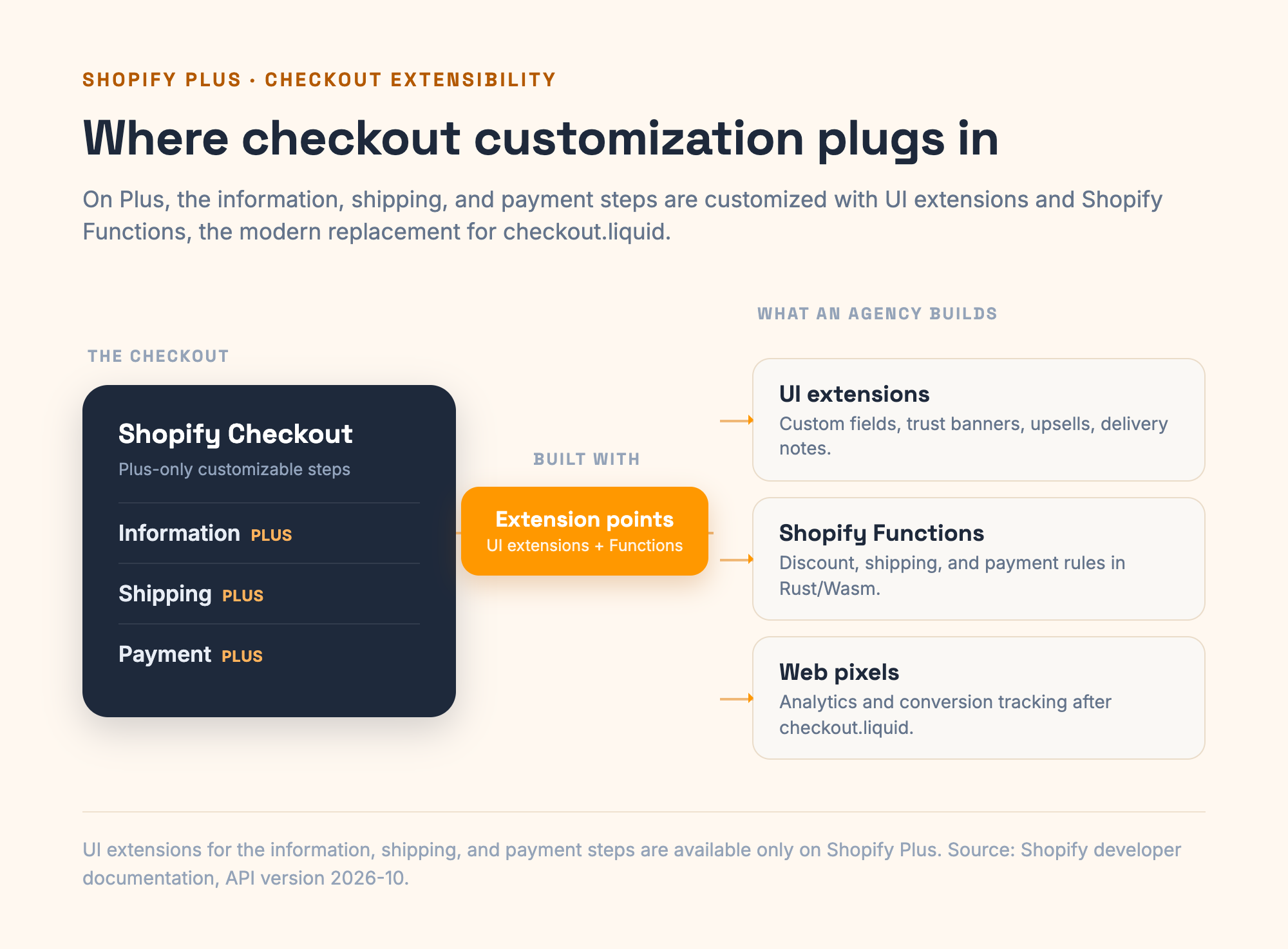
Shopify sunset the old model on a fixed schedule. For Plus stores, checkout.liquid and additional scripts on the Thank You and Order Status pages stopped working on August 28, 2025, and checkout.liquid is now unsupported for the information, shipping, and payment steps. Non-Plus stores lose script tags on those pages on August 26, 2026. A competent agency treats this as a dated migration with a deadline on it.
There is a second date worth writing into a scope. In API version 2026-10 the metafield owner_type property is optional; starting in version 2027-01 it becomes required. An extension built today without that field will break at the version bump. This is the kind of forward compatibility a thorough team plans for and a cheap one discovers in production.
The real-world failure mode is quieter than a broken page. When stores move off checkout.liquid, the conversion tracking that lived in the old checkout can silently stop firing, so sales keep happening while the ad platforms stop recording them.
PPC consultant Kirk Williams documented a client losing Google Ads conversion data immediately after a Checkout Extensibility upgrade. It is a one-line risk that costs weeks of blind spend when no one owns it.
Shopify Functions and the Scripts Shutdown
Shopify Scripts, the old way to customize discounts, shipping, and payments on Plus, stopped running in 2026. The replacement is Shopify Functions, and rebuilding Scripts logic as Functions is one of the clearest tests of real backend skill versus app installation. Functions compile to WebAssembly, and Shopify strongly prefers Rust.
Functions run inside strict limits that shape what is possible: a compiled binary capped at 256 kB, roughly 11 million execution instructions for carts up to 200 line items, and 128 kB of input. A team that knows these numbers will design a large-cart discount differently than one that writes naive logic and watches it fail at checkout. Shopify ties the Rust preference directly to staying inside those resource limits on big carts, so the language choice is a performance decision.
One honest point an agency should raise on its own: Shopify Functions are available on every Shopify plan through installed apps, including plans well below Plus. Custom-authored Functions and the full checkout extension surface are where Plus earns its place. A team that blurs that line to justify an upsell is telling you something about how it will scope the rest of the work.
The nine Function types, from Discounts and Cart Transform to Payment and Delivery customizations, map to specific merchandising and operations rules. The old Scripts and checkout.liquid world gave way to this model across 2025 and 2026, so a current build has to carry that logic as Functions.
For the deeper mechanics of auditing old checkout logic before a rebuild, the Shopify Scripts checkout logic audit walks through the inventory an agency should produce first.
Storefront Design and UX That Converts
Design is the half of the term buyers underrate, and search demand says the opposite: companies search for Shopify Plus designers, a Shopify Plus web designer, or Shopify Plus design experts as readily as for developers, and a Shopify Plus web design agency fields the same briefs a dev shop does. The reason is simple. A redesign that reworks product pages, navigation, and the checkout path can move conversion more than any backend change, because it operates on the exact moments a shopper decides to buy.
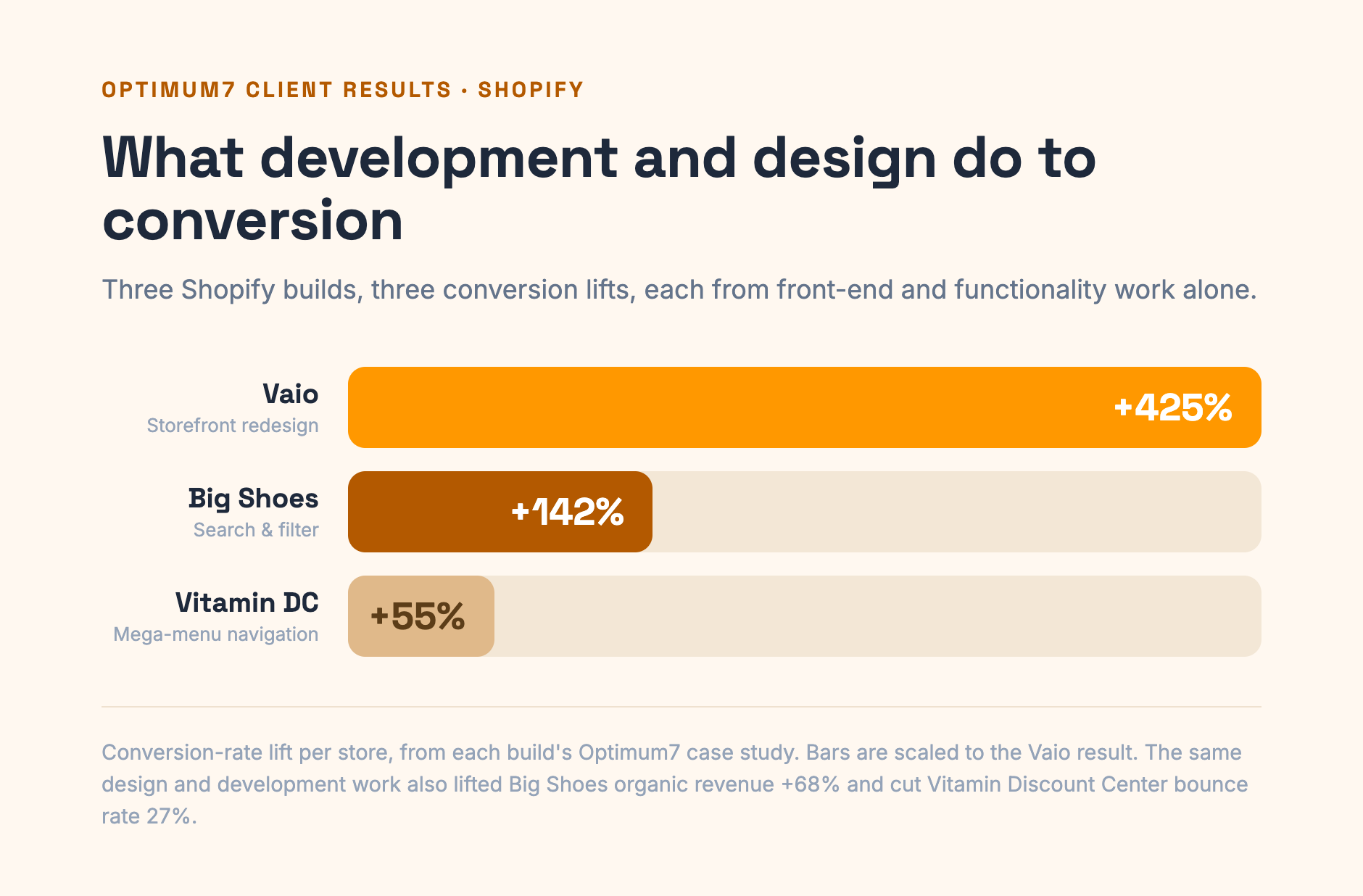
Optimum7 rebuilt the Vaio storefront as a pure front-end redesign on Shopify Plus, benchmarked against leading consumer-tech retailers, with no backend changes at all. Redesigned product and category pages, a sticky header, and a reworked mobile menu lifted conversion sharply, which makes the point that design is an engineering discipline with revenue attached.
The Theme as a Reusable Design System
Expert design work does not stop at how pages look. It builds the theme as a system. Shopify’s Online Store 2.0 architecture uses JSON templates, section groups for reordering headers and footers, and metaobjects, which let an agency define custom content types once and reuse them across the store. A team that models content this way gives marketing a storefront it can extend without a developer, and the same custom data often powers tools like a product configurator; a team that hardcodes everything leaves you dependent on them for every change.
Search and Filter at Catalog Scale
On a large catalog, product discovery is the highest-return design work an agency can do. When a shopper cannot narrow thousands of products to the few they want, they leave. A real-time filter and type-ahead search, wired into the storefront data, turns a sprawling catalog into something a person can shop in seconds.
Optimum7 added advanced search and category filtering to the Big Shoes Shopify store, where a large-size footwear catalog spanned brands, styles, and activities. The filter updates results instantly with no page reload, and the search groups suggestions by collection and product as the shopper types. Discovery of this quality moves conversion directly.
Catalog navigation is the same discipline one level up. On the Vitamin Discount Center store, spanning more than 300 brands, Optimum7 built a two-dimensional mega menu from studied click behavior, which raised page dwell time by 89% and conversion by 55% while cutting bounce rate by 27%. Discovery and navigation are design decisions with revenue attached.
Doing this without wrecking SEO is its own skill, since filter URLs can spawn thousands of thin, duplicate pages. The guide on faceted navigation without SEO issues on Shopify Plus covers the indexation controls that keep filters from becoming a crawl problem. For stores that want this built, Optimum7’s advanced search and filter service is the implementation path.
Shopify Stores Are Now Agent-Ready by Default
In October 2026, Shopify’s Fall Edition made every storefront agent-ready: AI shopping agents can search a store’s products, add to the cart, and complete checkout once the buyer approves. For a Shopify Plus build, making sure an AI assistant can complete a purchase is now part of the baseline an agency delivers.
The mechanics sit in two places. WebMCP exposes a set of tools on every Liquid and Hydrogen storefront and checkout, so a browser agent can read structured product data and act on it. Shop.dev gives any agent or app a single connection to the Shopify Catalog, cart, checkout, and Shop Pay. The agency’s job is to make a store’s product data, inventory, and policies clean enough for an agent to use without guessing.
The control that decides what agents say about you is the Knowledge Base, where a merchant approves the facts agents share about the store, from return windows to shipping destinations. An agency that builds agent readiness in from the start is the one preparing you for how a growing share of product discovery now happens. Optimum7’s guide to answer engine optimization covers how products surface inside AI answers.
When Headless Hydrogen Is Worth the Cost
Headless commerce is the capability agencies oversell more than any other. Going headless means decoupling the storefront from Shopify’s themes and building a custom front end, usually with Hydrogen, Shopify’s React framework now built on React Router and deployed to its Oxygen hosting. It unlocks total design control and app-like performance, and it triples the surface area a team has to build and maintain.
Has your store hit a wall that a well-built theme genuinely cannot clear? When the honest answer is no, headless adds cost and maintenance weight without a return to match. The decision belongs to a small set of conditions. The tree here maps when a themed Online Store 2.0 build is the right call and when headless earns its keep.
When the conditions are right, the payoff is real. Optimum7 moved Tees2UrDoor and its wholesale sister brand SugarStitch onto dual Shopify Plus instances with a headless, API-driven front end, carrying a high-volume operation across the cutover cleanly. The migration preserved 930,000+ historical orders and 457,000 customer accounts with zero downtime and zero critical data loss, which is the standard a headless replatform has to clear before its design upside counts for anything.
If you are weighing the architecture, the deeper walkthrough in how to go headless with Shopify covers the build and hosting model in detail.
B2B on Plus Without Bolt-On Apps
B2B is where Shopify Plus development gets genuinely complex, and where the native capabilities now run deep enough that a good agency builds directly on the platform. Plus supports company profiles with per-location permissions, payment terms, and tax exemptions, plus customer-specific catalogs, volume pricing, quantity rules, and sales-rep accounts, all without a third-party wholesale app.
The buyer’s test here is if an agency knows where native ends and custom begins. Company hierarchies, per-location catalogs, and net-terms invoicing are native. Complex approval workflows, deep ERP synchronization, and custom pricing logic across thousands of accounts are custom development on top. The Tees2UrDoor build above ran retail and wholesale as separate storefronts under one parent for this reason: the two buyer types needed different workflows, so they got them.
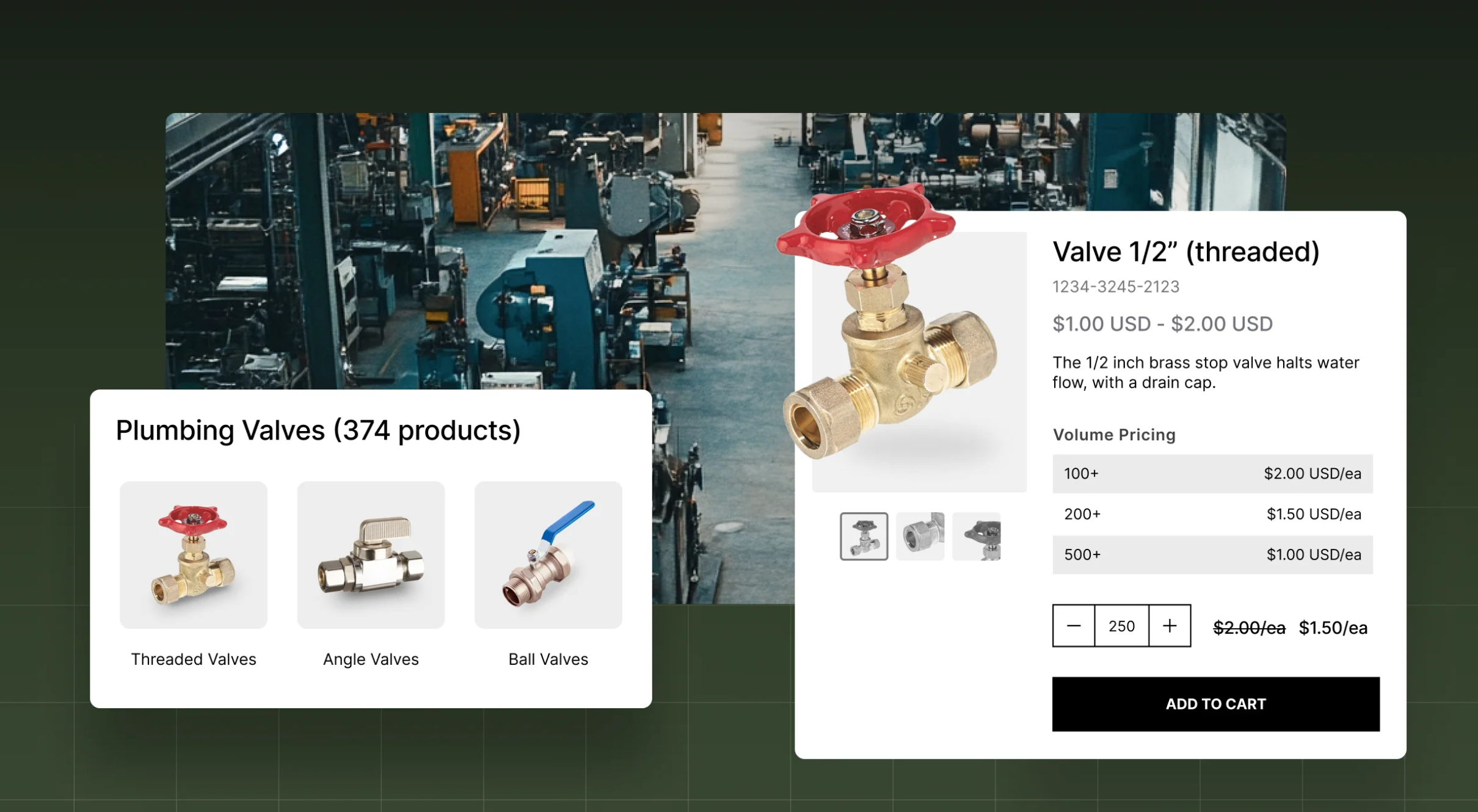
For distributors and manufacturers with heavier requirements, the B2B ecommerce migration guide details the customer-specific pricing and permission structures that often sit at the center of these projects.
Connecting Shopify Plus to ERP, OMS, and PIM
Enterprise stores run on more than Shopify. An ERP holds finance and inventory, an OMS routes fulfillment, and a PIM owns product data. Expert Shopify Plus development syncs these systems through the Admin API and Shopify Flow so stock counts, orders, and prices stay consistent across every system.
The core design decision is real-time against batch. A store that promises accurate stock needs near real-time inventory sync; a nightly batch is cheaper and shows stale counts. On Plus, the 20X admin API rate limit gives an agency the headroom to sync heavy catalogs and high order volumes without throttling, which is what an OMS pushing thousands of orders a day or a customer-360 view pulling history from several systems demands.
The buyer’s test is to ask how the agency handles sync conflicts and failures, down to what happens when a connected system goes offline mid-order. For distributors and manufacturers with the heaviest integration needs, the guide to building a B2B ecommerce platform for distributors covers the data architecture these projects depend on.
Performance, Core Web Vitals, and Conversion
Performance is engineered into a build through design and development choices. Google’s Core Web Vitals measure loading, interactivity, and visual stability, and Interaction to Next Paint (INP) replaced First Input Delay as the responsiveness metric in 2024. On a storefront, a slow INP shows up as taps that feel laggy, which quietly erodes the same conversion a redesign is trying to lift.
The agency’s job is to protect that head start: disciplined app usage, lazy-loaded media, a lean theme, and real measurement against field data. Optimum7’s guide to Shopify speed optimization covers the theme-weight and media techniques that hold the line. The Big Shoes result earlier, where better discovery lifted organic revenue by 68%, is partly a performance story, since faster, lighter category pages rank and convert better than heavy ones.
Migration and Data Integrity
A Shopify Plus project usually begins with a migration, and the migration is where a careless agency does permanent damage. Orders, customers, and SEO equity either arrive intact or they do not, and a botched cutover shows up as lost revenue the day you launch. Method decides the outcome: field-by-field mapping, staged validation, and a full redirect strategy separate a controlled move from a hopeful one.
A disciplined migration follows the sequence shown here, and validation is the stage where data loss slips through more often than export.
That is the standard the Tees2UrDoor move cleared at nearly a million orders. For the platform-specific detail, the Shopify Plus migration and replatforming guide covers the full cutover process, and Optimum7’s ecommerce migration service is where these projects run.
What Drives a Shopify Plus Quote From $40K to $120K
The spread between a $40,000 and a $120,000 Shopify Plus quote is scope. The two agencies in this guide’s opening are pricing different projects: a theme refresh with light customization sits at the low end, and custom Functions, a headless front end, deep ERP integration, a complex B2B configuration, and a large data migration are what carry a quote past six figures.
Three things raise a quote for real reasons. Custom backend work, such as Scripts rebuilt as Functions and bespoke checkout extensions, is billable engineering. Systems integration adds a mini-project for every ERP or OMS connection. And migration scale compounds, since moving a million orders with validation costs far more than moving ten thousand. A quote well below the rest is usually scoping less of this work.
The costs that surprise buyers are the ones a thin quote leaves out: change orders when scope was underspecified, integration delays when a third-party system behaves differently than assumed, and rebuilds when an app the store relied on is sunset. An honest agency names these risks in the proposal and prices a contingency for them.
After Launch: Support, Code Ownership, and Version Compliance
The engagement continues past launch, and the terms that protect you are the easiest to skip in a proposal. You should own the code, the theme, the domain, and every app credential at project end. The support SLA should name response times by severity, and someone has to keep the build current as Shopify ships updates.
Version compliance is the quiet one. Shopify supports each stable API version for a minimum of 12 months, so a Plus build needs periodic updates to its extensions and Functions to stay on supported versions. An agency that goes quiet after launch leaves you to find a broken checkout extension at the next version bump.
Before you sign, get clear answers on these items. They decide if you own a working store or rent one you cannot maintain.
Turning These Capabilities Into Agency Questions
Read together, these nine areas give you a vetting script that cuts through a polished pitch. When you compare the top Shopify Plus agencies, or weigh a boutique studio against a larger Shopify Plus development company, ask what replaced checkout.liquid, how the team rebuilt Scripts as Functions, when headless is the wrong choice, and how they validate a migration. The answers separate an agency that has shipped recent Plus work from one describing it secondhand.
That vetting process, including partner tiers, references, red flags, and what drives a quote, has its own detailed walkthrough in how to choose a Shopify Plus agency, and the roundup of top Shopify marketing agencies covers the growth-marketing side of the same decision. For the broader platform decision behind all of it, see Optimum7’s guide to choosing the best ecommerce platform. When you are ready to scope a build, Optimum7’s ecommerce development team works on exactly this range of Shopify Plus work.
Frequently Asked Questions
What does a Shopify Plus agency do?
A Shopify Plus agency builds the custom development and design work the platform does not supply: checkout extensions and Functions, storefront and theme design, search and navigation, headless front ends, native B2B configuration, performance engineering, and data migration. The Plus subscription provides enterprise infrastructure; the agency builds everything a customer sees and interacts with.
How is a Shopify Plus developer different from a standard Shopify developer?
A Shopify Plus developer works with capabilities exclusive to the enterprise plan: checkout UI extensions for the information, shipping, and payment steps, higher API limits, native B2B, and expansion stores. Standard Shopify developers cannot build on those surfaces. The clearest signal is recent work with checkout extensibility and custom-authored Shopify Functions.
Did Shopify Scripts get discontinued?
Yes. Shopify Scripts stopped running in 2026, and discount, shipping, and payment logic now lives in Shopify Functions, which compile to WebAssembly with Rust strongly preferred. Any current Plus build needs Scripts logic rebuilt as Functions. Functions themselves are available on all plans through apps, while custom-authored Functions are where an agency’s backend skill shows.
Do you need Shopify Plus for B2B?
For serious B2B, Plus is the native path. It supports company profiles with per-location permissions, customer-specific catalogs, volume pricing, quantity rules, payment terms, and sales-rep accounts without a third-party wholesale app, plus 20X the admin API rate limits. Smaller wholesale needs can run on lower plans with apps, though complex buyer hierarchies belong on Plus.
Is headless Shopify worth it?
Headless with Hydrogen is worth it when a store needs design control or app-like performance a theme genuinely cannot deliver, and has the budget to maintain a separate front end. For a typical store, a well-built Online Store 2.0 theme reaches the same goals for a fraction of the cost and maintenance. Let specific needs drive the decision.
How much does a Shopify Plus build cost?
Build cost depends almost entirely on scope: a storefront redesign, a Scripts-to-Functions rebuild, a headless front end, and a complex B2B configuration are very different projects. The platform fee is a small, fixed part of the total. Optimum7’s breakdown of how much Shopify Plus costs separates the subscription from the development spend.
About the author: Duran Inci is the CEO and Co-Founder of Optimum7, an ecommerce development and digital marketing agency. He helps mid-market and enterprise brands scale revenue through conversion optimization, SEO, and custom ecommerce solutions.