

TL;DR: SEO works in three stages: Google crawls your pages, indexes what they mean, and ranks them against every competing answer. Results compound when on-page content, technical structure, and off-page authority pull in the same direction. Plan on 4 to 12 months for meaningful gains, and treat AI Overviews as one more reason to build genuine topical authority.
SEO works by making your pages easy for search engines to find, understand, and trust, so they show up when someone searches for what you sell. Google handles the discovery and the ranking; your job is to give it clear, credible, useful material to rank.
How much of your revenue last quarter started with a search you never saw happen? Optimum7 CEO Duran Inci covers the fundamentals in the video above; this guide then runs from zero to advanced: what Google does with your pages behind the scenes, the seven steps of a real SEO campaign, how long each phase takes, how rankings turn into revenue, and what changes now that AI writes the top of the results page.
What Is SEO? The Basics of Search Engine Optimization
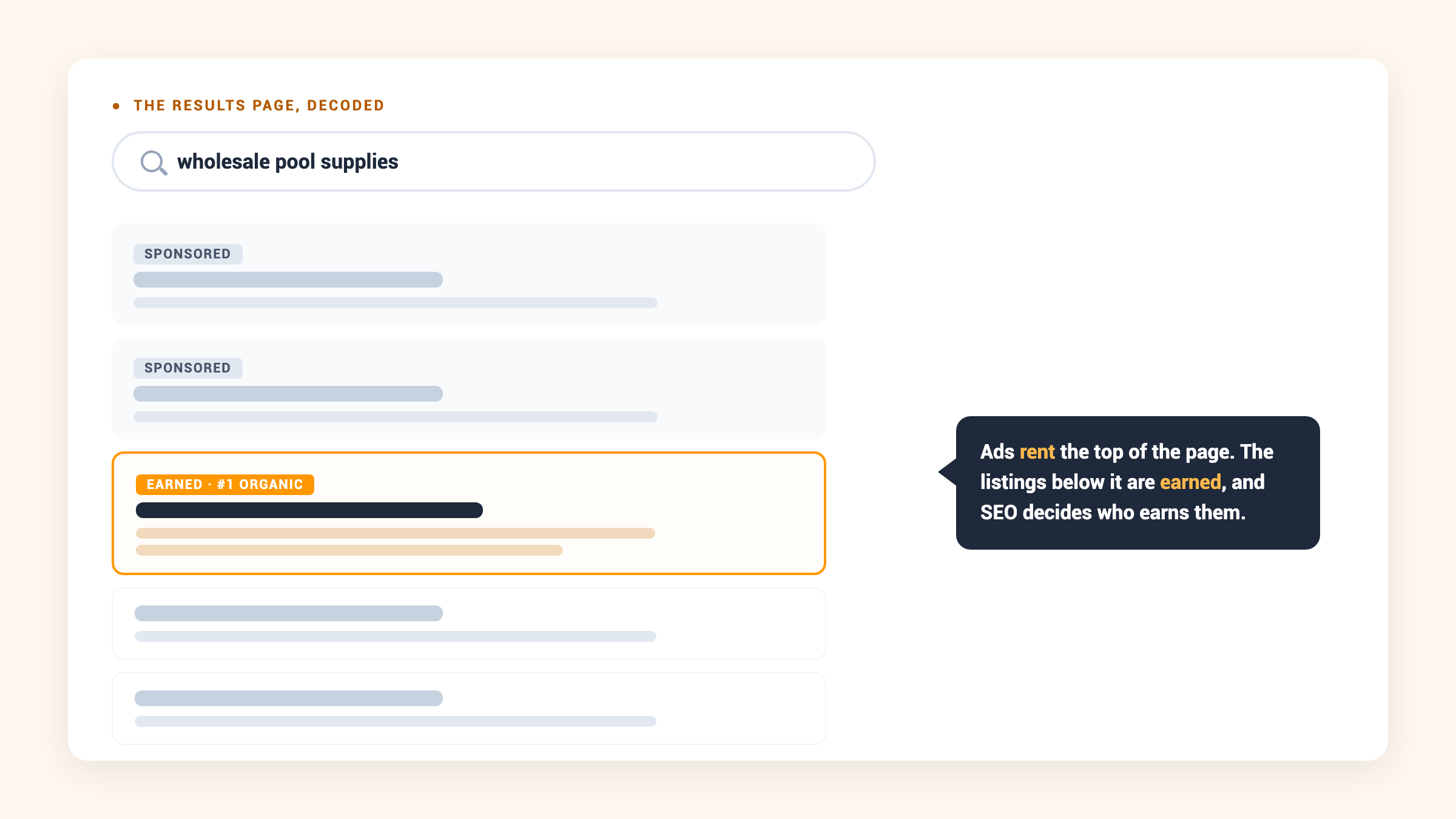
The diagram above shows a results page for “wholesale pool supplies.” The sponsored slots change hands whenever ad budgets change; the organic positions below them hold until a better page takes the spot, and that competition is where SEO lives.
Google charges nothing for organic placement, which makes the traffic feel free. The visibility still has a cost; you pay for it in research, content, engineering, and patience before the first ranking appears. The payoff structure is what separates SEO from every other channel in digital marketing: a paid ad stops producing the moment the budget stops, while a page that ranks keeps producing visits month after month at no additional cost per click.
If you want the terminology and history first, start with our companion piece on what SEO stands for and how the term evolved, then come back here for the machinery.
Where SEO Fits in Digital Marketing

SEO works as the demand-capture layer of a digital marketing program: other channels create interest, and search collects it. A prospect who sees your ad, hears a podcast mention, or gets a referral almost always routes through a search box before buying, and the brand that owns that search result collects credit for every channel that came before it.
The channels also feed each other in measurable ways, and teams that treat SEO as a silo forfeit every one of these exchanges:
Budget logic follows the same structure. Paid channels buy this quarter’s revenue; SEO builds the asset that discounts every future quarter. A program weighted entirely toward either one is fragile, either starved of near-term proof or permanently renting its visibility.
Crawling, Indexing, and Ranking: The Three Stages of Google Search
Before a page can earn a single visitor, it has to survive three filters: crawling, indexing, and serving results. Failing one stage means never reaching the next; a site that never gets crawled cannot be indexed, and a page missing from the index cannot rank for anything, no matter how good the writing is.


Crawling has a budget. Google allocates a finite amount of attention to each site, a limit practitioners call crawl budget, and large catalogs waste it on duplicate URLs, redirect chains, and orphaned pages. Trim the waste and the pages that matter get crawled sooner and refreshed more often.
Indexing is where silent failures live. A stray noindex tag, a conflicting canonical, or a page Google judges too similar to another can keep content out of the index entirely. Google Search Console shows exactly which pages were crawled but never indexed, and checking that report is the fastest diagnostic in all of SEO.
Google Ranking Signals: Relevance, Trust, Usability, and Authority
Google’s ranking systems weigh hundreds of signals, but they cluster into four questions: does the page match the query’s intent, can the searcher trust the source, does the page load and behave well, and does the wider web vouch for it? Every tactic in SEO exists to improve the answer to one of those four questions; for the factor-by-factor breakdown, see our guide to the Google ranking factors that matter most in 2026.


These weights get re-tuned several times a year through core algorithm updates, which is why rankings move even when your site stays still. Google’s May 2026 core update took nearly twelve days to finish rolling out, and it landed two months after the one we broke down in our March 2026 core update analysis.
The Three Parts of SEO: On-Page, Technical, and Off-Page
Every SEO tactic belongs to one of three workstreams, and the sites that win run all three at once. On-page work shapes what each page says, technical work shapes how machines access it, and off-page work shapes how much the rest of the web trusts it. A weakness in any one caps the return from the other two.
On-Page SEO
On-page SEO covers everything inside the page itself. The highest-return on-page habit is answering the searcher’s question in the first paragraph, then earning the rest of their attention with depth. The elements below carry the weight:
- Title tag: the headline Google shows in results. Lead with the keyword phrase searchers use, keep it under about 60 characters, and write it to earn the click, since two pages at the same position can see wildly different traffic.
- Headings: H2s and H3s that mirror the sub-questions inside the topic. Google matches passages to queries, so a section headed the way people search can rank on its own.
- Body copy: complete answers with evidence, written for the reader first. Depth wins against padding; a 900-word page that resolves the query beats a 3,000-word page that circles it.
- Internal links: descriptive anchors connecting related pages. They route authority to priority pages and teach Google which page owns which topic.
- Image alt text: scene-level descriptions that make images legible to crawlers and screen readers alike.
Technical SEO
Technical SEO keeps the crawl-index-rank pipeline unclogged: clean site architecture, fast load times, mobile-first rendering, correct canonical tags, structured data, and redirect hygiene. When Optimum7 rebuilt BSI’s site structure, the technical pass came before a single word of new content, because content published into a broken structure inherits the structure’s ceiling.
Architecture deserves special attention on large sites. Every page should be reachable within three or four clicks of the homepage, category hierarchies should follow how buyers think about the catalog, and URL patterns should stay stable through redesigns. Structured data rounds out the technical layer by labeling products, reviews, FAQs, and articles in a vocabulary Google parses directly, making pages eligible for the enhanced result formats that raise click-through on crowded pages. New to this workstream? Our technical SEO guide for beginners walks through each fix in order.
Off-Page SEO
Off-page SEO builds the authority signals that live outside your domain, and backlinks remain the loudest of them. Earning links from sites your industry already trusts moves rankings; buying links from sites nobody reads invites penalties. Study who links to the competitors above you first; our walkthrough on bulk backlink analysis in Ahrefs shows how to audit an entire competitor set in one pass.
Link quality beats link count by a wide margin. One editorial mention from a publication your buyers read outweighs dozens of directory listings, and the anchor text, the linking page’s topic, and the linking site’s own authority all shape how much each link transfers. Unlinked brand mentions, reviews, and expert quotes in trade coverage feed the same trust calculation, which grows in importance as AI systems decide which brands to cite by reading the same signals.
The 7 Steps of SEO
Campaigns differ in emphasis, but the sequence barely changes. These seven steps describe how SEO works in practice, from first audit to compounding growth, and skipping a step early usually means repeating it later at a higher price.
Keyword Research: Matching Pages to Search Intent
Keyword research decides what SEO works on, and intent decides what each keyword deserves. Behind every query sits a purpose: learning, comparing, buying, or navigating. Google classifies that purpose before ranking anything, so a product page aimed at a research query loses to an article every time, regardless of how well the page is optimized.
| Intent | Example query | What to build |
|---|---|---|
| Informational | “how does seo work” | Guides, explainers, and answers that teach without selling |
| Commercial | “best seo agency for ecommerce” | Comparisons, reviews, and case study pages that support evaluation |
| Transactional | “buy 22re header online” | Product and category pages with clear pricing and availability |
| Navigational | “optimum7 case studies” | Brand pages that load fast and take the visitor exactly where they asked to go |
Head terms like “seo” carry huge volume and near-zero specificity, so realistic programs win on long-tail keywords: longer, more specific phrases with lower volume and far higher conversion rates. The LCE Performance campaign covered later in this guide was built on that pattern, one engine code at a time.
Assign one primary topic per page while you research. Two pages chasing the same phrase split signals and suppress each other, a failure pattern called keyword cannibalization that shows up as two URLs trading positions for the same query, with neither reaching page one.
How Long SEO Takes to Work

Expect 4 to 12 months before SEO produces results you can defend in a revenue meeting. Google’s own guidance sets that range, and it matches what Optimum7 sees across client programs: technical fixes register within weeks, rankings move within months, and revenue impact arrives last because it depends on everything upstream of it.

| Phase | Work happening | What you see |
|---|---|---|
| Months 1-3 | Audit, technical repairs, keyword mapping, first optimizations | Faster pages, cleaner index coverage, early movement on low-competition terms |
| Months 4-6 | Content production, on-page rewrites, first authority wins | Rankings climbing into the top 20, organic traffic trending up month over month |
| Months 7-12 | Cluster completion, link velocity, refreshing early content | Page-one rankings on priority terms, measurable pipeline and revenue attribution |
Three Optimum7 clients show the realistic range. A luxury jeweler with an established domain added traffic within six months; a B2B software company starting from 140 monthly organic visitors multiplied its keyword footprint from a near-zero base; a consulting firm recovering from a traffic collapse rebuilt its lead flow inside a year.
The timeline is also the industry’s biggest trust problem. Ask any group of practitioners about agency promises and the same complaint surfaces: a guarantee of page one inside 30 days. Treat that guarantee as a red flag, because the promiser either plans to target keywords nobody searches or knows you will churn before the deadline matters.
Competition density, domain history, publishing velocity, and how fast fixes ship all stretch or compress the timeline. When every fix waits a quarter for a development sprint, the curve stretches with it.
How SEO Makes Money

The SEO business model is simple to state: it lowers the cost of each new customer over time. What does a paid click cost you today, and what will the same click cost next year? Paid acquisition rents attention at a price that rises with competition. Organic rankings behave like an asset instead: the investment is front-loaded, and once a page ranks, each additional visitor arrives at near-zero marginal cost.
The revenue chain runs in one direction: rankings produce impressions, impressions produce clicks, clicks produce qualified visitors, and visitors convert into pipeline or orders. Breaking any link in that chain starves everything downstream, which is why serious programs measure all four stages, from impressions through revenue.
LCE Performance shows the full chain working. The Toyota parts retailer had inventory and expertise but fragmented rankings, with several pages competing for the same engine terms. Optimum7 organized the 20R, 22R, and 22RE engine families into distinct keyword clusters, cut crawl waste, and removed checkout friction. Monthly revenue grew almost 2.5x in twelve months.
The same economics explain how the SEO services business model works from the agency side. Agencies price by retainer, project, or hourly consulting because the work is continuous: research, production, engineering, and authority building run every month, and the compounding return justifies the recurring cost. Evaluate any provider, including Optimum7’s SEO services, on one question: can they trace their work to revenue, and will they show you the chain? For the attribution math behind that question, our guide on measuring the ROI of SEO works the numbers end to end.
SEO for Ecommerce, B2B, and Local Businesses
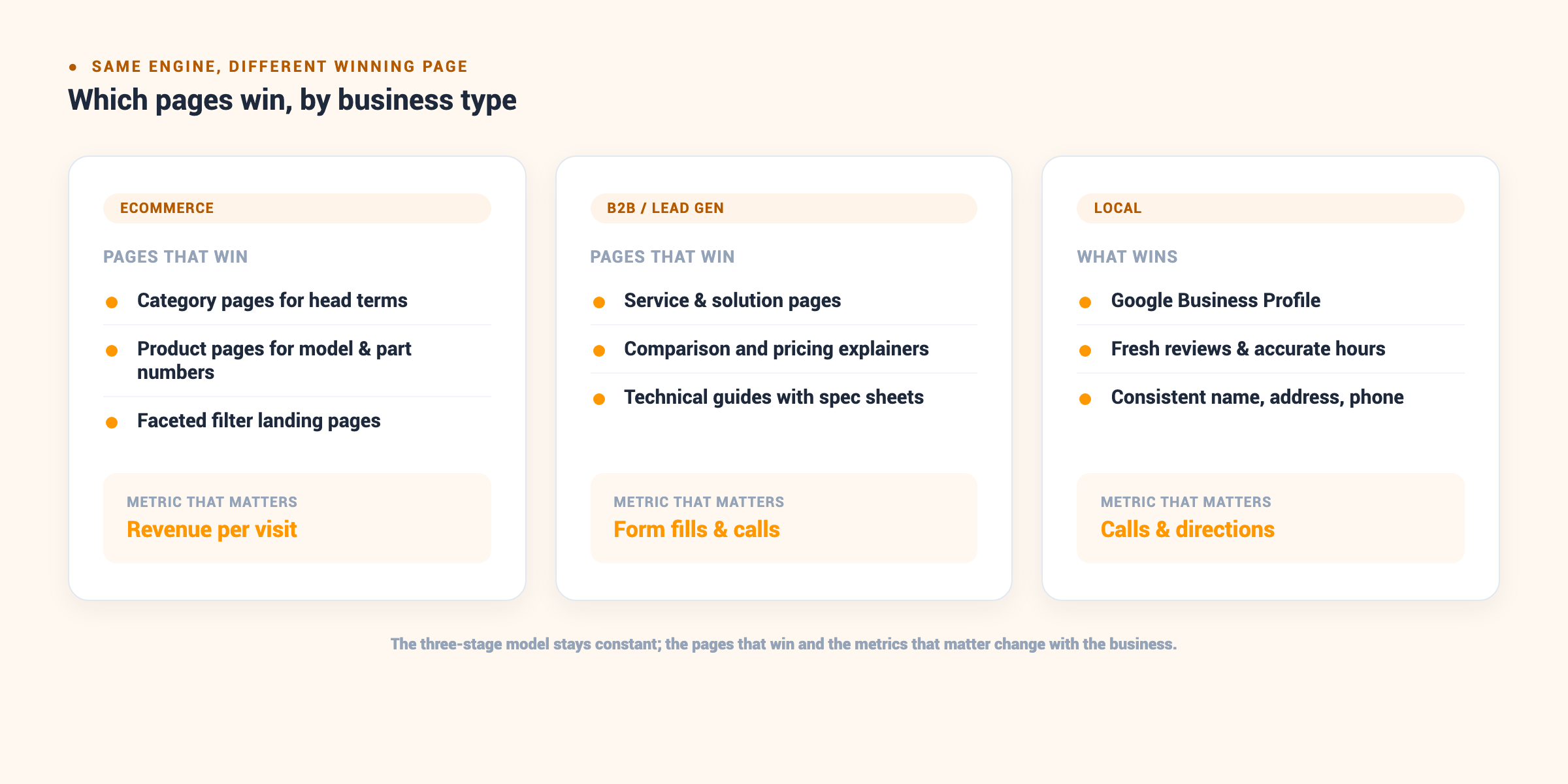
How SEO works for a business depends on what that business sells. The three-stage model stays constant across industries, but the pages that win and the metrics that matter change with the business model. Applying an ecommerce playbook to a lead-generation site, or the reverse, wastes months on the wrong page types.
Ecommerce SEO
Ecommerce SEO lives and dies on category and product pages, because those pages match transactional intent. Category pages target the head terms, product pages capture the specific model and part-number searches, and product schema feeds the price, availability, and review stars that make a listing stand out in results. The platform matters too: crawl behavior, URL structures, and duplicate-content risks differ across BigCommerce, Shopify, and Volusion, which is why we maintain a dedicated ecommerce SEO strategy guide per platform.
Faceted navigation deserves its own line item. Filter combinations multiply URLs by the thousands, and without canonical discipline they flood the index with near-duplicates that burn crawl budget; engineered well, as covered in our faceted search guide for ecommerce, the same filters become indexable landing pages for high-intent combinations. Optimum7 builds custom search and filter functionality for exactly this reason: filters shape both what shoppers find and what Google crawls.
B2B and Lead Generation SEO
B2B programs sell to committees on long timelines, so the content has to serve a researcher who will not fill out a form for months. Service pages carry the commercial intent while comparison content, technical guides, and pricing explainers nurture the middle. Measurement centers on form submissions, consultation requests, and calls, the same KPI set that anchored the BSI and ESW programs covered earlier, because raw traffic says little about pipeline in a six-figure deal cycle.
The B2B keyword pool is also smaller and more expensive per miss. A manufacturer’s buyers might type thirty relevant phrases a month in total, so a single misjudged page can absorb an entire quarter’s opportunity. Winning programs compensate with depth per query: the page that answers a compliance officer’s exact question, in their vocabulary, with a spec sheet attached, takes the ranking and the meeting.
Local SEO
Local businesses compete in a second arena alongside the classic results: the map pack. Rankings there weigh the Google Business Profile, review volume and recency, consistent name-address-phone data across directories, and proximity to the searcher. A dentist or contractor gains more from fifty fresh reviews and a complete profile than from a blog, which inverts the priority order every other business type follows.
The profile work is unglamorous and decisive: pick the precise business categories, load real photos monthly, answer every review within days, and keep hours accurate through holidays. Google reads response behavior and data consistency as proxies for a business that will still answer the phone when the searcher calls.
AI Overviews, Zero-Click Searches, and SEO in 2026
AI answers now sit above the traditional results on a large share of informational queries, and they keep a measurable portion of clicks that once flowed to websites. The response that works treats AI Overviews as a new distribution surface: the sources the AI cites still win visibility, and the sources it ignores lose ground twice.
User behavior data points the same way. Pew Research tracked real browsing sessions and found clicks on traditional results falling by nearly half when an AI summary appears, while links inside the summaries themselves drew almost no clicks at all.
Where Searchers Click When an AI Summary Appears
Share of Google searches with a click on a result, March 2025 (68,879 searches)
No AI summary shown
15%
AI summary present
8%
Links inside AI summary
1%
Clicks on traditional results fall by nearly half when an AI summary appears. Pew Research Center, 2025.
Google reads the same period differently. “Overall, total organic click volume from Google Search to websites has been relatively stable year-over-year,” Google’s Head of Search Liz Reid wrote in August 2025, arguing that “people are searching more and asking new questions that are often longer and more complex.” Both readings can hold at once: total clicks redistribute toward the sources AI systems trust, away from everyone else, and your job is to be on the receiving side of that redistribution.
Three practical consequences follow. Informational rankings now pay partly in citations and brand exposure, so structure content in clear, quotable passages the AI can lift and attribute. Bottom-funnel and transactional queries keep sending clicks, so commercial pages gain relative importance. And the same authority signals that win rankings decide who gets cited, which means zero-click searches punish thin content hardest. For platform-specific tactics across ChatGPT, Perplexity, and Google’s AI results, see our guide on doing SEO for AI-based search engines.
Measuring SEO Results: From Impressions to Revenue
SEO progress shows up in a fixed order, and judging a program means knowing which stage it should be in. A campaign three months old with rising impressions and no new revenue is on schedule; the same numbers at month twelve signal a targeting problem.
Google Search Console is the source of truth for the first three stages because the data comes from Google itself: which queries surfaced your pages, at what position, and how often searchers clicked. Pair it with GA4 or your commerce platform for the final stage, and tie organic sessions to pipeline, orders, and revenue. If your organic traffic doubled tomorrow, could you say what it earned? Programs that answer that question keep their budgets.
Watch leading indicators between milestones: index coverage growing, average position improving on priority queries, and the count of queries a page appears for expanding. Those move weeks before traffic does and tell you the engine is turning over even while the click totals still look flat. The same reports double as an early-warning system; our walkthrough on using Search Console to spot algorithm update damage shows the exact views to check after any ranking swing.
4 SEO Mistakes That Cost the Most to Undo
The expensive failures in SEO repeat across industries, and every one of them is avoidable with discipline earlier in the process. Four patterns account for the bulk of the damage Optimum7 gets called in to repair.
Your First 30 Days of SEO
Reading about SEO changes nothing; the first month of disciplined groundwork changes the trajectory. Work through this list in order, and by day 30 you will have the measurement, the baseline, and the first targets that everything in this guide builds on.
Frequently Asked Questions About How SEO Works
How does SEO work for beginners?
Start with the three-stage model: Google crawls your pages, indexes what they mean, and ranks them for each search. Your work splits into three parts: publish pages that answer real searches, keep the site technically clean so Google can process it, and earn links from trusted sites. Master those before any advanced tactic.
How does SEO work step by step?
A campaign runs in seven steps: audit the site, research keywords and intent, fix technical architecture, optimize existing pages, build content around topic clusters, earn authority through links and PR, then measure and iterate monthly. The order matters because each step compounds the one before it.
Can I do SEO myself?
Yes, for the fundamentals. A business owner can write intent-matched pages, fix titles and headings, and read Google Search Console without outside help. The ceiling appears when technical fixes, content velocity, and authority building outgrow your available hours; at that point the choice is hiring in-house or retaining an agency.
How much does SEO cost?
Providers price by monthly retainer, fixed project, or hourly consulting, and the number follows competition, site size, and scope. Judge cost against the revenue an organic customer produces over time. A retainer that generates customers below your paid acquisition cost is cheap at almost any headline price.
What is the difference between SEO and SEM?
Search engine marketing (SEM) is the umbrella covering both paid ads and organic optimization; SEO is the organic half. Paid search buys placement instantly and stops when spending stops, while SEO earns placement slowly and keeps producing after the work is paid for. Mature programs run both and let each cover the other’s gaps.
Does SEO still work now that AI answers questions?
Yes, with changed payouts. Click rates on AI-answered informational queries fell sharply, while cited sources gain visibility and bottom-funnel queries keep sending buyers. The winning move is building the authority that makes AI systems cite you, which is the same authority that wins classic rankings.
How does SEO make money for a business?
Rankings bring in visitors who searched for what you sell, and those visitors convert into orders, leads, or booked calls without a per-click fee. The economics improve over time: content and authority accumulate, so each year of work lowers the effective cost of every customer the channel produces.
About the author: Duran Inci is the CEO and Co-Founder of Optimum7, an ecommerce development and digital marketing agency. He helps mid-market and enterprise brands scale revenue through conversion optimization, SEO, and custom ecommerce solutions.