

TL;DR: AI search optimization gets AI engines like Google AI Overviews, ChatGPT, and Perplexity to cite your pages inside the answers they write. This guide covers how AI picks sources, the seven steps to earn citations, using AI to do the work, and measuring a channel where you can win rankings and still lose clicks.
A search result can rank third for a high-intent query and never get seen. If an AI answer resolves the question at the top of the page, does the shopper ever reach your link, or does the engine settle it before a single click happens? That gap is the reason ranking and traffic have come apart, and it is the problem AI search optimization exists to solve.
Optimum7 watched this happen inside a live client account. One industrial manufacturer Optimum7 works with tripled its top-three rankings over twelve months and lost a quarter of its organic clicks in the same window, because AI Overviews and AI Mode were answering buyers before they clicked. Rankings went up. Traffic went down. The old scoreboard stopped telling the truth.
So how does a search engine that writes its own answers decide which sites to name? This guide answers that in full: what AI search optimization is, how the four major AI engines choose and cite sources, the exact steps to make your content citable, how to point AI tools at your own SEO work, and how to track visibility when position tracking no longer captures it. The tactics apply to any site, with specific notes for ecommerce and B2B where the stakes are highest.
What AI Search Optimization Is
Traditional SEO earns a position. AI search optimization, the work people also call SEO for AI search, earns a mention inside a written answer. The two share the same foundation, and the difference sits in the target: a ranked link waits for a click, while a cited passage gets quoted in the answer itself. A page can do one, both, or neither, and the pages that do both are the ones structured for machine extraction from the first sentence of every section.
Two related terms show up alongside this work. Answer engine optimization (AEO) targets the direct-answer surfaces: featured snippets, the “People Also Ask” box, and Google AI Overviews. Generative engine optimization (GEO) targets the fully generated answers from tools like ChatGPT, Perplexity, and Gemini. Both sit on top of ordinary search visibility, and Optimum7 covers the direct-answer layer in depth in its guide to answer engine optimization.
Why Top Rankings No Longer Guarantee Traffic
Rankings and clicks used to move together, and now they can move in opposite directions. When an AI Overview sits above the results, Pew Research Center found that users click a traditional result in 8% of visits, down from 15% when no summary appears, and click a link inside the summary itself just 1% of the time. The answer arrives, the question closes, and the ranked page below it goes unseen.
Where the clicks go when an AI summary appears
Share of Google searches where a user clicks a link
Google users click a result far less often when an AI summary is shown. Pew Research Center, 2025. Source
This is the paradox behind the whole discipline. You can dominate the rankings and watch clicks fall, because the engine is spending your visibility on its own answer. The response is to make sure that when the answer gets written, your brand is the source it names. Optimum7 documented exactly this outcome with an industrial power-generation client, where the fix was restructuring content to appear as a cited source in ChatGPT, Perplexity, and Google AI Mode responses.
Rankings still matter here: engines pull from pages they already trust, so strong positions feed the AI answer. The finish line simply moved from position one to the citation, and everything below depends on understanding how that citation gets awarded. If you want the fundamentals underneath all of this, start with how organic search works.
How AI Search Engines Pick and Cite Sources
Every AI answer travels the same five-step path, and optimization is the practice of surviving to the last step. The engine reads a conversational question, retrieves short candidate passages from its index or a live crawl, ranks those passages for trust and clarity, synthesizes the strongest ones into a single answer, then credits a handful of sources beside it. The pages that make it through are structured for the middle step, where authority and clean formatting decide the shortlist.
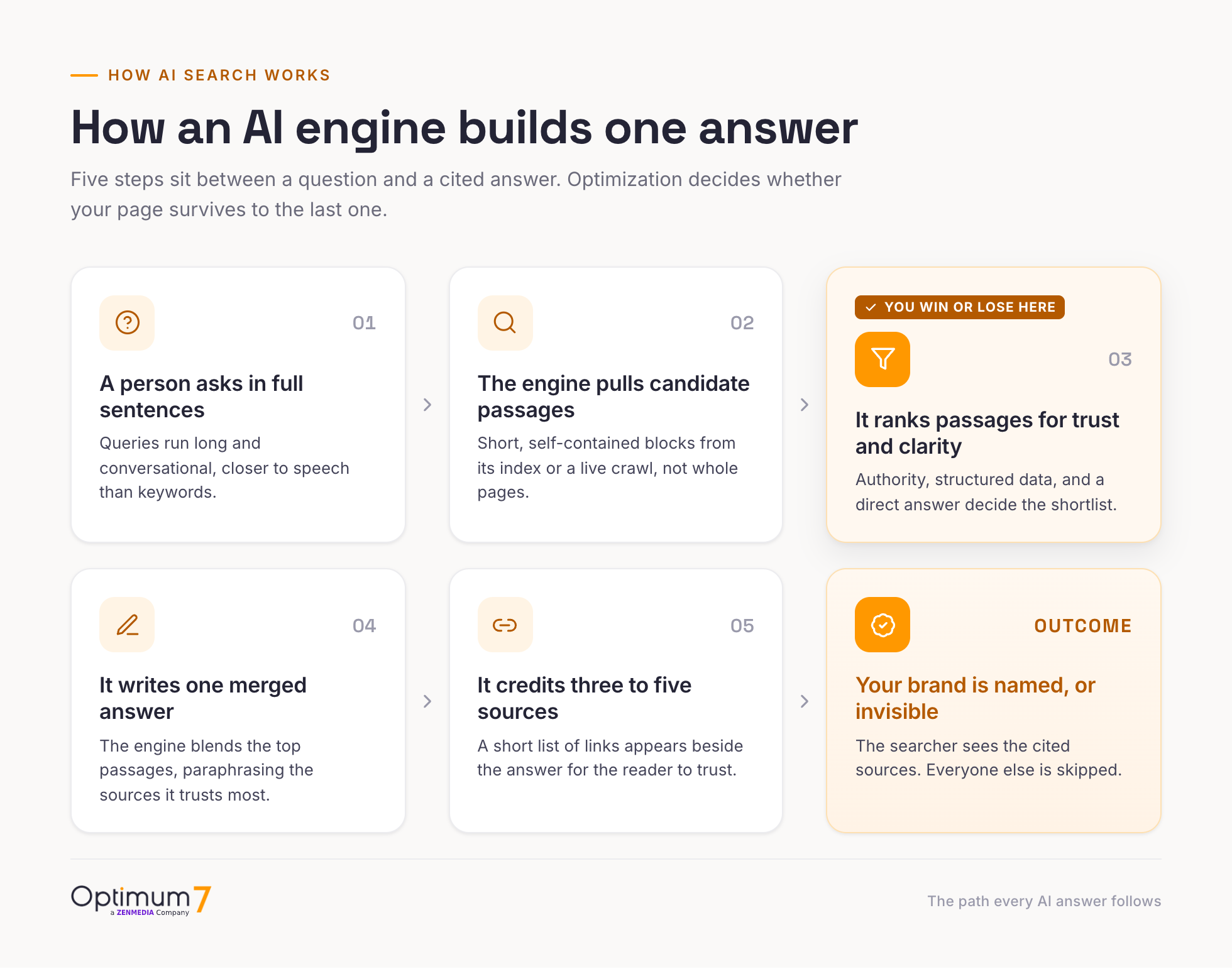
Retrieval is where visibility is won or lost. Engines pull passages, self-contained blocks that answer a question on their own, so a brilliant answer buried in paragraph six rarely gets found. Selection is where authority pays off: pages with clear expertise signals, matching structured data, and a direct opening sentence get shortlisted, and the rest get skipped. When AI Overviews credit sources, Pew found they typically name three or more, so the goal is to make that shortlist of named sources.
Three signals tip that selection in your favor. Freshness is one: a recently updated page gets pulled ahead of a stale one on fast-moving topics. Consistency is another, since a brand described the same way across its own site, its profiles, and third-party coverage reads to a model as a known source. Source diversity matters too, because an engine assembles its answer from several corroborating pages, which rewards brands that show up across the wider conversation on a topic. Practitioner reports through 2026 show fresh discussion on community forums feeding those answers, one more reason to earn mentions off your own site.
The Four AI Answer Engines and What Each Rewards
Four surfaces carry the bulk of AI answers today, and each reaches your pages through a different crawler and trusts a different signal. Google AI Overviews and AI Mode read from Google’s own index, crawled by Googlebot and gated for AI use by the Google-Extended token, and they lean on E-E-A-T and structured data. ChatGPT Search fetches pages with OAI-SearchBot and trains on GPTBot, drawing on the Bing web index, and it weights frequent brand mentions and authoritative, widely-linked sources. Microsoft Copilot reads that same Bing index through Bingbot and rewards domain authority and structured, well-organized content. Perplexity runs its own live crawl with PerplexityBot and favors fresh, fact-dense pages it can quote word-for-word. One well-built page can earn all four, because the fundamentals overlap.
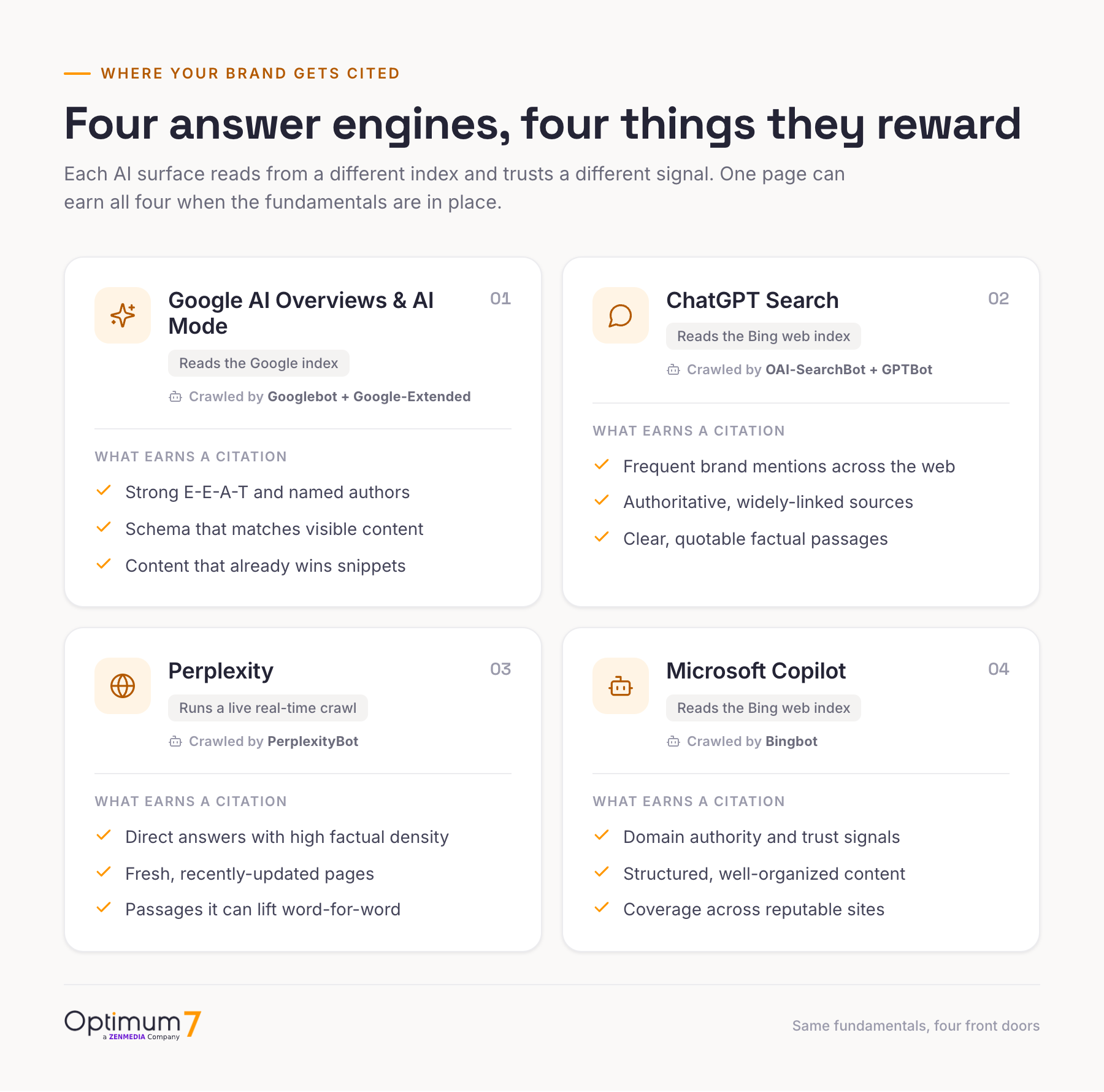
The overlap has limits worth knowing. Pages already strong in classic Google search hold a head start on AI Overviews, since the same technical health and structured data that win a featured snippet feed the Overview. For the two Bing-based engines, registering with Bing Webmaster Tools and earning off-site brand mentions matters as much as the Google work most teams focus on. Perplexity rewards recency most directly, so a page refreshed with current figures can surface there faster than an older page carrying more authority.
The scale explains the urgency. Google reported that AI Overviews reached 2 billion monthly users by mid-2025, with AI Mode passing 100 million, and through 2026 Google has kept folding AI Mode features into core Search and started placing Shopping ads directly inside AI Mode answers. The surface where buyers get their answers is expanding, and product results are moving into it, a change Optimum7 examines in its look at how AI is reshaping product discovery.
How SEO, AEO, and GEO Fit Together
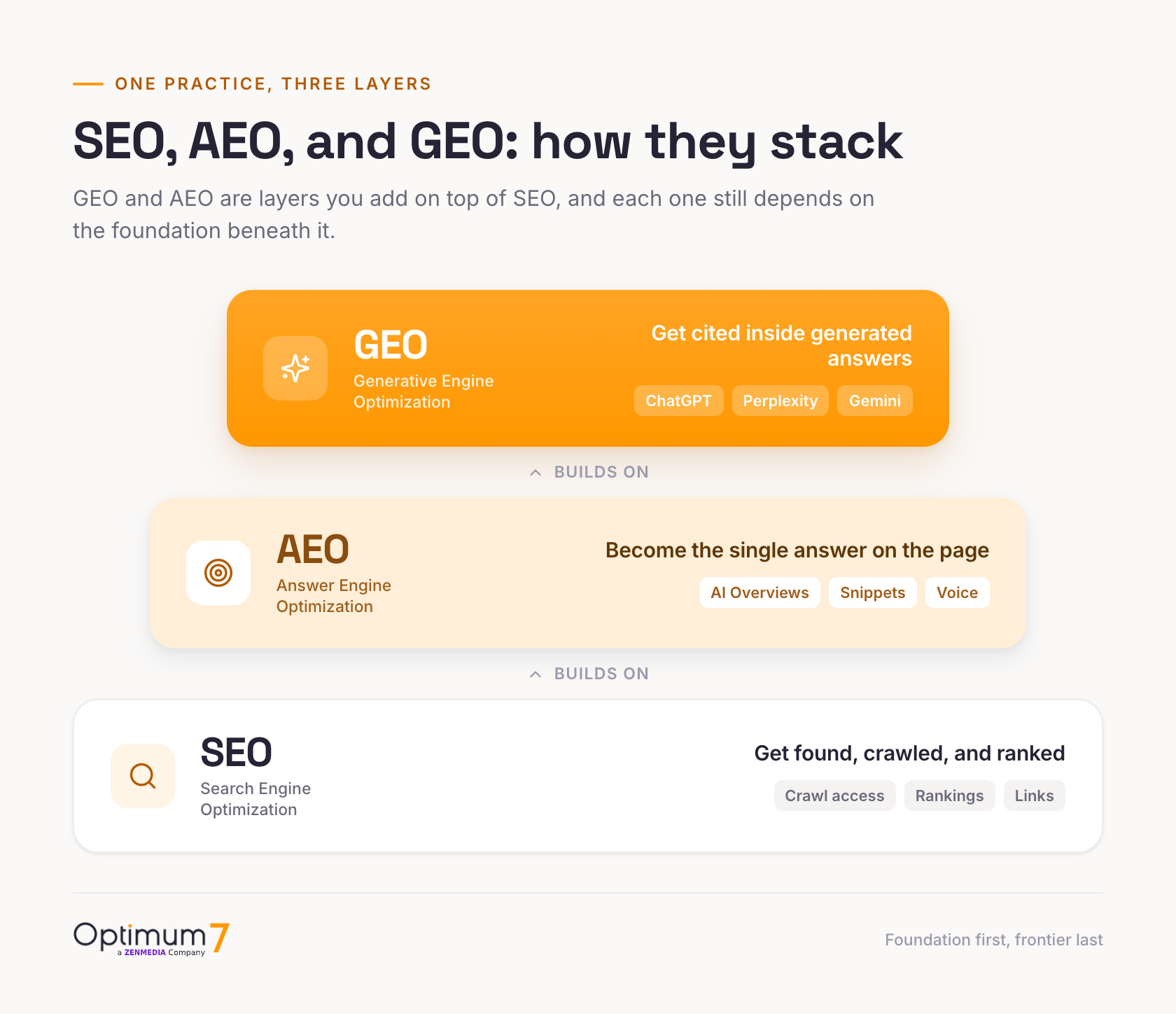
GEO and AEO are layers on top of SEO, and none of them replaces the one beneath it. SEO gets your pages crawled, indexed, and ranked on the strength of crawl access, quality links, and relevance. AEO wins the direct-answer boxes: featured snippets, the “People Also Ask” panel, voice-search answers, and AI Overviews. GEO earns a mention when a generative engine writes a fresh answer from scratch. Skip the foundation and the upper layers have nothing to stand on, because an engine cannot cite a page it never indexed.
In practice, the day-to-day work changes more than the fundamentals do. The table below shows what stays constant and what you handle differently once AI answers enter the picture.

| What changes | Traditional SEO | AI search optimization |
|---|---|---|
| The goal | Rank high enough to earn the click | Get quoted and cited inside the answer |
| The unit | The page and its keywords | The passage and its clarity |
| The query | Short keyword phrases | Long, conversational questions |
| The metric | Position and click-through rate | Citation frequency and brand mentions |
| What stays | Crawlability, authority, quality content | Crawlability, authority, quality content |
How to Optimize Your Website for AI Search Engines
Seven steps take a page from invisible to citable, and they run in order because each one feeds the next. The first three shape the content itself, the middle two build the authority that earns selection, and the last two clear the technical path and keep the work honest with measurement. Nothing here is exotic; it is disciplined execution of core SEO fundamentals that AI engines happen to reward.
Structured Data and Schema for AI Citation
Structured data is the single most useful technical move available, because it hands the engine an unambiguous reading of your page. JSON-LD schema tells a model what a page is, who wrote it, what a product costs, and what each answer says, and it removes the guesswork that keeps borderline pages out of the citation shortlist. FAQPage schema is especially useful, since a question-and-answer structure mirrors the shape of an AI answer.
The results show up in the numbers. When Optimum7 rebuilt the technical foundation for a B2B parts retailer with a 10,000-SKU catalog, the work centered on consolidating pages, cutting crawl waste, and refining schema across every major category. Organic sessions and revenue climbed together, and the catalog stayed stable through the change.
Priority order for a typical site: FAQPage on your answer content, Article with a named author on editorial pages, HowTo on process guides, and Product with Offer and Review on commerce pages. A solid technical SEO base makes all of it easier to deploy and keep valid.
Writing Content That AI Engines Cite
Citable content is dense with facts and light on filler. Engines quote passages that state something specific and verifiable, so a sentence with a number, a date, or a named detail beats a paragraph of hedged generalities. Lead with the answer, support it with evidence, and keep each idea in its own short block that reads correctly when lifted out of the page.
The harder problem is knowing which questions buyers put to an AI in the first place. Optimum7 built its 1,000 AI Prompts resource to answer that, mapping the real prompts buyers type into ChatGPT, Gemini, and Perplexity across a category so content targets the questions that drive purchases. Pair that map with your own Search Console queries and you write for demand that already exists.
“You need to allow AI crawlers to access your content. The rules you set might need to be different depending on your context.”
That line comes from international SEO consultant Aleyda Solís, speaking on the Humans of Martech podcast, and it points at the next requirement: great content only counts if the crawler can read it.
Letting AI Crawlers Reach Your Content
AI engines use distinct crawlers, and a robots.txt rule written for Googlebot may silently block them. Confirm your file permits the agents that feed AI answers, then confirm the content they fetch is there to read. AI crawlers often do not execute JavaScript the way a browser does, so a page that renders its main content client-side can look empty to the engine.
Using AI for Search Engine Optimization
AI reshapes where you compete and how fast you can do the work. The same models that write answers can accelerate the SEO behind them: clustering questions, drafting outlines, and generating valid schema in seconds. The judgment stays human, and the throughput multiplies. Three uses return the most time.


One caution governs all three: never publish AI-drafted content unchecked. Models produce fluent, generic prose that adds no expertise and can invent facts, and thin AI copy is the fastest way to lose the authority this whole strategy depends on. Treat the model as a fast junior assistant whose work a specialist always reviews.
How to Track AI Search Visibility
Standard rank tracking cannot see an AI citation, which is why a page can hold its position and quietly lose clicks. The industrial generator client proved it: rankings up, traffic down, with no rank report able to explain the drop. Measurement has to widen from position to presence, tracking how often your brand is named and quoted across AI answers.
“Rank tracking, however, is full baloney.”
Rand Fishkin, founder of SparkToro, made that case on the Near Media podcast, arguing that brand-presence frequency, measured with statistical rigor, is the metric that now matters. In practice, that means three signals worth watching: how often your brand appears in AI answers for your priority questions, click-through-rate declines on pages that still rank well in Search Console, and referral traffic arriving from AI sources in your analytics.
Turning those signals into a monthly habit is straightforward. Run your ten most important buyer questions through ChatGPT, Perplexity, and Google AI Mode by hand, and note if your brand gets named and how the answer describes it. Watch Search Console for pages that hold their position while click-through rate slides, the fingerprint of an AI answer sitting above them. Then check analytics for referral sessions from AI domains, which confirm the channel is sending real visitors. Three readings, logged once a month, turn an invisible channel into a trend you can act on.
The practical read: measure direction, not a daily rank. A page that starts appearing in answers, holds its impressions, and pulls steady referral traffic from AI sources is winning, even if its old position number barely moves. The same widening applies to paid placements, which Optimum7 breaks down in its guide to how ChatGPT ads work and the measurement problem.
The Limits and Risks of AI Search Optimization
AI search optimization has limits worth planning around. Answers are non-deterministic, so the same question can return different brands and different sources from one day to the next, and a page cited this week may fade the next as models refresh. Optimum7 saw that volatility firsthand: the generator client’s rankings and clicks moved in opposite directions inside a single year. Treat each citation as a probability you can raise and expect it to keep moving.
The engines also make mistakes. AI Overviews and chatbots sometimes attribute a claim to the wrong source or state a fact a page never made, and there is no clean opt-out once your content sits in the training and grounding data. Monitoring how engines describe your brand matters as much as earning the mention, because a confident wrong answer travels fast.
Investment should match where your buyers already are. A brand whose customers research heavily in ChatGPT or Perplexity has more to gain than one whose audience never leaves a specialized marketplace. The reassuring part is that the safe path pays off either way: strong content, clean technical health, and real authority feed AI answers and classic rankings at once, so the effort holds its value even when a single engine cools off.
What This Means for Ecommerce and B2B Sites
For stores and B2B sites, AI search is already a real acquisition channel, and the traffic it sends is unusually good. Adobe found that visits to U.S. retail sites from generative AI sources jumped 1,200% between July 2024 and February 2025, and those visitors browsed 12% more pages and bounced 23% less than shoppers from other channels. Fewer clicks overall, higher quality per click.
Capturing it comes down to product-level structure. Product, Offer, and AggregateRating schema let engines read price, availability, and reviews and surface your items inside comparisons and recommendations. Category pages should answer buyer-intent questions directly, and product pages should state specs as extractable facts. On-site, an AI-powered search and filter helps the high-intent shoppers arriving from AI answers reach the exact product fast. With Google now placing Shopping ads inside AI Mode, the answer surface is becoming a storefront, a change Optimum7 unpacks in its look at how Google is bringing checkout into search and AI.
B2B sites earn from the same structure with a different emphasis. Buyers there run long comparison and specification queries, so detailed spec tables, clear quote paths, and side-by-side comparison content give an engine exact facts to cite in a vendor evaluation. A distributor that documents load capacities, compatibility, and lead times in extractable form becomes the source an AI names when a buyer asks which supplier fits a requirement, the same play behind the industrial results earlier in this guide.
The brands winning here treat AI visibility as a distinct deliverable sitting on strong SEO, the same pairing behind Optimum7’s generator and catalog results above. If you are still choosing the platform that makes this structure easy to maintain, start with how to choose the right ecommerce platform, and to build the program itself, see Optimum7’s SEO and AI visibility services.
Frequently Asked Questions
What is AI search optimization?
AI search optimization is the practice of structuring content so AI engines select and cite it inside generated answers on surfaces like Google AI Overviews, ChatGPT, and Perplexity. It builds on traditional SEO and adds direct-answer formatting, structured data, strong expertise signals, and consistent brand mentions so a page becomes a source the engine names.
How do I get my website cited in Google AI Overviews and ChatGPT?
Keep the page indexable, allow snippets and AI crawlers in robots.txt, and open each section with a direct answer backed by named expertise and structured data. AI Overviews pull from Google’s index, and ChatGPT draws on the Bing index, so strong organic visibility on both plus frequent brand mentions across the web give you the best chance of being named.
What is the difference between SEO, AEO, and GEO?
SEO gets a page crawled, indexed, and ranked. AEO, answer engine optimization, wins the direct-answer surfaces such as featured snippets and AI Overviews. GEO, generative engine optimization, earns a mention when a tool like ChatGPT or Perplexity writes a fresh answer. AEO and GEO are layers on top of SEO, and each depends on the foundation beneath it.
Can I use AI to do my SEO?
Yes, for the right tasks. AI accelerates question research, content outlines, and schema drafting, which frees time for the expertise and data that earn citations. Always have a specialist review the output, because unchecked AI content is generic, can invent facts, and erodes the authority AI engines reward.
How is optimizing for AI search different from traditional SEO?
Traditional SEO targets a high ranking that earns a click. AI search optimization targets selection as a cited source inside a written answer. The underlying quality and authority requirements stay the same; the format shifts toward passage-level answers, conversational questions, and measurement that weighs citation frequency as heavily as position.
Can ecommerce sites benefit from AI search optimization?
Yes, and the traffic tends to convert well. Product, Offer, and Review schema let AI engines surface items in recommendations and comparisons, while category and blog content targeting buyer-intent questions pulls high-intent visitors toward product pages. With Shopping ads now appearing inside AI Mode, structured product data is becoming a direct commerce advantage.
About the author: Duran Inci is the CEO and Co-Founder of Optimum7, an ecommerce development and digital marketing agency. He helps mid-market and enterprise brands scale revenue through conversion optimization, SEO, and custom ecommerce solutions.