

TL;DR: The right AI tool depends on your catalog size and where you are losing visibility. This guide ranks 16 tools across six jobs: product copy, content optimization, content strategy, technical automation, AI search visibility, and full-suite platforms. Every pick names the store size it fits, carries one honest verdict with the downside its marketing hides, lists the real price, and is backed by named proof, so you buy the right one once.
Search for the best AI SEO tools and the lists that rank are dominated by companies selling the tools they recommend. Which of those lists shows you what a tool did to a real store, and the catch its marketing hides? Optimum7 runs these tools on client catalogs every week, has no software of its own to sell, and can say where each one earns its price and where it quietly costs you rankings.
Ecommerce changes the math on every tool here. A blog-focused writer that produces ten polished posts is almost useless against a catalog of 4,000 product pages with duplicated descriptions. A content score that rewards keyword density can push a product page straight into an over-optimization filter. This list is organized by the job you are hiring the tool to do, and each pick names the store size, the price, and the platform it fits. If you want the groundwork first, start with how SEO works, then come back here to choose a stack.
Why Ecommerce SEO Now Runs on AI
AI is no longer only a production shortcut for ecommerce; it is now a traffic source and a ranking surface in its own right. Traffic to US retail sites from generative AI tools rose 693.4% year over year during the 2025 holiday season, which means shoppers are discovering products inside ChatGPT, Gemini, and Google AI Overviews before they ever reach a traditional results page. At the same time, catalogs have outgrown manual work: no team hand-writes unique, optimized copy for 5,000 SKUs, and no editor manually tracks which products get cited in an AI answer. The tools below exist to close both gaps.
How to Read This List
Before you compare brands, decide what you are buying. Three questions separate a tool that pays for itself from one that drains a subscription line. Check each tool against them as you read.


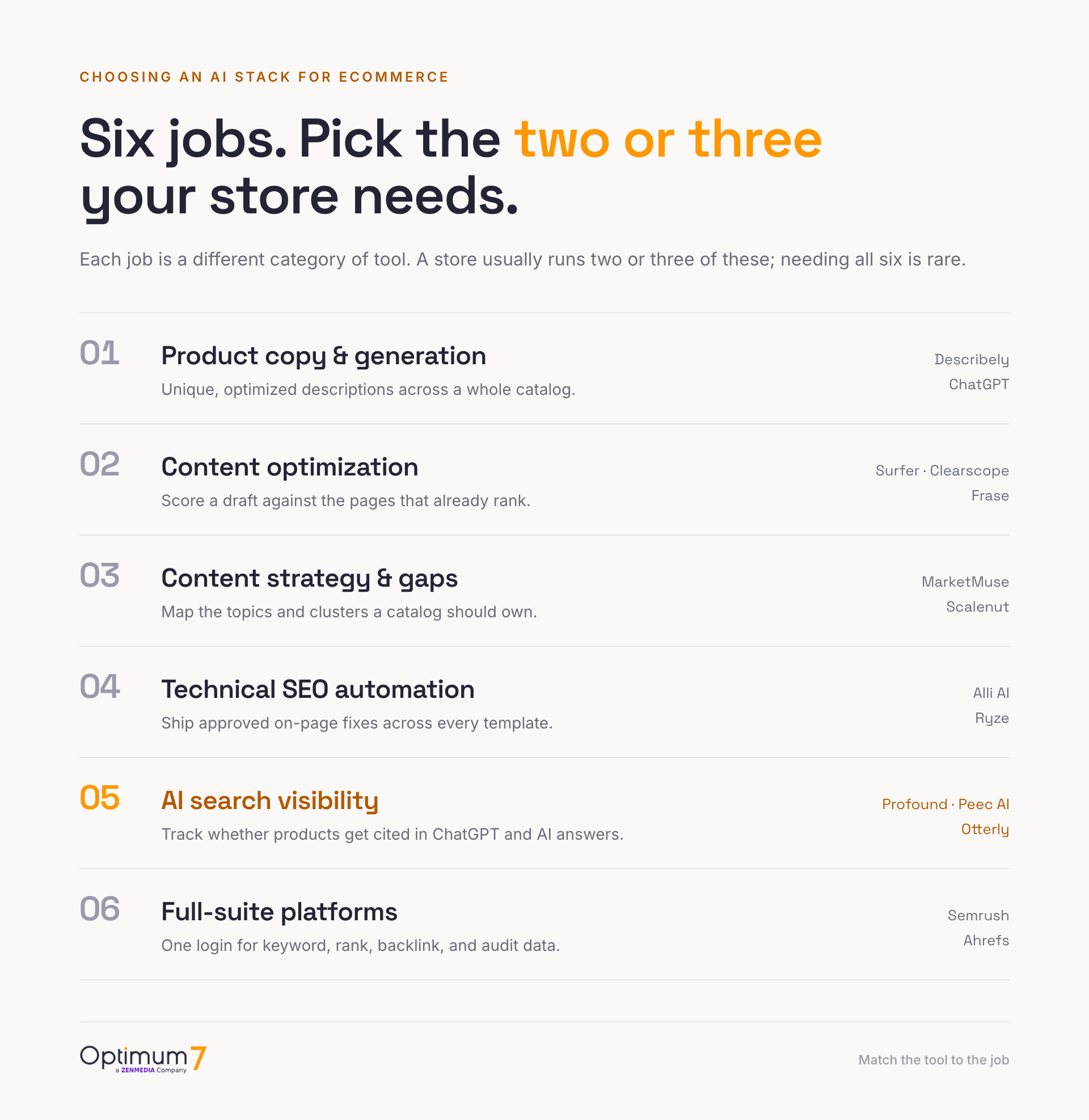
The list is grouped into six jobs: product copy and generation, content optimization, content strategy and gap analysis, technical SEO automation, AI search visibility, and full-suite platforms. Two or three of these usually cover what a store needs, and needing all six is rare. The map below shows how the jobs fit together.
Product Copy and Generation at Scale
This is where teams usually start, because duplicated and thin product descriptions are the on-page problem that dogs large catalogs. The job is producing thousands of unique, accurate, on-brand descriptions without a copywriter touching every SKU. Tool choice here depends almost entirely on catalog size.
Describely
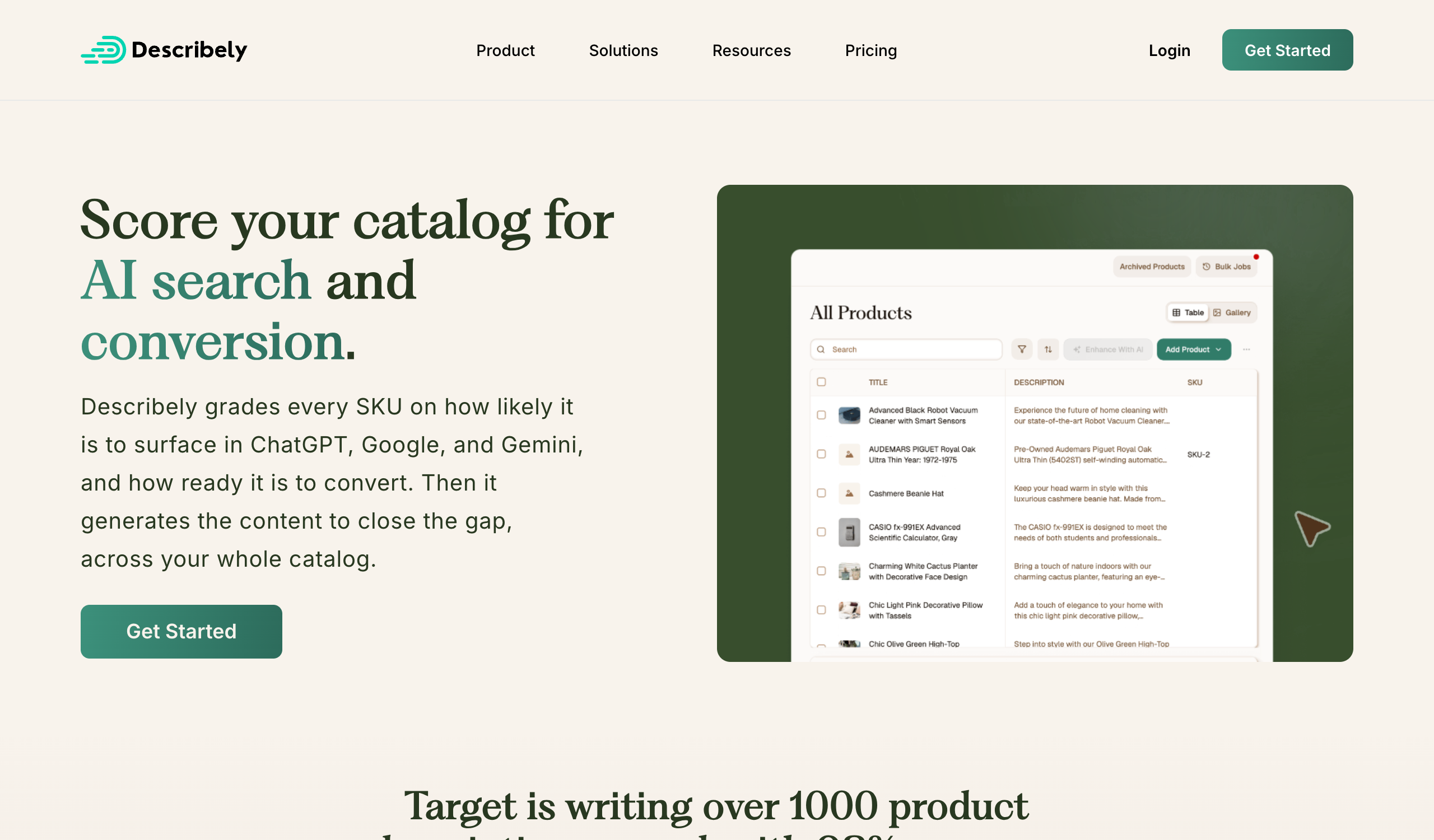
Describely is purpose-built for the one job general-purpose writers choke on: turning a feed of bare SKUs into thousands of unique, optimized product descriptions. Connect a Shopify, BigCommerce, or WooCommerce catalog and it generates titles, descriptions, meta tags, and bullets in bulk, enforces your brand rules through a Content Rules system, and publishes back to the store with no export-import dance. The feature that sets it apart is enrichment: point it at a manufacturer or supplier URL and it crawls the page to pull the specs, materials, and dimensions your own feed is missing, so a bare gasket row becomes a description that answers real buyer questions. It audits the whole catalog for AI-search and conversion readiness first, so you fix the weakest pages first. It rates 4.8 out of 5 on G2 (on a small review base) and runs pay-as-you-go at $0.75 per product with the first five free, which turns a 2,000-SKU rewrite into a predictable line item.

ChatGPT
ChatGPT is the flexible workhorse of the stack. Load your brand voice, sizing chart, returns policy, and sourcing notes into a Project or a custom GPT once, and it will draft on-brand descriptions, category intros, buying guides, FAQ answers, and schema-ready questions with a nuance no templated app reaches. Through the API it generates against your own product spreadsheet in bulk, so a developer can wire it into a catalog workflow. The limit is that it ships raw text with no SEO scoring, no SERP data, and no native feed connection, so it rewards teams that build a prompt-library-and-review process around it. At $20 a month for Plus it is the best value per dollar here for anyone who can write a tight prompt. If you are on Shopify and want a free first draft, Shopify Magic writes descriptions right in the admin at no extra cost, though every merchant prompts the same model, so the output stays generic until you edit it.
Koala AI
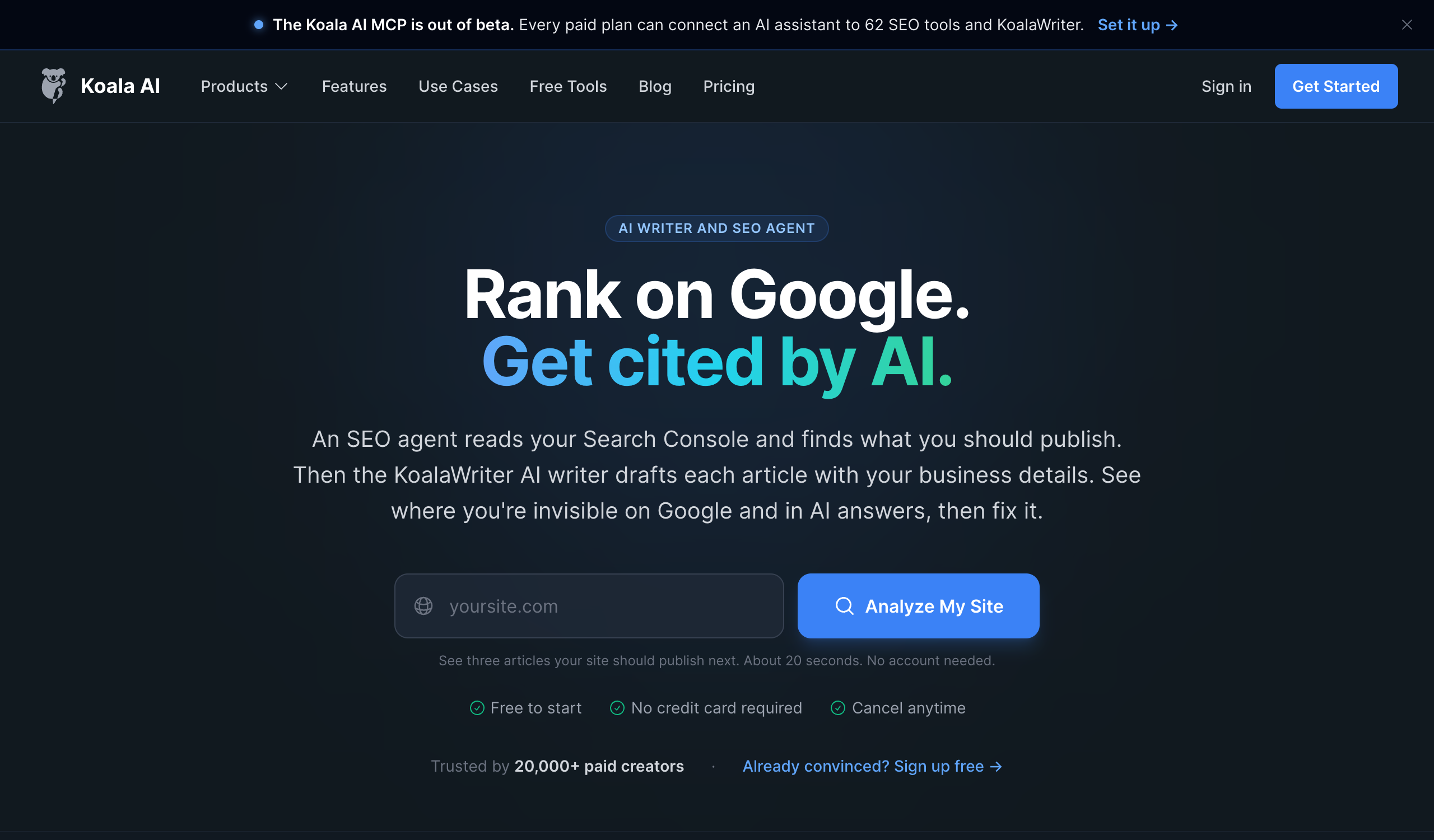
KoalaWriter is the writer built specifically for ecommerce work. It ships dedicated modes for single-product reviews, Amazon product roundups that auto-build comparison and pricing tables, and YouTube-to-article conversion, and its SEO agent reads your Search Console to tell you which articles to publish next and where you are invisible in both Google and AI answers. Output lands in clean, publish-ready formatting with real-time data and internal links already placed, which is why affiliate and content-led stores reach for it. It is trusted by 20,000+ paid creators and starts at $25 a month on the Starter plan, with higher tiers scaling article volume. For a store that monetizes buying guides and comparison content, that feature set lands closer to the real work than a general brand-voice suite.
Jasper
Jasper is a brand-voice marketing suite more than a product-copy tool. It stores one brand profile and 50-plus templates, then its AI agents spin that voice into Meta and TikTok ad copy, email sequences, landing pages, and product descriptions at campaign volume, with team workflows and brand governance built for marketing departments. It holds 4.7 out of 5 across 1,270+ G2 reviews, so the breadth and polish are real. Pricing starts at $69 a month on the Pro plan, with Business pricing on request. The catch for a store is specialization: it realistically handles a handful of descriptions at a time, and reviewers consistently note the output can sound robotic without a solid editing pass, so it earns its keep on multi-channel campaigns more than on a 3,000-SKU catalog.
The catalog-scale version of this work is where AI content earns its place, and where it can go wrong. When MT Pool Distributors lost 65% of its organic traffic after Google’s December 2024 spam update, the recovery ran on an AI-assisted content workflow with human oversight that rebuilt duplicated descriptions across thousands of SKUs. The same pattern powers B2B catalogs; see how it maps to distributor data in our guide to AI deployment for B2B ecommerce.
Content Optimization
Optimization tools score a draft against what already ranks and tell you what to add. For ecommerce, they matter especially on category pages and the informational blog content that feeds your product pages with internal links and topical authority. The risk in this category is over-trusting the score, so read each tool with that in mind.
Surfer SEO

Surfer runs the widest optimize-and-track loop of the three. Its real-time Content Editor scores a draft against the live SERP as you write, grading word count, headings, images, and the exact terms the top pages use, so a writer can see whether a category page covers a topic the way Google already rewards. Around it sit a SERP Analyzer, keyword and cluster research, internal-linking automation, an AI writer, and AI Search Analytics that tracks mentions in ChatGPT, Gemini, and Claude. It holds 4.8 out of 5 from 539+ G2 reviews, and independent tests put its score correlation to rankings above Frase’s. Plans start at $49 a month, with higher tiers adding AI Search Analytics and extra seats.
Clearscope
Clearscope is the premium editorial grader, and the one content tool editors genuinely enjoy using. It builds a term-coverage and readability report from the live SERP, grades a draft against it with a clean letter score, and now tracks whether Google, ChatGPT, Gemini, and Claude mention you or a competitor, so a team of writers hits one consistent quality bar across every page. Its 9.9 out of 10 G2 support rating (against Surfer’s 9.4) is the detail reviewers keep citing: onboarding and help are best in class. It starts at $129 a month on Essentials with unlimited users, so it scales cleanly across a content team without per-seat math.
Frase
Frase is the fastest path from a search query to a finished brief. Point it at a keyword and it pulls the ranking pages, extracts their headings and the questions people ask, and assembles an outline and a research brief in seconds, then its editor and AI writer draft against that outline. The 2026 Starter tier now bundles AI-answer-engine tracking, so even a budget team can see whether its pages surface in AI results. It starts at $39 a month for ten articles and scales to Professional and Scale for higher volume, which keeps it the cheapest serious entry in this category. The honest weak spot is its optimization score: independent tests put its correlation to rankings near 0.1, well below Surfer’s.
Optimization done for both traditional and AI search surfaces is what moved the needle for Garrett Metal Detectors: after a migration recovery, blog and product content was rewritten by audience segment and formatted to appear in both Google and AI-driven results.
Content Strategy and Gap Analysis
Strategy tools decide what to write before anyone optimizes a word. For a catalog, that means mapping the informational topics and buying-stage questions that pull discovery-stage shoppers toward product and collection pages. Skipping this step is why a store blog can publish for months and still rank for nothing.
MarketMuse
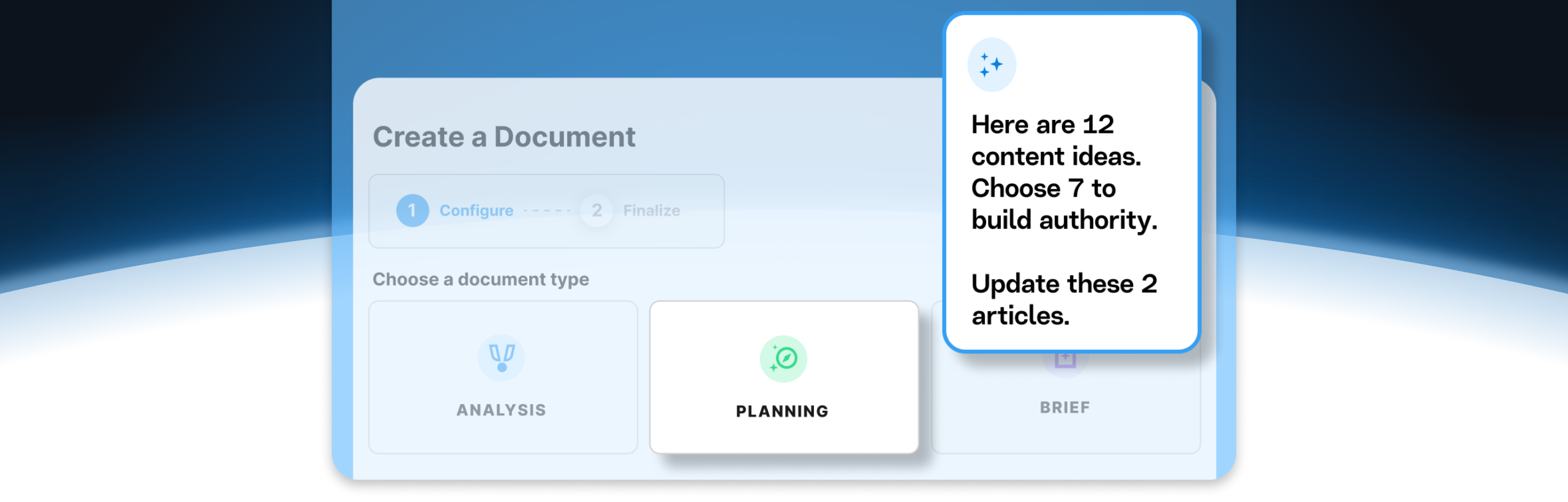
MarketMuse works a level above page grading. Its patented topic-modeling engine scores how completely your domain covers a subject and assigns a Topic Authority score that predicts your realistic chance of ranking, then its inventory analysis crawls everything you have published and flags the gaps, the thin pages, and the clusters worth building next. For a catalog, that means it tells you which buying-guide and category topics to own before a writer opens a document, and which existing pages a refresh will lift fastest. There is a free tier (10 queries a month) to test it; paid Optimize, Research, and Strategy plans moved off public pricing and start in the low hundreds a month. The payoff is real for teams that publish on a schedule and have to decide where effort goes.
Scalenut
Scalenut folds planning, writing, and AI-search tracking into one seat. Its Cruise Mode turns a keyword into a researched, SERP-informed long-form draft in about five guided steps, its keyword planner clusters a topic into a publishing roadmap, and its built-in GEO tracker shows whether your pages get picked up by AI answers, so a lean team covers strategy and execution from a single login. It is used by teams at Microsoft, NVIDIA, and Zoho, and starts at $59 a month ($21 on annual billing), which undercuts running a separate grader, writer, and tracker. The trade-off is the one every one-click writer carries: the first draft is a starting point, so a human pass for brand voice is non-negotiable before it ships.
A disciplined cluster strategy is what turned organic search into a growth channel for You Make Candy: four interconnected content clusters, with evergreen questions formatted for AI-driven results and People Also Ask, lifted sessions 104% year over year and pushed search impressions from roughly 75,000 to over 580,000.
Technical SEO Automation
The newest category carries the biggest stakes for large stores: tools that apply changes directly to your live pages. On a catalog with thousands of templated pages, the bottleneck is rarely knowing the fix; it is applying the same approved fix across every page. These tools close that distance, which also makes them the highest-impact and highest-risk entries on the list.
Alli AI
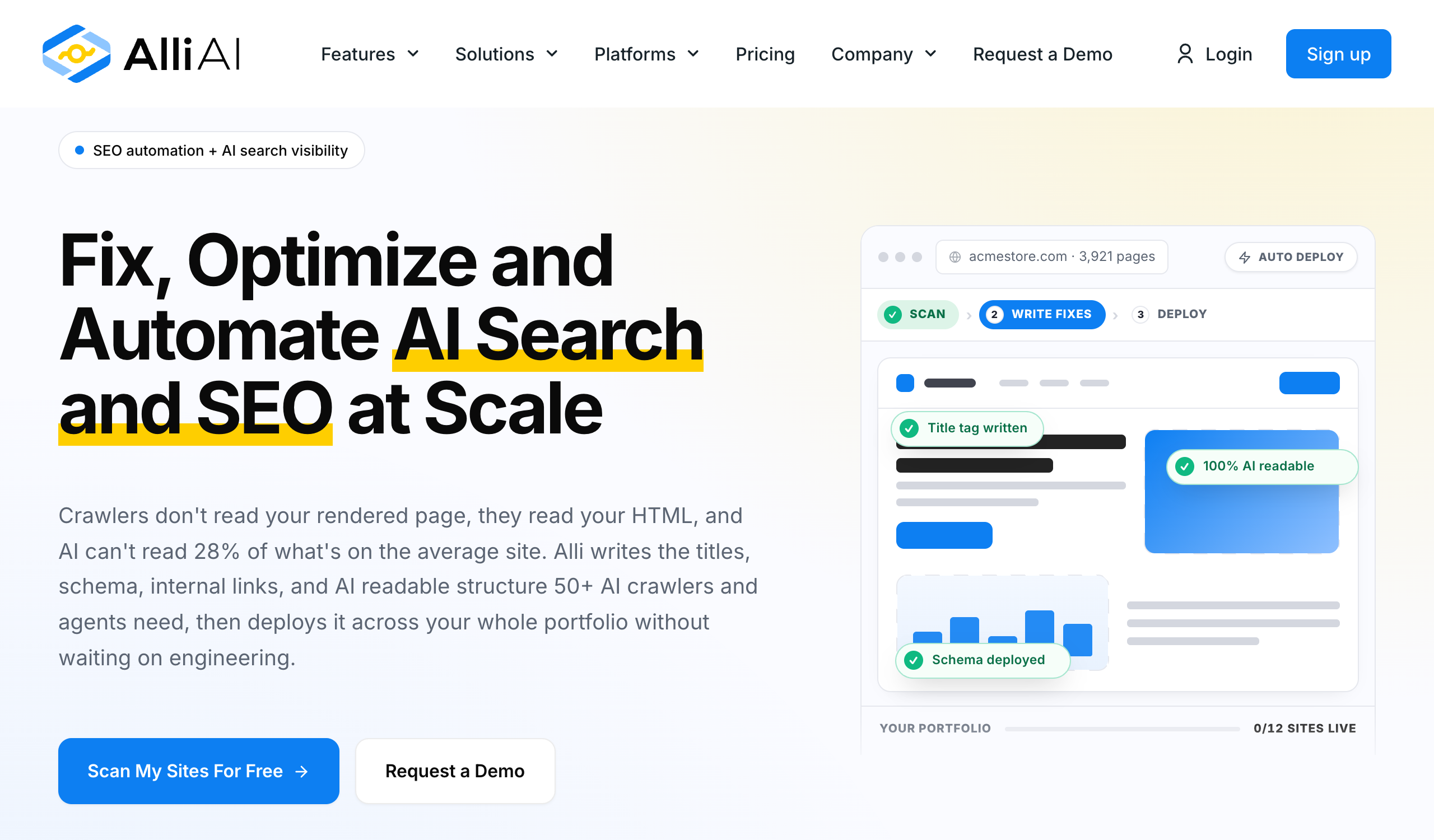
Alli AI exists to get approved SEO work live without waiting on a developer. You install one JavaScript snippet or a CMS integration, and from a dashboard you write and deploy title tags, meta descriptions, header structure, internal links, and schema across a whole template at once, with every change staged for approve-or-reject before it ships. For a 4,000-page catalog where the same fix needs to reach every product page, that turns a multi-sprint dev ticket into an afternoon. It starts at $249 a month for five sites on the Business plan, with Agency and Enterprise tiers above. The honest catch, flagged repeatedly by users: because the changes are injected through the snippet, they disappear the moment you cancel, so you are effectively renting your optimizations.
Ryze AI
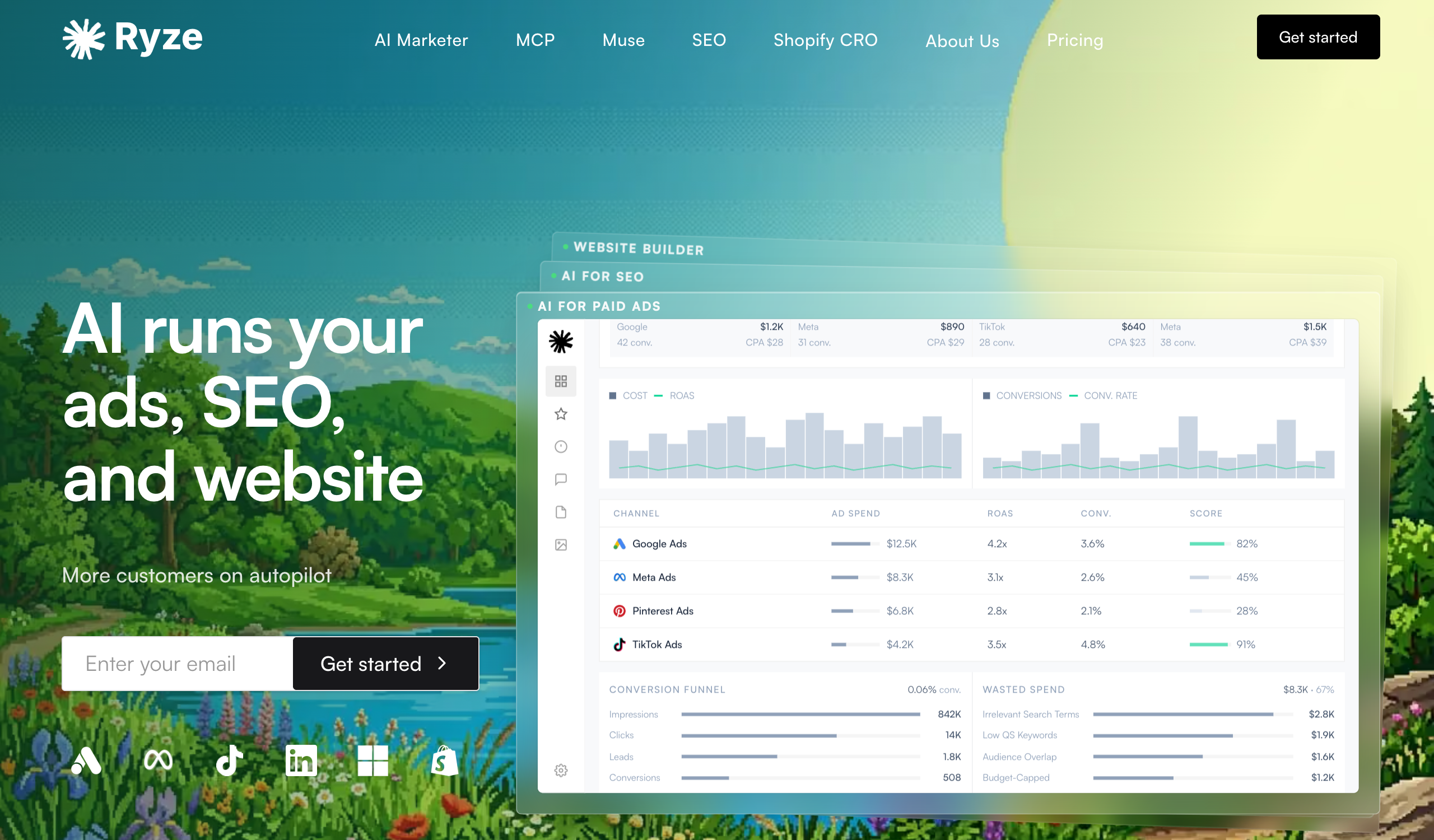
Ryze is built to close the loop other SEO tools leave open: it finds the problem and then fixes it. It connects to Search Console, your analytics, and your CMS, runs a continuous audit, and applies title, meta, schema, internal-link, and redirect fixes to the live site with your sign-off, all while tracking whether you get cited in ChatGPT and Perplexity and publishing roughly ninety articles a month. One flat price covers the whole loop, which is why lean teams with no in-house SEO run it as an autopilot. It costs $129 a month flat on the SEO plan. The caveats are fair: it is an execution layer without a research database of its own, so a serious SEO still pairs it with Semrush or Ahrefs, and its strongest numbers are vendor-published, so measure against your own analytics before you trust them.
Full-Suite Platforms
Sometimes one platform replaces the stack. Full-suite tools combine keyword research, rank tracking, backlinks, site audits, and content tools under a single login, which is efficient for teams that would otherwise juggle five subscriptions. The trade-off is paying for breadth you may not use.
Semrush
Semrush is the widest all-in-one data platform in the category, the tool a serious SEO team opens first every morning. It carries the largest keyword and backlink databases, daily position tracking across locations and devices, full site audits, and competitor analysis, and over the last two years it has bolted on an AI layer: the ContentShake writer, a Copilot advisor that reviews every project and surfaces prioritized weekly fixes, and AI-visibility tracking for ChatGPT and AI Overviews. For an ecommerce team that needs research, tracking, and reporting under one login, nothing else covers this much ground. Core plans start around $139.95 a month, with a restructured Pro+ tier and AI add-ons like ContentShake at roughly $60 a month layered on top.
Ahrefs with Brand Radar
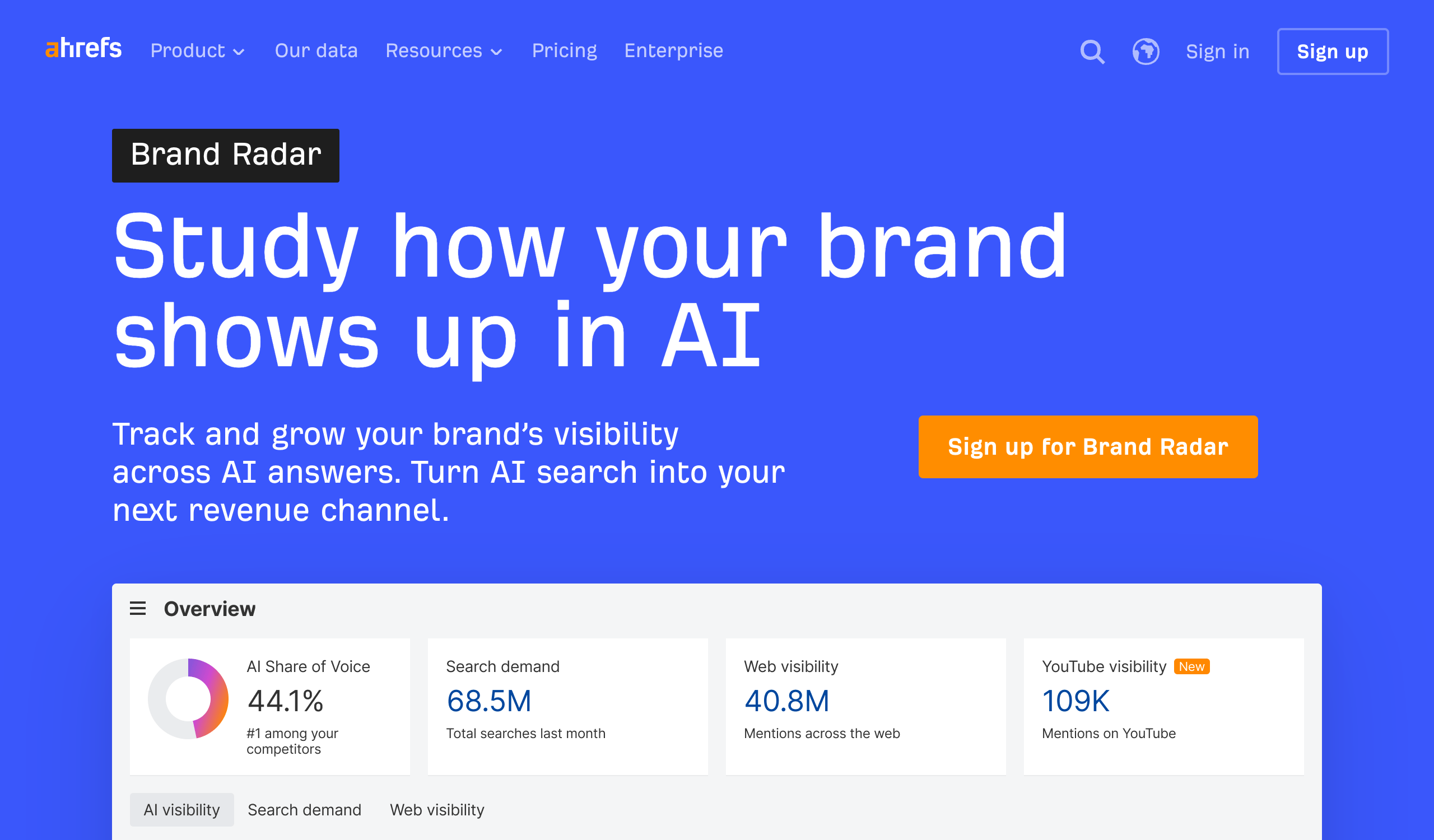
Ahrefs stays the reference tool for backlinks and keyword data, and its newer Brand Radar extends that strength into AI search. The standout is the AI Visibility Index: roughly 525 million prompts pre-collected and modeled on real Google searches, which you can query instantly for any brand, competitor, or topic, with sentiment, buyer-journey funnel stages, and AI-bot traffic analytics, so you get a read without waiting weeks for a tracking project to accumulate data. Custom-prompt daily monitoring sits alongside it. Brand Radar custom prompts start at $50 a month on top of an Ahrefs plan, with the full AI Visibility Index running $199 a month per platform. The honest limit is that its modeling works at the keyword level, a notch less precise than a prompt-level tracker.
AI Search Visibility: AEO and GEO Tools
This is the category general SEO lists miss, and the one with the fastest-growing stakes for ecommerce. Answer engine optimization tools track whether your products get cited inside ChatGPT, Perplexity, Gemini, and Google AI Overviews, a surface where a ranking position does not exist and a citation is the whole game. With AI referrals to retail climbing, this is now a measurable channel worth its own tool. For the strategy behind the tooling, read our guides to answer engine optimization and SEO for AI-based search engines.
Profound

Profound is the enterprise AI-search platform, and the one tool that measures prompt volume, the real AI-search demand behind a topic, so you can optimize for the questions people put to an AI. Alongside that it runs Agents, a read-and-write engine that drafts AI-optimized content in your brand voice, tracks citations across up to nine answer engines, and plugs into Cloudflare, Fastly, and Vercel to see how AI bots crawl you. It has raised $58.5 million from Khosla, Kleiner Perkins, NVIDIA, and Sequoia, and counts Ramp, MongoDB, Figma, and Walmart among its customers, which tells you who the product is built for. A free 7-day trial exists; paid pricing moved behind custom quotes in 2026.
Peec AI
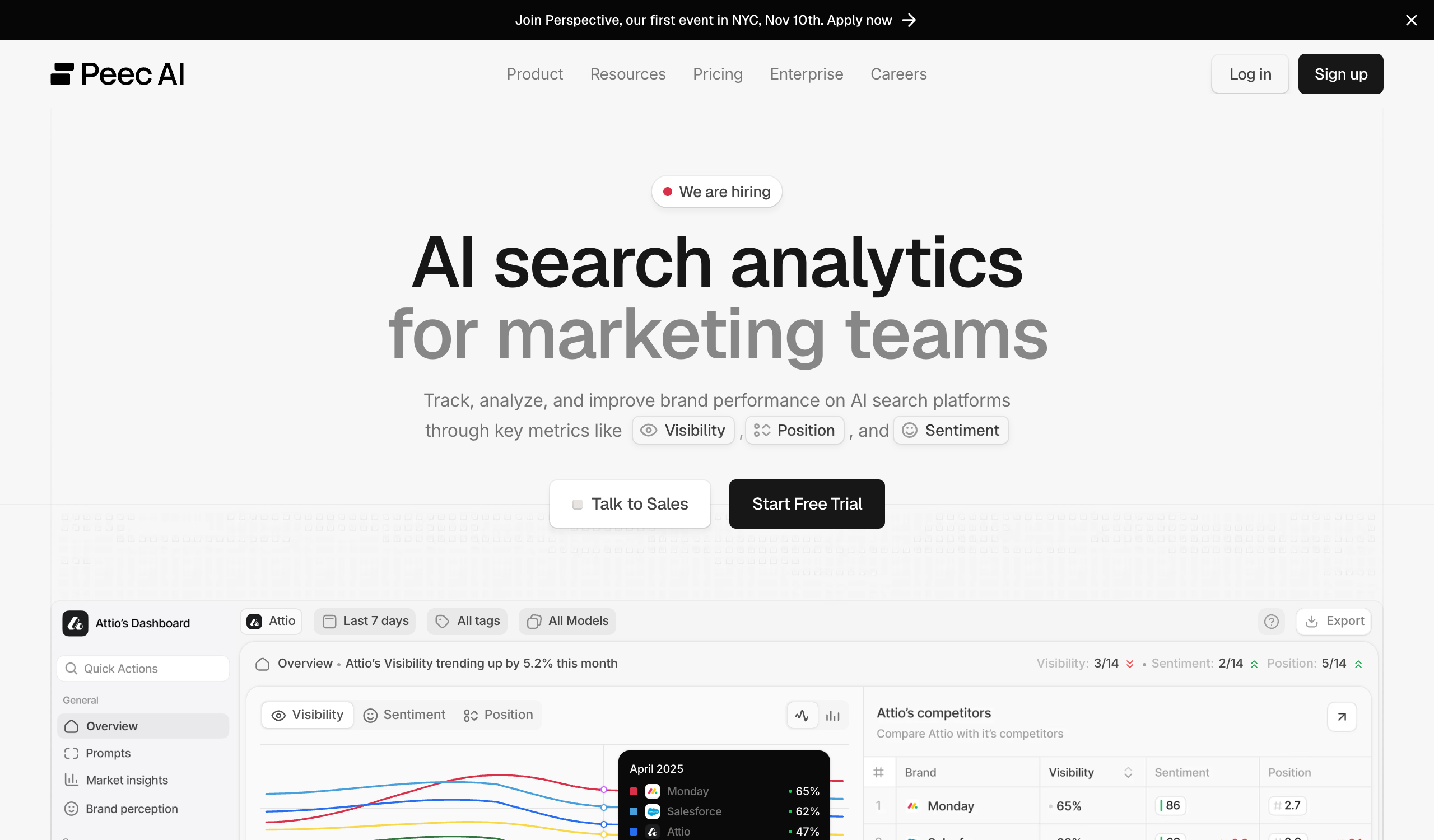
Peec AI gives you Profound’s prompt-level depth at a mid-market price. Its dashboard tracks visibility, ranking, and sentiment across ChatGPT, Perplexity, Claude, Gemini, and AI Overviews, and the detail that sets it apart is source attribution: it shows the exact pages shaping each AI answer about you, so you know which content to strengthen to win the citation. Daily refreshes, competitor benchmarking, and strong multi-language and European coverage make it the practical pick for an agency watching several brands at once. It starts at $95 a month on the Starter plan, scaling to Pro and Advanced for more prompts and seats. The honest gap is execution: it measures and benchmarks, so the content work to close a gap stays on your team.
Otterly.ai
Otterly is the cheapest credible way to find out whether AI engines mention you at all. You give it the prompts you care about and it monitors ChatGPT, Gemini, Copilot, and Perplexity for your brand, your products, and your competitors, with position and sentiment on each, from $29 a month on the Lite plan. For a small store testing whether answer engines even know it exists, that is the lowest-friction entry on the market. The ceiling is real: Lite tracks 15 prompts with shallow source analysis, so a growing brand outgrows it, and it reports where you stand while the fixing stays with you.
All three track brand mentions in general AI answers; none yet track product visibility inside AI shopping engines. For that, newer ecommerce-specific trackers like Goodie and Scrunch watch whether your SKUs surface in Amazon’s Rufus and Walmart’s Sparky, the shopping assistants that increasingly decide which products a buyer sees first. The category is young, but for a store whose demand runs through marketplaces, it is the visibility layer worth watching next.
AI visibility is already a measurable traffic line. When Optimum7 built brand hubs and optimized content for AI-assisted discovery at Pool Depo, AI-driven referral traffic and online sales both moved in the first months, against established competitors the store could not outrank the slow way. This is the same discovery change we cover in why ChatGPT might be the next Amazon.
Two Things the Tool Lists Do Not Tell You
Every vendor list sells tools as pure upside. Two realities decide whether the stack you buy protects your revenue, and neither shows up in a feature comparison.
Rankings can rise while clicks fall
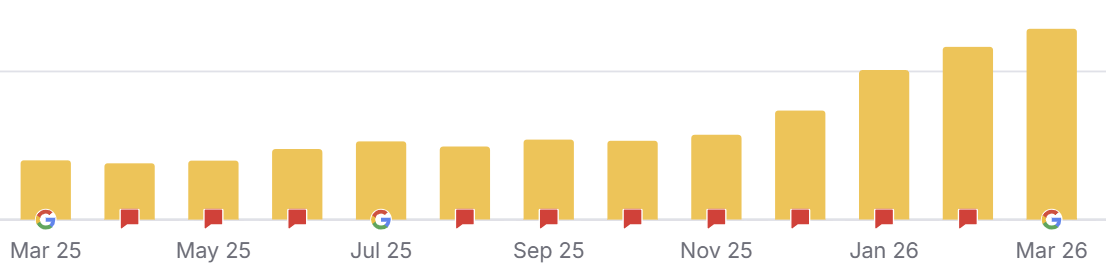
A rank tracker can report a banner year while your traffic quietly erodes. One Optimum7 client, an industrial generator manufacturer, grew top-three rankings 222% and impressions 28% over a year, yet organic clicks fell 19% and sessions fell 26% in the same period. The cause was AI click interception: AI Overviews and AI Mode answered the query before the user clicked anything. If your tooling only tracks rank, it will tell you everything is fine while an AI answer eats the click. That is why an AI-visibility tool belongs in the stack alongside a rank tracker.

| Question | Rank trackers | AI-visibility tools |
|---|---|---|
| Where you appear | Position in Google results | Citations inside ChatGPT, Perplexity, AI Overviews |
| What it misses | Clicks lost to AI answers above the results | Traditional ranking movement and backlinks |
| Fails when | Rankings climb but AI answers intercept the click | Used alone, with no traditional SEO baseline |
Ungoverned AI content is a penalty risk
The tool is rarely the problem; unedited output at scale is. Google’s December 2024 spam update cut traffic for sites that had published thin, duplicative content, and across practitioner communities the consistent lesson is that one-click AI articles pushed live without human review tank rankings and raise bounce rates. On a catalog, the specific danger is thousands of near-identical AI descriptions reading as duplicate content. The fix is a governance step: generate at scale, then edit, differentiate, and fact-check before publishing, which is exactly the human-oversight layer that carried the MT Pool recovery.
How to Choose by Platform and Store Size
The right stack is the two or three tools that match your catalog size, your platform, and where you are losing visibility. Use the guide below to match a profile to a starting stack, then add an AI-visibility tracker once AI referrals show up in your analytics. If you are still choosing a platform underneath all of this, start with our breakdown of the best ecommerce platform for selling online.
| Store profile | Product copy | Optimization / strategy | AI visibility |
|---|---|---|---|
| Small Shopify store (under ~500 SKUs, under $150/mo tooling) | Shopify Magic or ChatGPT ($20/mo) for drafts | Frase ($39/mo) for briefs and optimization | Otterly.ai ($29/mo) for a baseline |
| Mid-market (BigCommerce / Shopify Plus) (~500 to 5,000 SKUs) | Describely ($0.75/product) for bulk catalog copy | Surfer ($49/mo), plus Scalenut or MarketMuse for clusters | Peec AI ($95/mo) for competitive tracking |
| Enterprise / custom build (5,000+ SKUs) | Describely with the ChatGPT API, plus Alli AI for technical rollout | Clearscope ($129/mo) and Semrush for the full stack | Profound for enterprise AI-answer tracking |
Whatever the profile, the sequence is the same: fix product copy first, add optimization and strategy as you publish, automate technical work once the catalog is large enough to need it, and layer in AI-visibility tracking the moment AI referrals appear. If you would rather have the stack chosen and run for you, Optimum7’s ecommerce SEO services build exactly this.
Frequently Asked Questions
What is the best AI tool for ecommerce SEO?
There is no single best tool, because the job decides the pick. For bulk product descriptions on a large catalog, Describely leads; for content optimization, Surfer or Clearscope; for content planning, MarketMuse or Scalenut; for tracking visibility in AI answers, Profound, Peec AI, or Otterly by budget. A store usually needs two or three tools matched to catalog size, and no single platform does all six jobs well.
Can AI write product descriptions without hurting SEO?
Yes, with a governance step. AI can generate unique descriptions across thousands of SKUs, but output pushed live unedited creates duplicate, thin content that Google’s spam updates target. The working pattern is generate at scale, then edit, differentiate, and fact-check before publishing. That human-oversight layer is what let MT Pool Distributors recover and grow revenue after a penalty.
What AI tools track whether my products appear in ChatGPT and AI Overviews?
Dedicated answer engine optimization tools do this. Profound covers enterprise needs, Peec AI suits agencies and multi-brand teams at around $95 a month, and Otterly offers a budget baseline near $29 a month. Ahrefs Brand Radar also reads AI-visibility signals if you already use Ahrefs, and newer ecommerce trackers like Goodie watch product visibility inside Amazon’s Rufus and Walmart’s Sparky.
Do AI SEO tools work for small Shopify stores?
They do, at a smaller scale. A small store can run Shopify Magic or ChatGPT for drafts, Frase at $39 a month for briefs and optimization, and Otterly at $29 a month for an AI-visibility baseline, without an enterprise platform. Back up existing descriptions before any bulk job, since some native description apps overwrite live copy in place.
Will AI-generated content get my store penalized?
Not for being AI-generated. Google penalizes thin, duplicative, unhelpful content regardless of how it was made. The risk with AI is volume without oversight: thousands of near-identical descriptions reading as duplicate content. Edited, differentiated, accurate AI content that genuinely helps the shopper is safe, and is what the tools on this list are meant to produce.
About the author: Duran Inci is the CEO and Co-Founder of Optimum7, an ecommerce development and digital marketing agency. He helps mid-market and enterprise brands scale revenue through conversion optimization, SEO, and custom ecommerce solutions.