
eCommerce Migration Services and Replatforming Agency
Optimum7 is a U.S.-based eCommerce migration agency. We have replatformed 1,000+ stores across Shopify, BigCommerce, Magento, WooCommerce, Volusion, and 10 more platforms, with full SEO preservation, zero data loss, and no revenue interruption.
From platform migration and data migration to a full replatform, we run the technical, SEO, and project-management side of the move, so your rankings and revenue hold through launch.








An eCommerce-only agency since 2007.
Migrations we handle, platform to platform
Pick where you are now and where you want to go. Every route below is a move we have run before, with SEO and revenue protected end to end.
 See the migration
 3Dcart to BigCommerce migration
See the migration
3Dcart to BigCommerce migration
See the migration
 3Dcart to Shopify migration
See the migration
BigCommerce to Shopify migration
3Dcart to Shopify migration
See the migration
BigCommerce to Shopify migration
 See the migration
Episerver to BigCommerce migration
See the migration
Episerver to BigCommerce migration
 See the migration
Magento Enterprise to Shopify migration
See the migration
Magento to BigCommerce migration
See the migration
Magento to Shopify migration
See the migration
Shopify to BigCommerce migration
See the migration
Magento Enterprise to Shopify migration
See the migration
Magento to BigCommerce migration
See the migration
Magento to Shopify migration
See the migration
Shopify to BigCommerce migration
 See the migration
Miva to BigCommerce migration
See the migration
Miva to Shopify migration
See the migration
Miva to BigCommerce migration
See the migration
Miva to Shopify migration
 See the migration
OpenCart to Shopify migration
See the migration
OpenCart to Shopify migration
 See the migration
Salesforce Commerce Cloud to BigCommerce migration
See the migration
See the migration
Salesforce Commerce Cloud to BigCommerce migration
See the migration
 Salesforce Commerce Cloud to Shopify Plus migration
 See the migration
SAP Hybris to BigCommerce Enterprise migration
See the migration
SAP Hybris to Shopify Plus migration
See the migration
SAP Hybris to BigCommerce Enterprise migration
See the migration
SAP Hybris to Shopify Plus migration
 See the migration
Volusion to BigCommerce migration
See the migration
Volusion to Shopify migration
See the migration
See the migration
Volusion to BigCommerce migration
See the migration
Volusion to Shopify migration
See the migration
 Volusion to WooCommerce migration
 See the migration
VTEX to BigCommerce migration
See the migration
VTEX to Shopify Plus migration
See the migration
VTEX to BigCommerce migration
See the migration
VTEX to Shopify Plus migration
 See the migration
Wix to BigCommerce migration
See the migration
Wix to Shopify migration
See the migration
WooCommerce to BigCommerce migration
See the migration
WooCommerce to Shopify migration
See the migration
Wix to BigCommerce migration
See the migration
Wix to Shopify migration
See the migration
WooCommerce to BigCommerce migration
See the migration
WooCommerce to Shopify migration
No migration matches that combination yet. Ask us about your move →
How to decide, and where to move
Check whether your current platform is holding the business back, then match your needs to the right target.
Six signs the platform is the constraint. When two or more describe your store, you have outgrown it.
Your catalog is hard to export, or too messy to migrate cleanly.
The platform cannot support the custom features your store needs.
Connections to your ERP, PIM, or marketing tools keep failing.
You have hit the limit of what the platform lets you optimize.
Fees and maintenance no longer match what the platform returns.
You are preparing for growth the current platform cannot handle.
Where to move
The best eCommerce platform for you depends on your catalog, your integrations, and how much you build in-house. Where each platform fits:

Fastest to launch, with the deepest app ecosystem, for teams that grow through apps rather than custom code.

Feature-rich and headless-ready, with strong native B2B, for stores that need advanced functionality without heavy development.
 Adobe Commerce (Magento)
The most customizable, built for large, complex catalogs and deep B2B, for enterprise stores with the resources to run it well.
 WooCommerce
Commerce inside WordPress, where content and catalog live together, for content-led stores already built on WordPress.
A general guide; your exact fit depends on your catalog, integrations, and goals. A free migration evaluation maps them to the right platform.
Products, customers, orders, and SEO carried across in one controlled move, with a checkpoint at every stage.
How we migrate without losing your rankings
Most post-migration traffic loss traces to broken redirects, changed URLs, or lost metadata, all of it avoidable.
Organic traffic through a migration
Rankings hold through launch, then climb
URL inventory and mapping
Every live URL exported and crawled with Screaming Frog, ranked by organic traffic.
One-to-one 301 map
Each old URL gets a single-hop 301 redirect. No chains, no dead ends, live at cutover.
On-page signal carryover
Titles, metadata, canonicals, structured data, and alt text move across unchanged.
Sitemap and crawl control
XML sitemap resubmitted; robots.txt checked so the new store is never blocked.
Staged cutover, parity checks
Product, customer, and order counts verified field by field on a staging clone first.
30-day post-launch watch
Index coverage, redirects, and top URLs tracked against baseline, so dips are caught early.
Migrations that grew the business
Replatforms where the move preserved SEO and lifted revenue, traffic, and conversions.
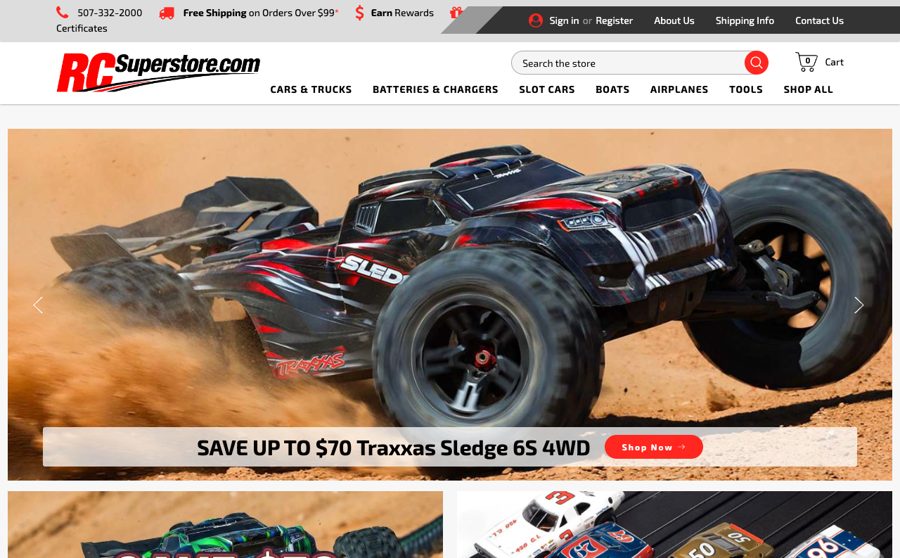
Volusion → BigCommerce
RC Superstore
A toys and hobbies retailer moved off Volusion with 8,720 products and 94,265 customers migrated intact, then grew on organic search.

Volusion → BigCommerce
Arlyn Scales
Replatformed to a BigCommerce back end with a WordPress front end, paired with an SEO program that grew traffic and conversions.

Volusion → BigCommerce
EcoEnclose
Migrated to BigCommerce with a custom product-view build that doubled revenue and multiplied organic leads.
Two decades of eCommerce migrations
Optimum7 has been eCommerce-only since 2007, with one framework refined across every move.
Everything we migrate and rebuild
A move is more than a product export. Every asset that makes your store work arrives on the new platform, tested against the original.
- Products and catalog
- Variants, option sets, and bundles, with metafields mapped and SKUs kept stable so ERP and OMS links hold.
- Customers and segments
- Accounts, customer groups, and B2B price lists. Passwords reset securely on first login.
- Orders and history
- Full order history, line items, and refunds, with parity reports confirming counts match the source.
- Content and blog
- Pages, articles, and media, with in-content image URLs updated to the new store.
- URLs and redirects
- A one-to-one 301 map so every old link resolves to the right new page in a single hop.
- SEO assets
- Titles, meta descriptions, canonicals, structured data, and alt text carried across.
- Integrations
- ERP, PIM, OMS, payment, shipping, tax, reviews, and subscriptions reconnected and tested.
- Custom functionality
- Non-standard features rebuilt and verified against the original behavior.
- Analytics
- GA4, Consent Mode, server-side tagging, and conversion tracking carried over so reporting does not go dark.
The parts other agencies drop, rebuilt by hand
We use Matrixify, Cart2Cart, and LitExtension for bulk moves, and custom ETL scripts for the fields those tools flatten. When a Magento attribute model becomes Shopify metafields, or a URL structure has to change, our custom development team translates it by hand so navigation, indexing, and downstream systems keep working.
eCommerce migration, explained
Short, plain answers to what buyers ask before they commit to a move.
What is an eCommerce migration?
An eCommerce migration moves your store from one platform to another, for example Volusion to BigCommerce or Magento to Shopify Plus. It carries the catalog, customers, orders, content, and SEO equity across, so the store your customers know keeps working on new software.
How is replatforming different?
Migration is the data-transfer step. Replatforming is the full move: data, design, functionality, and integrations rebuilt on the new platform. A redesign changes only the look, and can happen with or without a platform change.
When should you replatform?
When your platform is what caps growth: data you cannot get at, features it will not support, integrations that keep breaking, or fees that outrun the return. If two or more apply, you have outgrown it.
Eight stages, nothing left to chance
Each stage clears a checkpoint before the next begins, so the catalog, customers, SEO, and custom functionality all arrive intact.
Discovery and requirements
We map your catalog, integrations, custom features, and traffic before anything moves.
Platform and data audit
Every product, URL, redirect, and dependency on the current store is inventoried.
Store build and design
We build the theme, information architecture, and templates on the target platform.
Data migration
Products, categories, customers, orders, content, and blog move with structure intact.
Custom functionality rebuild
Non-standard features are re-engineered on the new platform and tested against the old.
SEO and performance
The 301 redirect map, metadata, structured data, and Core Web Vitals are locked in.
QA and launch
Full pre-launch QA and a staged cutover scheduled for a low-traffic window.
Post-launch monitoring
Indexation, redirects, rankings, and errors are tracked at 7, 30, and 90 days.
Beyond the migration
A new platform is the starting point. These services turn it into more traffic and more revenue.
eCommerce SEO
Protect rankings through the move and grow them after, with technical and content SEO built for online stores.
Conversion Rate Optimization
Turn the new platform into more revenue with testing and CRO tuned to how your customers buy.
eCommerce Development
Custom development and design that rebuilds and extends your store with the functionality your catalog needs.
We tried to migrate from Volusion on our own and it was a disaster. Optimum7 handled our data migration to BigCommerce in 90 days, kept our Google traffic, and increased our organic search ranking after the move.
eCommerce migration questions
Most mid-market migrations land between $15,000 and $50,000. Small-catalog Shopify-to-Shopify moves can start around $5,000, and complex enterprise replatforms with custom integrations, large catalogs, and multi-store setups run $150,000 and up. The biggest cost drivers are catalog size, custom functionality, and the number of integrated systems. Optimum7 gives you a fixed scope and price before the project starts.
A standard mid-market migration takes 6 to 12 weeks from kickoff to launch. Catalogs under 500 products can be ready in 4 to 6 weeks. Enterprise migrations with custom functionality, large catalogs, or multiple integrations run 4 to 6 months. Every project includes a fixed timeline as part of the plan.
Not if the migration is done correctly. Most post-migration ranking drops come from broken redirects, lost metadata, or changed URL structures. Our process preserves every 301 redirect, page title, meta description, image alt text, structured data element, and canonical tag, which is why our migrations typically hold or improve organic traffic within 30 to 90 days.
Every old URL gets a one-to-one 301 redirect to its new location in a single hop. We map them from a full crawl of your live site and prioritize any URL with recent organic traffic, so links, rankings, and bookmarks keep working after the move.
Accounts, order history, and customer groups move across. Passwords are stored as one-way hashes that cannot be transferred between platforms, so customers set a new password through a secure reset on their first login. You keep every customer record.
A clean migration usually holds traffic through launch. When there is a temporary dip, most stores recover to baseline within 30 to 90 days, and faster when redirects and metadata are handled correctly from day one.
The new store is built and fully tested before go-live, so the switch itself is fast. Any downtime is planned, kept short, and scheduled for low-traffic windows, and you know the exact window in advance.
A complete migration includes platform setup, theme migration or redesign, full data migration of products, customers, orders, and reviews, custom functionality rebuilds, third-party integrations, payment gateway configuration, SEO preservation covering redirects, metadata, and structured data, pre-launch QA, post-launch monitoring, and team training on the new platform.
Yes. Every migration starts with a pre-migration SEO baseline covering rankings, traffic, indexed URLs, and backlink profile, then runs post-migration audits at 7, 30, and 90 days. We monitor for indexation issues, broken redirects, ranking drops, and crawl errors, and resolve them within the migration warranty period at no extra cost.
A well-planned migration is low risk and often improves site speed, functionality, and conversions. The risk comes from poor planning: data loss, broken redirects, incompatible apps, and design that does not carry over. Working with a team that runs a proven process and sets up 301 redirects protects your SEO value and your revenue during the move.
Optimum7 migrates between every major platform, including Shopify, Shopify Plus, BigCommerce, Magento, WooCommerce, Volusion, Wix, Salesforce Commerce Cloud, SAP Hybris, VTEX, Miva, OpenCart, and custom carts. We build an individual migration plan for your source and target platform.
Look for a team that names its SEO-preservation method, including 301 mapping, metadata carryover, and staged cutover, has migrated your specific platform pair before, rebuilds custom functionality instead of dropping it, and monitors traffic after launch. Ask for case studies with real post-migration results.
Optimum7 offers a Free Migration Evaluation: we review your current store, catalog, integrations, and goals, then recommend a target platform and scope. There is no commitment. After the evaluation you can move ahead with a full data migration or replatforming project.
Ready to replatform without losing traffic or revenue?
Start with a free migration evaluation. We review your store, recommend the right platform, and scope the move with a fixed timeline and price.