customer opens ChatGPT and types “find me waterproof hiking boots under $150 in a wide fit, in stock, ships by Friday.” The model does not open ten tabs. It reads structured data, shortlists a handful of products, and in some flows completes the purchase. Your store either appears in that shortlist with accurate price, inventory, and shipping data, or it does not exist for that shopper.
This is agentic commerce, and it is already moving real revenue. Agentic commerce optimization is the work of getting an AI agent to read your catalog, trust your data, and act on it, and polished marketing copy barely enters into it. Has your product feed ever been built for a machine that shops on a human’s behalf? For stores that have never built their catalog for machines, the honest answer is no.
The full picture runs from the ground up: what agentic commerce is, how an AI agent actually buys, the three checkout protocols you will hear about (ACP, UCP, and AP2), the product data and schema work that gets you shortlisted, the platform-specific build steps for Shopify, BigCommerce, and Magento, and a 90-day plan to start. Every recommendation is a build decision an ecommerce team can execute.
What Agentic Commerce Is, and Why It Changes Who Finds Your Products
The buyer in agentic commerce is a model acting for a person, and it never browses a category page. Someone asks ChatGPT, Perplexity, or Google’s AI mode to handle a purchase, and the agent does the searching, filtering, and shortlisting that a shopper used to do by hand. The person still decides, but they decide from a list the agent assembled, and that list is built from machine-readable data, with your homepage design playing no part.
You can see this in Google’s AI shopping surface already. A natural-language request returns a panel of real products with images, prices, star ratings, retailers, and one-line specs, all pulled straight from merchants’ structured data.

That single change rewrites product discovery. A traditional shopper lands on your site, reads your copy, and reacts to design, photography, and social proof. An agent never sees any of it the way a human does. It reads your product attributes, your prices, your stock status, and your structured data, then reasons about trade-offs against the shopper’s constraints. Accuracy and completeness beat persuasion, because the agent compares data fields and never feels the brand.
Three open standards now define how agents and stores talk to each other. The Agentic Commerce Protocol (ACP), released by OpenAI and Stripe, governs how an agent runs checkout against a merchant it does not own. Google’s Universal Commerce Protocol (UCP) covers discovery through post-purchase and ships with a store manifest. The Agent Payments Protocol (AP2) handles the authorization and payment layer with signed mandates. You do not need all three on day one, and later sections break down which does what.
How an AI shopping agent actually buys
An agent purchase runs through four moves, and your store can fail at any one of them. First it interprets the request, turning “wide-fit waterproof boots under $150, ships by Friday” into structured constraints. Then it shortlists candidates by reading product feeds, schema, and reviews, so products with complete, correct attributes make the cut and everything else is filtered out before a human sees it. Next it evaluates and recommends, weighing price, availability, shipping speed, and ratings, where stale inventory or a price that disagrees with your product page breaks trust. Finally it executes the purchase, either inside the agent through a checkout protocol or by handing the shopper to your own site to finish.
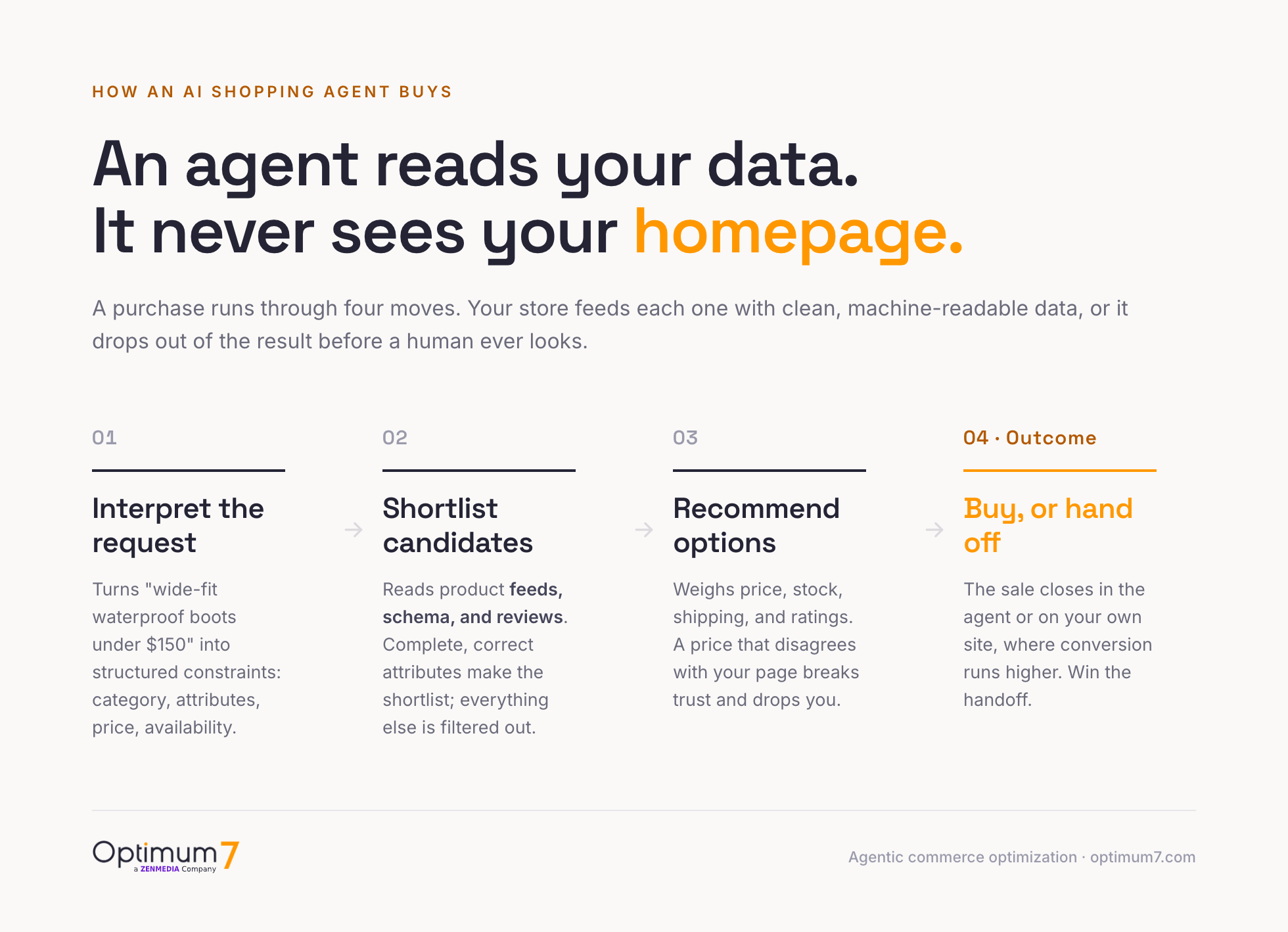
Read that sequence as a funnel built for a machine. The first two moves are a data problem, the third is a trust problem, and the fourth is a checkout problem. Agentic commerce optimization is the work of removing failure points at each stage, and the rest of this guide is organized the same way.
Why Agents Are Already a Live Revenue Channel
AI-referred traffic is exploding, and it is already landing sales. During the 2025 holiday season, traffic to US retail sites from generative AI tools grew 693% year over year, and 670% on Cyber Monday, according to Adobe Analytics. The channel was a rounding error a year ago, and the trend line is now near-vertical, which is the signal worth acting on before the volume arrives in full.
Adobe expects the surge to keep going. Its September 2026 holiday forecast projects AI traffic to US retail sites will rise a further 130% year over year from November through December, with the steepest day on Thanksgiving at 159%, followed by Black Friday at 95% and Cyber Monday at 88%. Each of those gains stacks on a base that already grew nearly sevenfold the year before.
Volume is only half the signal. Shoppers who arrive through an AI assistant come with intent the agent has already shaped, so they land ready to act. Stores an agent can read and trust capture that high-intent traffic, and that is where the sales growth is showing up first.
Forecasts for the near term point the same direction. Salesforce projects that 20% of all 2026 holiday ecommerce traffic will come from AI chat agents, and that one in three ecommerce sites will have a site-specific shopper agent live by Cyber Week. Retailers that already ran branded shopper agents grew holiday sales 6.2% in 2025, compared with 3.9% for those without one. Stores that are agent-ready are already separating from the field on holiday sales growth, and the lead compounds every quarter agent traffic climbs.
For a planning decision, the exact percentage is less important than the direction and the lead time. Building clean product data and a working checkout path takes weeks of engineering, so the stores that start now are the ones positioned when the traffic share doubles. A closer look at how AI is reshaping product discovery shows how fast the front door to ecommerce is moving from the search box to the chat box.
Agentic Commerce Optimization, Defined
Agentic commerce optimization is the practice of improving how AI shopping agents discover, understand, evaluate, and transact with your products. The term was coined in a 2026 Forbes piece that framed it around brand visibility and content. That framing is the starting point, and it stops short of the part that decides outcomes: the technical build.
Published guidance on getting recommended by AI usually names the requirements and leaves the implementation unwritten. It says to have rich structured data without showing the schema, to expose a product feed without defining the fields, and to support checkout without wiring the protocol. Agentic commerce optimization is where those requirements become engineering tickets. It spans four workstreams, and each one is an engineering build.
How it differs from SEO, AEO, and GEO
Agentic commerce optimization overlaps with answer-engine and generative-engine optimization, and it adds a layer neither of those has: the transaction. SEO earns a ranking so a person clicks. Answer engine optimization and generative engine optimization earn a mention inside an AI answer. Agentic commerce optimization has to do both of those and then let the agent act, which means your inventory, pricing, and checkout now carry the weight of ranking factors. The same structured-data discipline that powers how modern search works is the foundation here, extended from “be found” to “be bought.”
The Lesson From ChatGPT’s Retired Instant Checkout
One fact cuts through the noise in agentic commerce right now: a product that got pulled. In March 2026, OpenAI began moving in-chat Instant Checkout into dedicated retailer apps after a blunt finding: Walmart measured conversion as three times lower for products sold directly inside ChatGPT than for products that routed the shopper to the retailer’s own site to check out. The centralized in-chat purchase underperformed the handoff by a wide margin.
The protocol survived even though the product did not. Instant Checkout was the in-chat purchase experience; the Agentic Commerce Protocol underneath it is still open and still powers how agents talk to merchants inside ChatGPT apps. Why would AI shoppers convert worse in one study and better in another? Read that split carefully, because it resolves the apparent contradiction in the data. Studies that isolate in-chat ChatGPT sessions show weak sales, while the broader AI-referral channel keeps growing and converts once shoppers land on a store. Both are true: agents are excellent at sending high-intent shoppers to a store, and a store’s own checkout still closes the sale better than a purchase buried in a chat window.
For strategy, that points to a clear priority. Optimize so agents can discover, trust, and recommend your products, then make the handoff to your checkout flawless, and treat in-agent checkout as one more path to support alongside the handoff. A store with excellent product data and a broken or slow checkout wins the shortlist and loses the order, which is the costliest way to show up in agentic commerce.
Structure Your Product Data So Agents Can Read It
An agent can only recommend a product it can parse, so machine-readable data is the first build. If a shopper asked an agent for your best product by its exact size, material, and compatibility, could the agent find the data to match it? The practical target is a product record complete enough that an agent never has to guess: every attribute a shopper might filter on, stable identifiers, variant relationships, and live price and stock. This is the layer that decides if you enter the shortlist at stage two of the purchase funnel.
Start with schema.org Product markup on every product page, because it is the shared vocabulary agents and search engines already read. The type is used across more than ten million domains, and its properties map directly to the fields an agent needs: price and availability through Offer, ratings through aggregateRating, and physical and catalog attributes through dedicated properties and the generic additionalProperty field for anything without a native match.
In practice, a schema.org Product block sits in a script tag on the product page and carries the fields an agent reads, as a compact JSON object:
“@context”: “https://schema.org”,
“@type”: “Product”,
“name”: “Waterproof Trail Boot”,
“brand”: “Acme”,
“gtin13”: “0123456789012”,
“additionalProperty”: ,
“offers”: { “@type”: “Offer”, “price”: “139.00”, “priceCurrency”: “USD”, “availability”: “https://schema.org/InStock” }
}
Each field maps to a shopper constraint: gtin13 lets an agent verify the item against outside sources, additionalProperty holds the width or voltage a native property does not cover, and offers carries the live price and stock an agent checks before it recommends. Fill these for every variant, and keep offers accurate to the minute.
Beyond markup, agents consume a structured product feed, and feed quality is the common failure point. The fields below are the ones that decide if an agent can match and trust a product.
Practitioners building for this channel confirm the pattern from the field. In Shopify merchant discussions, stores with attribute-rich descriptions and complete structured data report a higher share of AI referral traffic, and the recurring observation is that an AI model does not crawl your product pages the way Google does. It pulls from structured data, retailer feeds, reviews, and editorial sources, so incomplete catalog data quietly removes you from consideration.
The feed has to reach agents in a format they can ingest on a schedule. Google’s Universal Commerce Protocol expects a store manifest at a well-known path that points agents to the catalog, and the Agentic Commerce Protocol defines product, inventory, and pricing feeds a merchant publishes for ChatGPT. The practical requirement is a single source of truth for product data that generates both your on-site experience and these machine feeds, so a change to price or stock propagates everywhere at once. A store that maintains the feed as a separate export drifts out of sync, and drift is what breaks agent trust.
ChatGPT is specific about what its feed needs. OpenAI’s commerce feed reference lists nine required fields for each purchasable item or variant: item ID, title, description, product URL, brand, seller name, image URL, availability, and price. Feed onboarding is open to approved partners, and completing checkout inside ChatGPT needs a separately enabled integration, so publishing a clean feed is the first move and the in-chat purchase is a later one.
None of this reaches an agent if your site blocks the crawlers that read it. Confirm your robots.txt and bot rules allow the AI crawlers and agent fetchers that retrieve product data, and publish a discovery manifest at the well-known path so a compliant agent can locate your catalog. A complete feed behind a blocked crawler is invisible, and it is one of the quietest ways to drop off an agent’s shortlist.
Get Shortlisted: The Signals Agents Use to Recommend Products
Clean data gets you parsed; corroboration gets you recommended. Agents cross-check a product against outside evidence before they put it in front of a shopper, which means your reviews, your presence in editorial roundups, and the consistency of your specs across the web are now part of the product record. This is answer-engine optimization applied to a catalog, where the product is the answer the agent surfaces.
Earn the Citations That Get You Recommended
An agent builds its answer from sources it already trusts, so earning those citations is the core of getting recommended. This is generative engine optimization and answer engine optimization applied to products: the goal is for your item, with correct specs, to appear in the reviews, comparisons, and roundups an agent reads when it assembles a shortlist. A product that only exists on its own product page gives the agent nothing to corroborate, and an uncorroborated product is an easy one to skip.
A useful public framework names five requirements for getting recommended by AI: completeness of product data, consumer-focused context in your content, citations from earned media and reviews, correctness verified by testing how agents describe your products, and tracking the path from AI visibility to revenue. That framework is accurate as far as it goes, and the work underneath each point is technical. Completeness is a feed and schema task, citations are an earned-media and reviews task, and correctness is a monitoring task that compares what agents say against your source data.
Three categories of signal carry the shortlist and recommend stages.
On-site search is an underused lever here, because the logic that helps a human filter a large catalog is the same logic that structures data for an agent. When Optimum7 built advanced search and filter functionality for the footwear retailer Big Shoes on Shopify, structuring the catalog around the attributes shoppers actually filter on, the store recorded a 142% increase in conversion rate. The same attribute discipline that made products findable for humans is what makes them matchable for agents.
The deeper point is that structured, filterable product data pays off twice: it lifts conversion for the humans on your site today, and it is the exact asset agents need tomorrow. AI-powered search and filter is the same catalog work agentic commerce needs, pointed at a second audience.
Connect to the Checkout Protocols: ACP, UCP, and AP2
Three open protocols govern how an agent moves from recommendation to paid order, and they work as a stack of layers. UCP handles discovery and cart, ACP handles execution inside a specific agent, and AP2 handles payment authorization. Knowing which layer each covers tells you what to implement and in what order.
The Agentic Commerce Protocol is the one ecommerce teams usually touch first, because it is what powers purchases inside ChatGPT apps. Its payment design is the detail that makes it safe for merchants: the agent requests a delegated payment token scoped to a single merchant and a single amount, so the buyer’s real card credentials never pass through the model. OpenAI’s own production guide lays out the checkout session, shipping, and payment-tokenization steps a merchant certifies before going live.
The delegated payment token is the detail that makes merchant participation safe, so it is worth understanding before you build. The agent never receives the shopper’s card. It requests a token scoped to a single merchant, bound to a specific amount, time-limited, and single-use, so a compromised or misbehaving agent cannot reuse it or spend it elsewhere. The merchant charges that token through its existing payment processor, which keeps the store as the merchant of record with the tax, fraud, and chargeback handling it already runs. Supporting agent checkout is closer to adding a new payment surface than rebuilding payments.
Google’s Universal Commerce Protocol approaches the same problem from the discovery side, with a store manifest an agent reads to learn how to browse and buy, and it launched with a broad set of retail and payments partners. Google put the protocol in front of shoppers in October 2026 when it launched Universal Cart, a cross-retailer cart in Search and the Gemini app that tracks price and stock across 60 billion product listings and checks out through UCP, with the merchant staying the seller of record. Optimum7’s breakdown of how Google is bringing checkout into search and AI covers the UCP mechanics in depth. For a typical merchant the practical sequence is to get clean data and a UCP-ready catalog first, support ACP where your agent traffic concentrates, and let your payment provider handle AP2-style authorization for you.
Decide Where Checkout Happens: In-Agent or On Your Site
For a typical store, the stronger near-term bet is to win the agent handoff to your own checkout. Selling the entire order inside the agent is the weaker play today. Walmart’s three-times-lower in-chat conversion is the evidence, and it reflects a simple reality: your checkout is tuned, trusted, and full of the cross-sell, loyalty, and account features that a purchase buried in a chat window loses. Supporting in-agent checkout is worthwhile where it fits, and it belongs alongside a flawless handoff.
Three questions decide the right path for a given store, and they are commercial as much as technical.
Whichever path you choose, the engineering requirement is the same underneath: the agent needs live, accurate cart, shipping, and tax data, and the transition to payment has to be clean. That is a custom development problem on a typical store, and it is the core of what an ecommerce development team builds for agentic commerce.
What Merchants Worry About, and What Holds Up
The hesitation in developer and merchant forums is real, and it points back to the same decision this guide already makes: keep control of the relationship and the checkout. The concerns below come up repeatedly in practitioner threads, and each has a response grounded in how agentic commerce is actually shaking out.
None of these concerns argues for sitting out. They argue for the ownership-first posture this guide takes: be discoverable and buyable through agents, keep the customer relationship and the checkout on your own property, and treat the agent as the channel that brings high-intent shoppers to your door.
Agentic Commerce Setup by Platform: Shopify, BigCommerce, Magento
The optimization work is the same across platforms; the implementation path differs. Each major platform exposes product data and checkout differently, so the build steps, the native support, and the custom development needed are specific to where your store runs. The three profiles below cover the platforms common to mid-market and enterprise stores.
Shopify and Shopify Plus
Shopify is the furthest along, as a co-author of Google’s UCP and an early surface for ChatGPT shopping. The build centers on getting the catalog agent-ready: complete the product and variant metafields that carry filterable attributes, set regional price and availability through Shopify Markets, keep the product feed and inventory in real-time sync, and serve the catalog through the Storefront API or a headless build so you control how the storefront responds to an agent. Stores on Shopify Plus with custom checkout logic should confirm that agent-driven sessions preserve discounts, tax, and shipping accurately on the way to payment.
BigCommerce
BigCommerce’s API-first, open architecture is an advantage for agentic commerce, because exposing a clean product catalog and checkout through its APIs is close to what agents need. The work is completing the product attribute and variant data, publishing accurate feeds, and extending the Catalog API (v3) so an agent receives real-time price, inventory, and shipping. A headless BigCommerce build gives the deepest control over how product data is structured and served to an agent.
Magento and Adobe Commerce
Magento gives the deepest control and takes the heaviest custom development to make agent-ready, which fits large, complex catalogs. The data model supports rich attributes and multiple sources, so the work is enforcing attribute completeness across attribute sets in a big catalog, building or extending feeds and a structured-data layer, and exposing the GraphQL API an agent needs for live catalog and checkout. For B2B catalogs with customer-specific pricing and permissions, the same AI deployment work for B2B ecommerce determines how an agent reads entitlements and pricing.
Legacy and Custom-Built Stores
Legacy platforms like older Magento, Volusion, and 3dcart, along with custom-built stores, hold the hardest version of this problem. The data an agent needs often sits inside page templates and back-office systems built for a human in a browser, so the readiness work is pulling each answer out where an agent can read it on its own.
Pricing is the clearest case. On a legacy store, the real price often resolves only inside the cart, after customer-group rules, discounts, and shipping run. An assistant asking from outside the site never reaches that step, so it can show the wrong price. Optimum7 pulls that price out of the cart and exposes it through a feed or API that applies the same rules, so an agent reads the number the customer will actually pay.
Some stores close these gaps on their current platform with custom functionality, like a price API that applies customer-group rules or one shared definition of sellable stock. For others, the work grows large enough to make a migration the better path. An Optimum7 assessment ends in either outcome, fixes on the existing store or a migration plan, depending on where the store’s data lives today.
Across all three, the decision of where to host a large or complex catalog is itself part of the strategy, and the trade-offs sit alongside the rest of the platform choice in the guide to choosing an ecommerce platform. The platform sets how much of the agentic build is native and how much is custom.
Measure Agent-Driven Sales, and Why Attribution Breaks
You can see agent traffic arriving, and attributing the sale to the agent is where measurement gets hard. The visible signal is referral sessions tagged with sources like utm_source=chatgpt, and merchants tracking these report a small but steadily rising share. The practitioner consensus in Shopify communities is that the trend is real and the numbers are still early, with a common note that the upward line is impossible to ignore even while volumes are low.
Attribution breaks in two places specific to agentic commerce. When an agent researches inside a chat and the shopper later arrives through a different path, the agent’s influence goes uncredited. When checkout happens inside the agent, the sale may never touch your analytics at all. Both mean standard last-click reporting understates the channel, so build measurement that accounts for it. Set a baseline for agent-referred sessions and revenue before you start the optimization work, so you can show the channel’s growth against a real starting point as the traffic share climbs.
What to Do First: A 90-Day Agentic Commerce Roadmap
Start with data, because every other layer depends on it, and sequence the rest so each phase builds on the last. The plan below takes a store from a catalog audit to a working agent checkout path in about a quarter, and it is ordered by dependency, so each phase unlocks the next.
The sequence matters as much as the tasks. A store that wires a checkout protocol before fixing its catalog has built a fast road to a product an agent cannot read. Data first, discovery second, checkout last is the order that compounds, and it is the order Optimum7 uses when building agent-ready stores on search and AI visibility engagements.
Frequently Asked Questions
What is agentic commerce optimization?
Agentic commerce optimization is the work of making your products discoverable, understandable, and buyable by AI shopping agents. It spans machine-readable product data and schema, discovery signals that get you shortlisted, a checkout path an agent can execute, and measurement of agent-driven sales. It extends SEO and answer-engine optimization by adding the transaction layer.
Can customers actually check out inside ChatGPT?
Yes, through retailer apps and the Agentic Commerce Protocol, though OpenAI moved away from a single in-chat Instant Checkout in 2026. Walmart found conversion was three times lower selling directly in ChatGPT than routing shoppers to its own site, so a growing number of merchants now use the agent for discovery and complete the sale on their own checkout.
How do I get my products to show up in ChatGPT shopping?
Give agents complete, accurate, machine-readable data. Fill every filterable attribute, add stable identifiers like GTIN and MPN, implement schema.org Product markup, keep price and inventory in real-time sync, and build third-party corroboration through reviews and consistent specs. Agents pull from structured data and trusted sources, and your page design does not factor in.
Do I need to support the Agentic Commerce Protocol?
Support it where your agent traffic concentrates, after your data is clean. The Agentic Commerce Protocol powers purchases inside ChatGPT apps and uses a delegated payment token so card details never reach the agent. For a typical store the priority order is accurate catalog data and a working checkout handoff first, then protocol support as agent volume grows.
How is agentic commerce optimization different from SEO or AEO?
SEO earns a human click and answer-engine optimization earns a mention in an AI answer. Agentic commerce optimization has to do both and then let the agent transact, which turns inventory, pricing, and checkout into ranking factors. It is the same structured-data discipline extended from being found to being bought.
How should I adjust my SEO budget for AI search?
Fund the structured-data and feed work first, because it serves traditional search, answer engines, and agents at once. The catalog attributes, schema, and identifiers that make a product readable by an agent also strengthen your regular search listings, so this is a reallocation toward machine-readable data, and one investment then serves every channel at once.
Which AI agents should I optimize for first?
Optimize the data layer once, because it serves all of them. ChatGPT, Perplexity, and Google’s AI mode all rely on structured product data and trusted outside sources to shortlist products, so clean feeds, schema, and reviews raise your visibility across every shopping agent. After the shared foundation, add protocol support where your own analytics show agent traffic concentrating.
Does agentic commerce replace my website?
No. Your site becomes the place agents send high-intent shoppers to buy and the system of record for your catalog, pricing, and checkout. Walmart found shoppers converted three times better when routed to the retailer’s own site than when buying inside ChatGPT, so a strong website is more valuable in agentic commerce, as the destination the agent trusts.
About the author: Duran Inci is the CEO and Co-Founder of Optimum7, an ecommerce development and digital marketing agency. He helps mid-market and enterprise brands scale revenue through conversion optimization, SEO, and custom ecommerce solutions.