

Recently, Google announced the Universal Commerce Protocol (UCP), a move that brings purchasing directly into Google Search experiences and select AI-driven surfaces, while the merchant remains the seller of record. UCP is an open standard that gives commerce systems and AI agents a consistent way to communicate, so merchants are not rebuilding custom integrations every time a new shopping surface appears. It is part of Google’s broader push to make its AI experiences part of the shopping flow, carrying intent closer to purchase and then supporting the steps required to complete it.
In its first form, this is rolling out through eligible retailers and specific Google surfaces, so the shift will arrive unevenly at first. Google is tying it to familiar payment rails, starting with Google Pay, with PayPal planned. It is also pairing the protocol with surface-level changes like Business Agent, new Merchant Center attributes for AI-driven discovery, and pilots like Direct Offers that bring promotions into AI Mode.
UCP gives agents a consistent way to interact with the systems behind your store. In practice, the agent checks what your store supports, what constraints apply, and what steps are required to proceed. It can validate shipping eligibility and payment support, then decide whether it can complete the purchase cleanly. When your stack can answer cleanly, the agent is far more likely to keep going. An agent can ask your store what’s actually true right now, what it costs, when it can arrive, and whether it can be bought without hitting a wall. When these signals are structured and accessible, transactions can move forward without a user navigating a traditional storefront.
Google’s UCP is one of several emerging standards, and OpenAI’s ACP is another, but the direction is the same: assistants are moving from recommendations to execution. At launch, UCP is implemented across Google-owned shopping experiences and the payment rails that enable checkout inside those surfaces, while ACP is positioned as a broader agent-to-merchant protocol that can operate across ecosystems. The implementation details will vary, but both push the same requirement onto merchants: your pricing, inventory, policies, and checkout steps must be exposed in a way an automated system can reliably read and act on. If those answers only resolve inside a front-end flow or depend on session-specific logic, the agent loses confidence quickly and moves on. Buying becomes something these systems can carry through to completion, even if they get there through different protocols and surfaces. That places new importance on the systems behind a merchant’s site. Inventory accuracy, pricing logic, policy clarity, and checkout reliability start influencing outcomes earlier in the process.
For eCommerce teams, the change often appears subtly. Performance shifts do not always line up with page-level metrics or campaign adjustments. The difference can start to show up in which products surface, which offers get favored, and which purchases proceed smoothly when an automated system is involved.
The moment this starts to matter is usually when teams realize they are spending less time debating page changes and more time questioning whether their commerce infrastructure is readable and reliable enough to participate when an AI is ready to buy.
How eCommerce Took Shape Before AI Became a Buyer
For most eCommerce teams, the buying journey was built around a clear assumption: a person would move through it step by step. Site Search and Google Ads helped customers discover products. Product pages carried the explanation. The cart captured intent. Checkout finalized the decision. Each step had a purpose, and the storefront was where the decision actually happened.

That one assumption quietly dictated how stacks were built. Feeds became the thing that earned visibility, while the hard answers lived elsewhere in the stack. Titles, attributes, images, and categories are enough to land the click. Pricing was often settled later, once the session exists and the buyer’s context comes into focus. Inventory was treated like a final checkpoint at add-to-cart or checkout, after the shopper had already spent time getting there. And policies stayed buried in help pages and footers because a person could read between the lines or at least go looking.
Optimization followed the same pattern. Teams adjusted layouts, messaging, promotions, and page performance to guide a human reader toward a decision. When conversion rates shifted, the diagnosis usually pointed back to the page. The underlying commerce logic remained largely invisible as long as the flow held together.
Over time, this produced stacks where critical business rules were scattered across templates, scripts, and services, all coordinated through front-end behavior. The system worked because people could tolerate ambiguity, recover from friction, and interpret intent even when signals were incomplete.
That structure delivered results for years. It also quietly tied the success of commerce to interfaces designed for human navigation, long before automated systems began participating in the act of buying.
What Changes When AI Can Act on Intent
When an AI is allowed to act on intent, buying starts to happen earlier than most teams expect. There is less waiting, less wandering, and less back and forth. The system looks at price, availability, delivery promises, and policies, then decides whether it can move forward without friction. That shift is already showing up in how products get discovered and chosen, and why AI-driven product discovery is starting to function like a storefront, with decisions happening inside the interface.
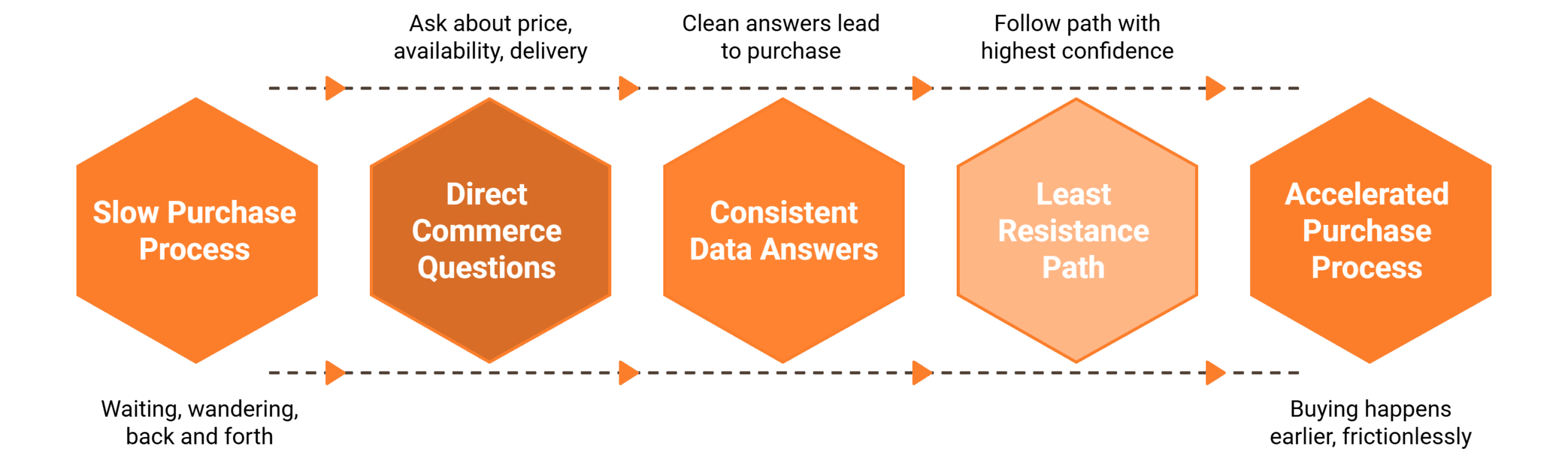
That changes what matters in practice. A product does not get picked because it looks good on a page. It gets picked because the conditions around it are clear enough to proceed. Inventory that updates late, pricing that resolves inconsistently, or fulfillment rules that live in copy instead of data all introduce hesitation. And hesitation, in an automated flow, usually means moving on.
UCP makes this possible by giving agents a consistent way to ask direct questions of a commerce stack. Can this be bought right now? Can it be delivered as promised? Can the transaction complete cleanly? When those answers come back clean, the purchase continues. When they do not, it stalls quietly.
This is where assistants like Gemini and other agent-based systems start behaving differently from human shoppers. They do not scroll or rationalize in the way humans do. They follow the path with the least resistance and the highest confidence.
Most teams feel this shift indirectly at first. A product that used to perform well becomes less visible in AI-driven surfaces. Conversion softens in ways that do not line up with traffic or campaign changes. Nothing appears broken, yet something feels off.
That moment is usually the first sign that buying is starting to happen somewhere your pages were never designed to reach.
Where the Stack Starts to Show Its Seams
The pressure rarely shows up where teams expect it. Pages still load. Campaigns still run. Checkout still works for customers who arrive the usual way. From the outside, nothing looks broken.
The strain shows up underneath, in the answers your stack gives when it is questioned out of sequence. Product feeds that were good enough for discovery struggle to support real fulfillment and eligibility checks. Pricing that “looks right” on a page resolves differently when it is called through a different path. Inventory drifts just enough to introduce doubt. Policies that make sense to a human reader stay invisible to systems that need clear, testable conditions.
Checkout becomes the quiet bottleneck. Many flows assume a person moving step by step, with logic embedded in the interface itself. When that same logic needs to be triggered programmatically, the weak points are small and easy to miss: a required field that only exists because a browser set it, a rule that fires only after a particular click path, a mismatch in timing between systems. None of this throws an obvious error. It just introduces hesitation.
For teams watching performance, this is disorienting. A product that used to show consistently appears less often in AI shopping surfaces. Certain offers stop converting the way they used to. The numbers shift without a clean trail back to a single broken page, and the instinct is to diagnose the storefront because that is where problems used to live.
Over time, the questions change. People stop asking what headline to test and start asking where price is actually resolved, where inventory truth really comes from, and which parts of checkout can be called without recreating a full browser session. That is usually the signal that the stack is being asked to do something it was never designed to do.
To make this concrete, these are the places UCP readiness most often breaks when an automated system tries to validate buyability early.
Where UCP Readiness Breaks in Real Stores
Most stacks do not fail loudly. They fail by answering the same question differently depending on where it is asked, when it is asked, and which layer answers it. Humans work around that. Agents do not. When UCP-driven surfaces validate inventory, price, shipping, and checkout eligibility earlier than your storefront does, inconsistencies surface immediately.
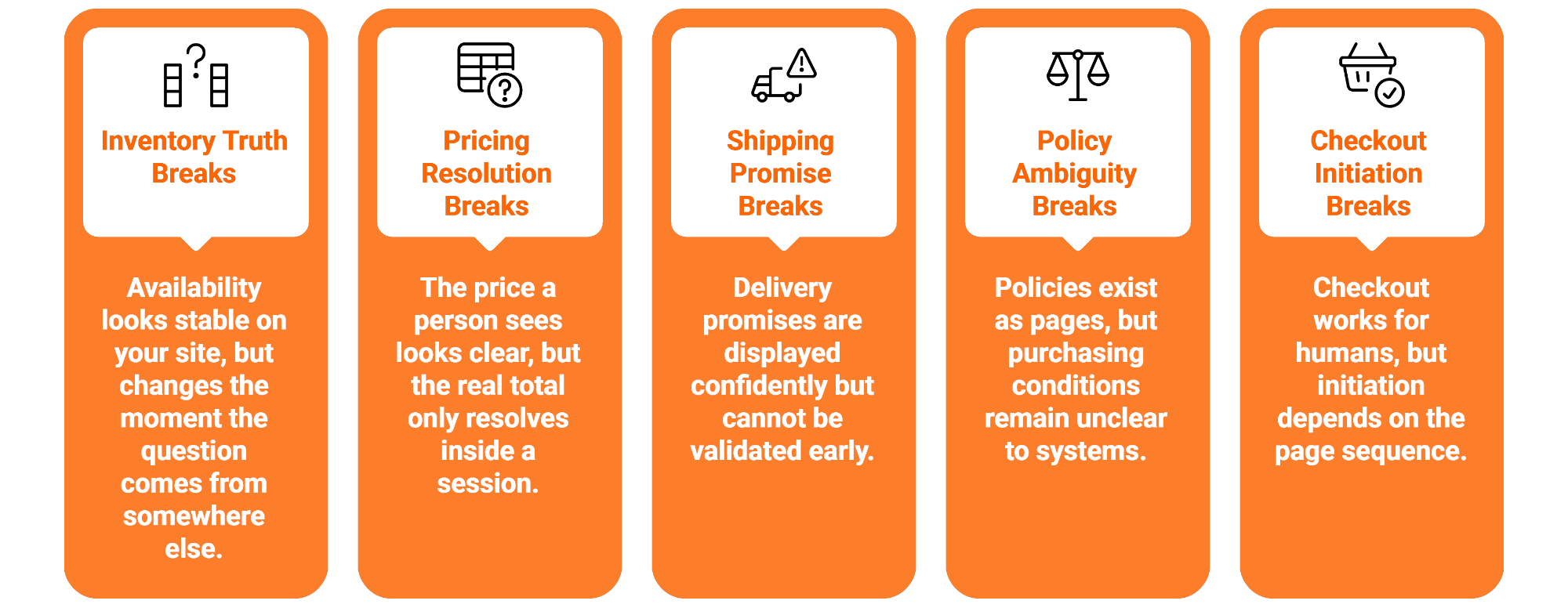
Inventory Truth Breaks
This shows up when availability looks stable on your site, but changes the moment the question comes from somewhere else. A shopper can add tothe cart, yet an agent sees conflicting signals between feeds, APIs, and checkout, then hesitates.
The cause is almost always split sources of truth or late resolution: warehouse sync lag, multiple systems publishing stock, or availability rules that only apply inside the storefront flow. The fix typically involves choosing one definition of sellable inventory and then making that answer respond consistently anywhere it is queried.
Pricing Resolution Breaks
This happens when the price a person sees looks clear, but the real total only resolves inside a session. Discounts, customer-specific rules, bundles, channel promotions, and fee logic create multiple possible answers until the buyer is deep in checkout.
Usually, pricing rules are scattered across tools and layers, so the first price an agent receives is not the same price checkout ultimately enforces. The fix tends to involve making the final price resolution callable, so the same question produces the same answer without requiring a browser session to arrive there.
Shipping Promise Breaks
This shows up when delivery promises are displayed confidently but cannot be validated early. “Arrives by Friday” sounds simple, yet it depends on carrier rates, cutoffs, warehouse selection, freight constraints, hazmat restrictions, and destination rules that only get applied late.
The root cause is shipping logic that lives as presentation first, then gets reconciled as rules at checkout. The fix typically involves exposing shipping eligibility and delivery logic earlier so promises can be confirmed before the final step forces a recalculation.
Policy Ambiguity Breaks
This breaks when policies exist as pages, but purchasing conditions remain unclear to systems that need clean constraints. Returns, warranties, restricted items, payment limitations, minimums, and cancellation rules may be written clearly, yet they are not expressed as decision logic an agent can evaluate.
The cause is the gap between policy copy and eligibility rules. The fix usually means converting the few policies that change buyability or risk into structured signals, then ensuring those signals resolve consistently across products, categories, and fulfillment paths.
Checkout Initiation Breaks
This appears when checkout works for humans, but initiation depends on the page sequence. Required fields are set inside the browser, validation assumes session context, and critical logic only triggers after specific steps have already happened.
The cause is the checkout acting as the place where everything gets reconciled late. The fix typically involves surfacing prerequisites earlier and making initialization reliable, so checkout can begin cleanly when the system already knows what it needs.
What an Agent-Ready Setup Begins to Feel Like
Teams that start pulling on these threads often notice a shift in how they think about their stack. The focus moves away from individual pages and toward the paths data takes when someone wants to buy. The question becomes whether pricing resolves the same way every time, whether inventory reflects reality in the moment it is queried, and whether checkout can begin without recreating a full browsing session.
In setups that adapt more easily, commerce logic tends to live in clearer places. Business rules are easier to trace. Policies are expressed in ways systems can read, not just people. Payment and fulfillment decisions are handled as services rather than steps buried in a flow. None of these changes how the store looks to a customer, but it changes how confidently other systems can interact with it.
The storefront still matters. It remains where brand, trust, and storytelling live. What changes is how much weight it carries. Buying no longer depends on a single interface. It depends on whether the underlying systems can respond cleanly when they are called from somewhere else.
Teams usually describe this shift as a relief once they get there. Fewer edge cases. Clearer ownership of logic. Better answers when something behaves differently than expected. The stack starts to feel more predictable, even as new buying surfaces appear.
Most organizations already have parts of this in place. The work is rarely about rebuilding everything. It is about seeing the system clearly enough to understand where it resists being used in ways it was never asked to before.
The Question That Starts to Matter
For most teams, this shift does not announce itself loudly. It shows up as a feeling that familiar explanations no longer cover what is happening. A product drops out of consideration in places it used to appear. A checkout path behaves differently depending on how it is reached. The data keeps moving, but the story behind it becomes harder to tell.
Over time, the conversation inside the business changes. Less energy goes into debating page tweaks and more into understanding how decisions are made beneath the surface. People start asking whether the systems they rely on can be understood and trusted by something that does not browse or hesitate.
That is usually when UCP enters the discussion in a practical way. It shows up as a signal that buying is starting to happen through paths the original stack was never designed around. The question becomes whether the current setup supports that shift cleanly or resists it in small, expensive ways.
There is value in clarity before anything feels urgent. Seeing where your commerce logic lives, how it resolves, and how it would respond if an automated system tried to act on it today.
If you want a second set of eyes on that, contact us. We help eCommerce teams assess whether their catalog data, pricing logic, inventory accuracy, and checkout flow are ready for AI-driven purchasing paths, then map the fixes in plain priorities so you can move without guessing.
Frequently Asked Questions
Is Google Universal Commerce Protocol live for all retailers today?
No. The rollout is limited and uneven. Google is starting with eligible retailers and specific shopping surfaces, using familiar payment rails like Google Pay, with PayPal planned. Some merchants will encounter UCP-driven behavior earlier than others, depending on the platform. category, and surface eligibility. That staggered rollout is why the early signals tend to show up as subtle performance changes rather than clear announcements.
Does UCP replace a merchant’s checkout or storefront?
Merchants remain the seller of record and still own the transaction, customer relationship, and fulfillment. What changes is where the decision to buy can occur. In some cases, the checkout experience is initiated or completed inside a Google or AI-driven surface. The storefront continues to matter for brand, trust, and complex journeys, but it is no longer the only place where buying can happen.
How does UCP affect Google Search and AI shopping experiences?
Search and AI interfaces begin to carry intent further down the buying path. Beyond product discovery and comparison, these systems can evaluate whether a purchase can proceed smoothly based on inventory, pricing, fulfillment, and policy signals. Products that are easier for an agent to evaluate and act on tend to surface more reliably in these flows.
Do eCommerce platforms or custom stacks need changes to support UCP?
Most stacks do not need to be rebuilt, but many need adjustment. The pressure usually shows up around data consistency, pricing resolution, inventory accuracy, and how checkout logic is exposed. Platforms that already separate commerce logic from front-end flows tend to adapt more easily. Custom stacks often need a closer look at where rules live and how they can be called outside a browser session.
How is UCP different from other agent commerce efforts?
Google’s UCP is one approach among several emerging standards, including OpenAI’s ACP. The shared direction is that AI systems are beginning to carry buying through to completion instead of stopping at recommendations. The specifics vary by platform and surface, but the underlying requirement is the same: commerce systems need to be readable, predictable, and trustworthy to automated agents.
What usually breaks first when a stack is not ready?
The first signs are rarely hard failures. Teams notice changes in visibility, offer selection, or conversion patterns that do not line up with traffic or campaign shifts. Over time, questions start surfacing around pricing logic, inventory truth, and which parts of checkout can be triggered programmatically. Those questions usually point to friction that human shoppers worked around, but agents will not.