TL;DR: An ecommerce RFP earns accurate bids when it hands vendors a priceable scope: documented catalog and order volumes, named integrations, migration and SEO requirements, a budget range, and scoring criteria set before anything goes out. Vague RFPs collect padded quotes or silence, and agencies answer only about half of the RFPs they receive.
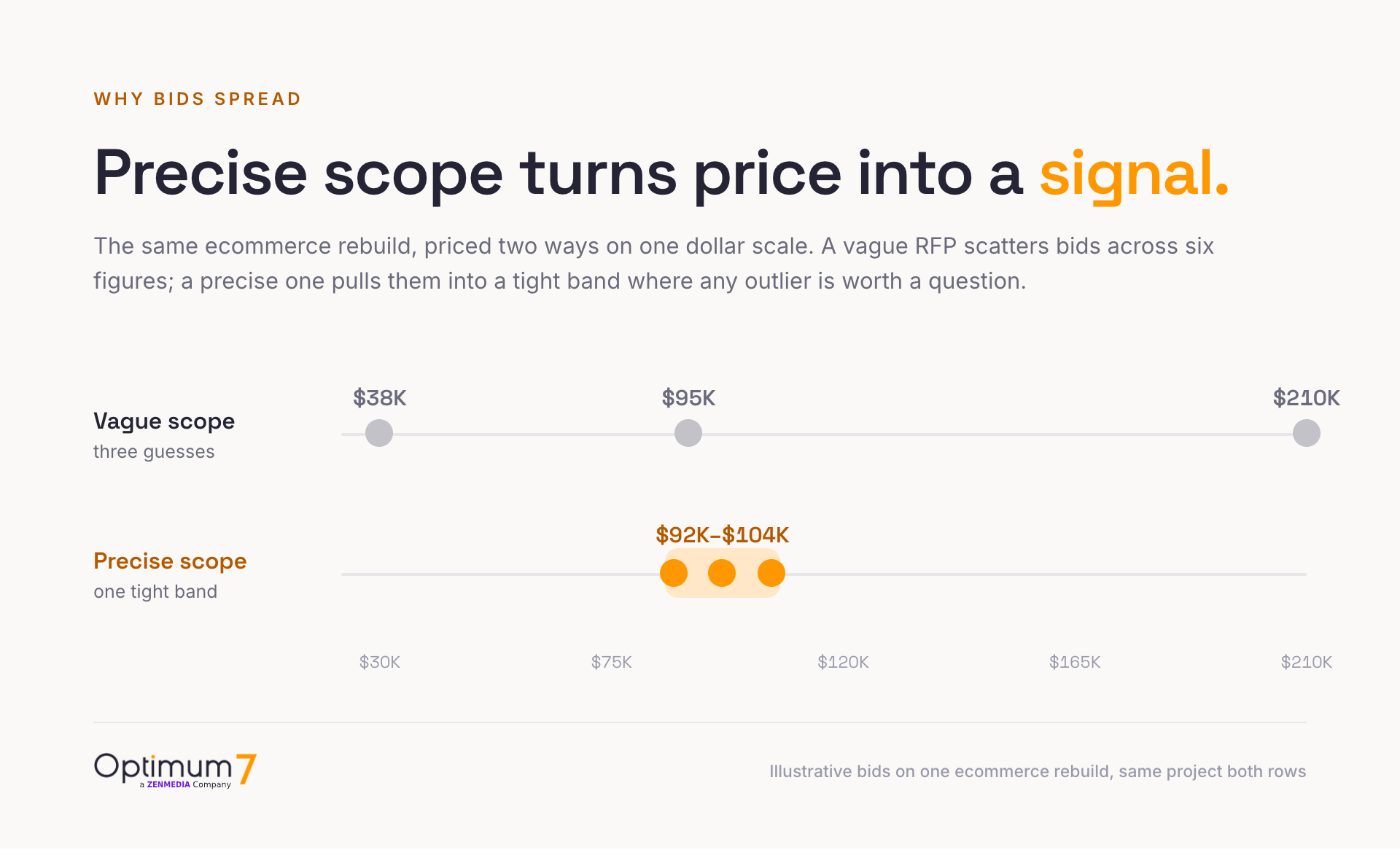
Three proposals land for the same ecommerce rebuild: $38,000, $95,000, and $210,000. Which number is right? A spread that wide means the vendors priced three different projects, and the document that caused it is the request for proposal. Each agency filled the undefined parts of the scope with its own assumptions, then priced those assumptions.
Optimum7 has sat on the receiving end of ecommerce RFPs for close to two decades, and one pattern holds across every platform and budget tier: proposal quality tracks document quality. A merchant who sends out catalog counts, named integrations, and a scoring method gets back comparable bids within weeks, while ten pages of adjectives invite a guessing contest. Knowing how to write an ecommerce RFP is mostly knowing what to make specific before the document leaves your building, and the rest of this guide is that list.
Ecommerce RFP Basics: RFP vs RFI vs RFQ
The RFP sits in the middle of a three-document family, and merchants routinely send the wrong one. A request for information (RFI) comes earlier: you have a problem, you want to learn how different vendors would approach it, and nobody is pricing anything yet. A request for quotation (RFQ) comes later: the scope is already locked, line by line, and the only open question is price. The RFP covers the territory between them, where the requirements are defined but the solution and the partner are both still open.

| Attribute | RFI | RFP | RFQ |
|---|---|---|---|
| Purpose | Learn how vendors would approach the problem | Collect comparable solution proposals with pricing | Collect prices for a fully locked scope |
| Send it when | Requirements are still forming | Requirements are defined; solution and partner are open | Scope is final down to the line item |
| What comes back | Capability overviews, no binding numbers | A proposed approach, team, timeline, and cost | A price, sometimes a delivery date |
| Typical use in ecommerce | Early platform exploration | Replatforming, site rebuilds, custom development | Hosting, licenses, fixed-spec apps |
The RFP vs RFQ choice is the first fork: an RFQ prices a scope already locked to the line, while an RFP invites a solution when the approach is still open. For an ecommerce rebuild, replatforming project, or large custom build, an RFP for an ecommerce website is almost always the right instrument, because the partner’s proposed approach weighs as much as the price. Two agencies can quote the same migration $60,000 apart and both be correct for the scope they imagined. The RFP exists to make them imagine the same scope.
One prerequisite belongs before the document, though. If the project includes choosing where to sell, settle the platform question first or state clearly in the RFP that platform selection is part of the engagement; a vendor cannot price a build when the foundation is undecided. A useful starting point is to compare the major ecommerce platforms before drafting a single requirement.
When an RFP Helps You and When It Slows You Down
An RFP earns its overhead on projects with real complexity and real money at stake: replatforming a store with years of accumulated data, a ground-up rebuild, a B2B commerce build with pricing tiers and account hierarchies, or any engagement a board or finance team will scrutinize. The document forces internal alignment before external conversations start, which is half of its value. Writing down the budget, the goals, and the integration list exposes every disagreement your team did not know it had.
Below a certain project size, the formal process costs more than it protects. A full RFP cycle runs six to ten weeks from requirements gathering to a signed agreement, and it asks each vendor for dozens of unpaid hours. For a theme adjustment, a single integration, or a project under roughly $25,000, a direct conversation with two or three researched agencies reaches a better decision faster. A one-page project brief with your catalog size, platform, and goal gets those conversations moving without the ceremony. Optimum7’s published migration cost benchmarks give the threshold a concrete shape: a store doing $500K to $2M a year replatforms for $15,000 to $20,000, a scope a brief can price, while a $5M to $10M store runs $50,000 to $70,000 and a $10M+ catalog reaches $75,000 to $150,000 or more, which is squarely RFP territory.
There is also a version of the RFP that helps nobody. If you already know which agency you want, what is the process for? Procurement rules sometimes require three bids even when the decision is made, and vendors recognize the signs of a pre-decided outcome immediately: hyper-specific requirements that mirror one vendor’s product, a compressed response window, no access to stakeholders. Agencies call the losing invitees column fodder, and the good ones decline the invitation. Running a real competition means every invited vendor has a genuine chance to win it.
The Ecommerce RFP Process in Seven Steps
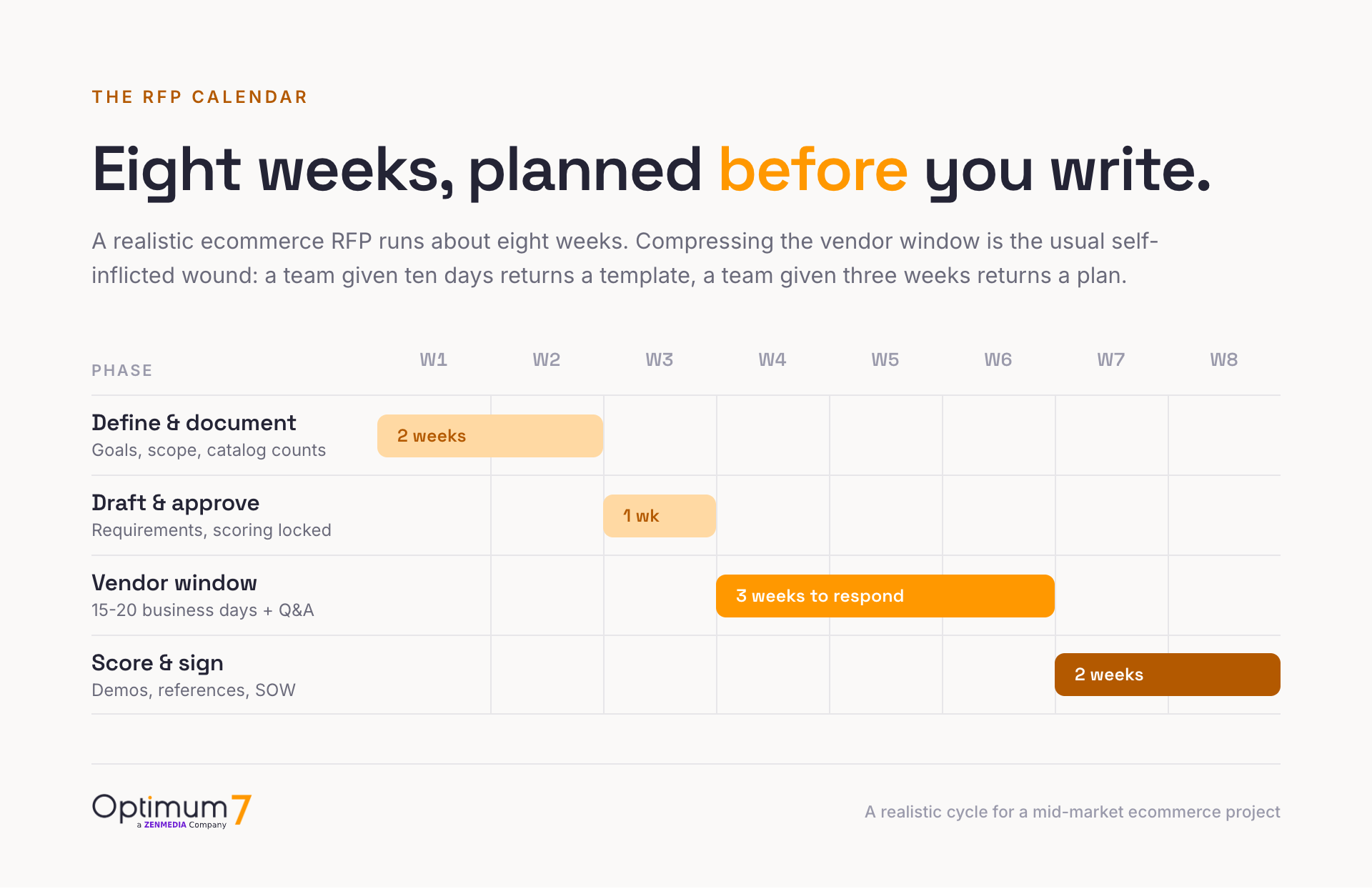
Plan the full cycle on a calendar before anyone writes a sentence. A realistic ecommerce RFP runs about eight weeks: two for internal discovery and requirements, one to draft and approve the document, three for the vendor response window with a mid-point Q&A, and two for demos, scoring, reference checks, and converting the winner’s proposal into a contract. Compressing the vendor window is a self-inflicted wound: a team that gets ten days returns a template, and a team that gets three weeks returns a plan.
The Nine Sections of an Ecommerce RFP Template
A strong ecommerce RFP template runs 8 to 15 pages and answers every question a vendor would otherwise have to guess at. Length itself is a warning sign: government-style 60-page documents bury the signal, and experienced agencies read them last. Each of the nine sections below exists because its absence shows up later as a change order.
Length distributes unevenly across the nine sections, and knowing the weights keeps the document honest. Company overview, budget, and submission instructions each need half a page. Goals and vendor questions take a page. The load-bearing sections are current state at one to two pages and functional requirements at two to four, with technical, integration, migration, and SEO requirements filling one to two pages each. Written to those weights, the document lands at 8 to 13 pages with every page carrying information a vendor prices from.
Section 07 deserves a direct word, because budget is where merchants sabotage their own document. Withholding the range produces proposals scoped to three different imaginary budgets, none of them comparable. A disclosed range also lets a vendor tell you early and honestly that the goals and the money do not match. Anchor the range to published benchmarks before setting it, and respect the floor: a bargain bid taken to save money is the one outcome worse than overpaying, since Optimum7 has seen $3,000 budget migrations generate recovery projects costing 3 to 10 times what the original saved.
Before the document leaves your building, run it against this list:
Sample RFP Language You Can Adapt
An ecommerce RFP example beats any amount of advice about one, so the document below is written as actual RFP language, ready to adapt. The six excerpts follow a single sample store throughout, an $8M lighting retailer leaving a legacy cart with 9,400 SKUs, so they read as one coherent document; swap its numbers, systems, and dates for yours. Notice what every excerpt has in common: a number a vendor can price against, and nothing a vendor has to interpret.
Two adaptation rules keep the document inside the page weights above. Write a full acceptance criterion only for must-have requirements; a nice-to-have gets one line, because vendors price must-haves and merely acknowledge the rest. And keep the budget range tight: a span wider than about 1.5x its floor ($90,000 to $130,000 passes, $50,000 to $200,000 fails) tells vendors the funding is still unsettled, and the proposals scatter accordingly.
RFP Requirements for Website Development and Migration Projects
A website development RFP or software development RFP lives or dies on its technical specificity, because development estimates are built bottom-up from data volumes and integration counts. When Optimum7 migrated RC Superstore from Volusion to BigCommerce, the priced scope rested on exact figures: 8,720 products, 228 categories, 170 product options, 94,265 customer accounts, and 114,463 orders. A vendor holding those six numbers can estimate within a sensible band, while a vendor holding “we have a large catalog” prices blind, and blind estimates are where blown budgets are born.
Four specification areas separate a priceable development RFP from a vague one:


The technical section is also where a store’s runtime belongs. Name the hosting environment and the exact software versions the build must run on, including the PHP version for a PHP-based platform, and require the vendor to confirm that the platform release, every extension, and the theme support those versions. Compatibility testing, deployment procedures, and ownership of security updates after launch are requirements too: state who installs patches, who tests them against custom code and integrations, and whether that work sits with the agency on a maintenance retainer or with an in-house team.
Requirement Rewrites: Vague to Priceable
The fastest way to raise an RFP’s quality is to rewrite its weakest requirements, and the pattern is always the same: replace the adjective with a number, a named system, or a condition a demo can verify. Six rewrites below cover the asks that appear in nearly every website development RFP Optimum7 receives. Each vague version forces the vendor to guess; each rewrite gives the estimate a floor and the contract an acceptance test.
| Area | The vague ask | The priceable rewrite |
|---|---|---|
| Search | “Improve site search” | “Shoppers filtering 12,000 SKUs by six attributes see results in under one second” |
| Checkout | “Modernize the checkout” | “Guest checkout completes in three steps or fewer, with supported at launch” |
| Migration | “Migrate all our data” | “9,400 products, 85,000 customers, and 112,000 orders migrate with a row-count reconciliation report per table” |
| Integrations | “Must work with our ERP” | ” syncs inventory hourly, orders post back in real time, and a failed sync alerts within 15 minutes” |
| Design and speed | “A modern look and feel” | “Theme rebuilt to the attached brand guidelines, with product pages loading LCP under 2.5 seconds at launch” |
| B2B | “Support wholesale buyers” | “Logged-in B2B accounts see their contract pricing, and orders above $5,000 route to an approver” |
B2B stores carry an extra layer: customer-specific pricing, account hierarchies, approval workflows, and punchout requirements all belong in the functional requirements, spelled out per buyer role, and those fields are what turn the nine-section template above into a B2B ecommerce RFP template. The B2B ecommerce migration guide breaks down the eight data layers a B2B replatforming RFP needs to cover.
Security, Compliance, and Accessibility Requirements
An ecommerce store takes payments and holds customer data, so three requirement areas belong in every RFP and are the ones first left out. State the security baseline: PCI DSS scope for the checkout, TLS encryption sitewide, and who owns vulnerability patching and penetration testing after launch. State the data protection rules the store operates under, such as GDPR or CCPA, and how customer data is stored, accessed, and deleted. And set an accessibility target, typically WCAG 2.2 AA for ADA alignment, as a tested acceptance criterion the vendor meets before launch. A sample requirement line: “The storefront meets WCAG 2.2 AA, verified by an automated scan plus manual keyboard and screen-reader testing before launch.” Each of these protects the store and the buyer, and each is far cheaper to specify now than to retrofit after a failed audit or a complaint.
Specificity pays off at launch, the only point where the RFP’s precision becomes revenue or regret. The RC Superstore project scoped above went live without losing its catalog or its customers, and the store tripled its organic revenue within six months of launch:
If the project on your desk is a replatforming, Optimum7’s ecommerce migration services team can also review a draft RFP against the data realities of your current platform before it goes out, which routinely surfaces requirements the internal team had no way to see.
How Vendors Decide Which RFPs to Answer
Your RFP has to win vendor attention first; vendors start competing for your project only after they decide your document deserves a response. Agencies run a formal go/no-go review on every inbound RFP and decline a large share, because a serious response consumes an experienced team for roughly a week. What earns that week? Clarity, above all: a visible budget, a named decision process, and requirements that read like someone inside the business wrote them.
The decline triggers are consistent across the industry, and every one of them is fixable on the buyer’s side. A missing budget forces the vendor to gamble a week of senior time on a project that may be funded at a tenth of their minimum. A response window under two weeks signals either disorganization or a pre-decided winner. A document written entirely by procurement, with no route to the people who run the store, tells an agency the project’s requirements were never pressure-tested. And boilerplate questions pasted from a generic template (“describe your quality philosophy”) tell experienced teams that nobody will read the answers.
The spread problem from this article’s opening resolves the same way. Send the same project out with precise requirements and the $38,000-to-$210,000 scatter collapses into a band like $92,000, $99,000, and $104,000, and the clustering itself is information: an outlier bid either found a risk the others missed or missed the scope entirely, and one clarifying call tells you which. When requirements are vague, a wide spread tells you nothing, because each vendor priced a different imaginary project. Precision in the document converts price from noise into signal.
Ten Questions to Ask Vendors in an Ecommerce RFP
The vendor-questions section (Section 08 of the template) earns its page only when every question has a wrong answer. Generic prompts (“describe your development philosophy”) produce copy-paste responses nobody reads; the ten questions below are the ones whose answers separate bidders, with the response each question is designed to surface. Put them in the document verbatim and score the answers against the right-hand column.

| Ask this | A strong answer includes |
|---|---|
| “List three migrations of 5,000+ SKUs completed in the last two years, with live store URLs.” | Named stores you can visit today, on your target platform, at your catalog scale |
| “Who exactly will work on this project, and what else are they assigned to?” | Named people with roles and availability, never “our senior team” |
| “Walk through your data migration process. How do you prove nothing was lost?” | A staged test migration, row-count reconciliation per table, and a rollback plan |
| “How do you protect organic rankings through cutover?” | A URL-by-URL 301 map, metadata carryover, a pre-launch baseline, and a monitoring window |
| “For each must-have requirement: native, app, or custom code on your proposed platform?” | A requirement-by-requirement table with app names and their license costs |
| “What does support look like in the 90 days after launch?” | Response times, a named owner, and a clear line between included and billed work |
| “What is your change-order process, and at what rate?” | A written process and rates stated now, while competing bids still give you negotiating power |
| “Describe a project that went wrong. What did you do?” | A specific story with the fix and what changed afterward; deflection is the wrong answer |
| “What will this store cost to run in years two and three?” | Platform fees, app subscriptions, and a maintenance figure: the total cost of ownership |
| “What do you need from us, and by when?” | A client-responsibility list with dates; silence here predicts the delays you will get blamed for |
One caution on using the bank: cap the section at these ten plus two or three questions specific to your project. A 40-question vendor section reads as procurement theater, and experienced teams answer it with boilerplate or decline. Ten sharp questions with scoreable answers tell every bidder a real evaluation is coming, which by itself improves the quality of the proposals.
Scoring Proposals and Choosing a Development Partner
Score proposals against the criteria you locked in step four, on a 100-point weighted scorecard, with at least three evaluators scoring independently before any group discussion. Independent first-pass scoring keeps one strong personality from deciding the outcome, and the spread between evaluators’ scores flags exactly which sections need discussion. The weights below are a proven starting distribution for an ecommerce development selection; tune them to the project before vendors are invited, never after.

| Criterion | Weight | What earns a high score |
|---|---|---|
| Platform and technical fit | 25 | Requirement-by-requirement answers naming native, app, or custom for each item |
| Relevant ecommerce experience | 20 | Named case studies at your catalog size and vertical, with verifiable outcomes |
| Migration and data plan | 15 | A staged plan with validation checkpoints, redirect mapping, and a rollback path |
| Team and process | 15 | The actual delivery team named, with roles, availability, and a communication cadence |
| Post-launch support | 10 | A defined support model with response times, named owners, and transparent rates |
| Price and total cost of ownership | 15 | A line-item estimate plus three-year platform, app, and maintenance costs |
Price carries 15 points, and that allocation is deliberate. The cheapest proposal on a complex build is frequently the one that understood the project least, and selecting on price alone hands the savings back during delivery, one scope dispute at a time. Scoring total cost of ownership over three years, including platform fees, app subscriptions, and maintenance, corrects for proposals that look inexpensive only because they defer costs past launch.
A Sample Scoring Run Across Three Proposals
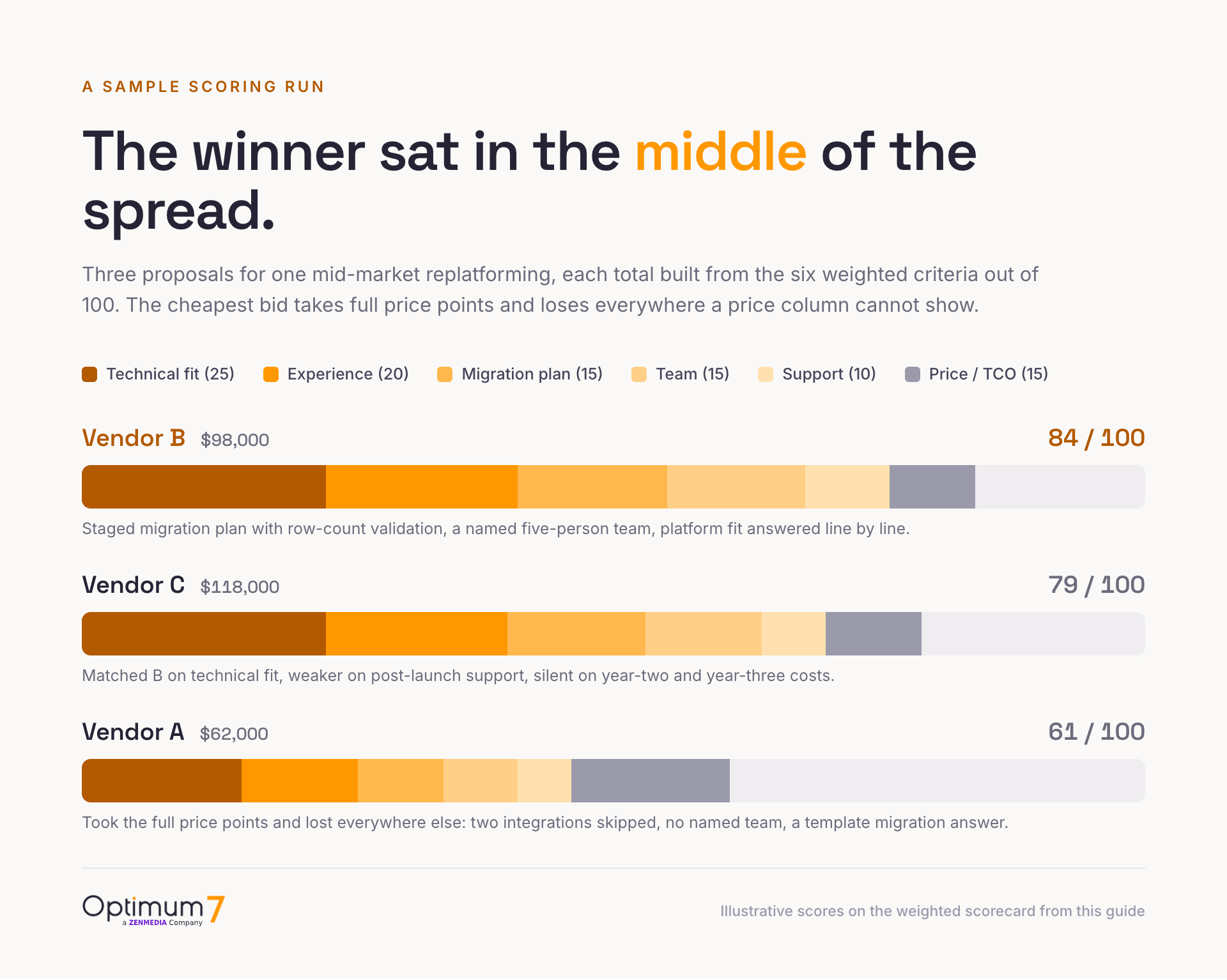
Here is how the scorecard behaves in practice, with illustrative numbers from a typical mid-market replatforming spread. Vendor A bids $62,000, takes the full 15 price points, and still totals 61 of 100: the proposal skipped two named integrations, credited no specific team, and answered the migration question with a paragraph about “proven processes.” Vendor B bids $98,000 and totals 84, carried by a staged migration plan with row-count validation, a named five-person team, and a requirement-by-requirement platform-fit table. Vendor C bids $118,000 and totals 79: equal to B on technical fit, weaker on post-launch support, and silent on year-two and year-three costs. The scorecard surfaces what a price column hides, which is that the cheapest proposal understood the project least and the winner was sitting in the middle of the spread.
Red Flags in Vendor Proposals
Before scores are finalized, sweep every proposal for the six warning signs below. Any one of them justifies a clarifying call; two or more in the same proposal justify a lower score on the team-and-process criterion regardless of how polished the document looks.
Two verification steps close the process for the top-scoring two or three vendors. First, run demos on your scenarios with your data, scripted by you: hand each team the same five buying scenarios and watch them work, since a vendor-led demo shows you only the paths that already work. Second, call the references and ask one question that cuts through rehearsed praise: “What went wrong, and what did they do about it?” Every multi-month project hits a problem, and the reference’s answer tells you how the agency behaves when it does. When the winner is chosen, attach their proposal to the statement of work, and the document you wrote eight weeks ago finishes its job as the baseline the whole engagement is measured against.
If you want a second set of eyes on a shortlist, a draft document, or a proposal spread that refuses to make sense, Optimum7’s ecommerce development team reviews RFPs from the vendor’s side of the table and will tell you plainly what your document will get priced at and why.
Ecommerce RFP FAQs
What does RFP stand for in ecommerce?
RFP stands for request for proposal. In ecommerce it is the document a merchant sends to development agencies or platform vendors describing a project’s goals, requirements, data volumes, budget, and timeline, so that every vendor proposes against the same scope and the resulting bids can be compared directly.
How long should a website RFP be?
Aim for 8 to 15 pages. Shorter documents usually omit the catalog counts and integration details vendors need to price accurately, while documents past 25 pages bury requirements in boilerplate and depress response rates from experienced agencies. Every page should carry information a vendor will use in the estimate.
What is the difference between an RFP and an RFQ?
An RFP asks vendors to propose a solution, a team, a timeline, and a price for a defined problem, and it fits projects where the approach is still open. An RFQ asks only for a price against a fully locked specification. Use an RFQ for commodity purchases and an RFP for development work.
How many vendors should receive an ecommerce RFP?
Invite three to five researched vendors. Fewer than three removes real comparison; more than six signals a lottery and lowers response quality from the strongest candidates, since serious teams screen inbound RFPs and skip wide broadcasts. Each invitee should already match your platform, catalog size, and vertical.
How long does the RFP process take?
Plan on six to ten weeks from requirements gathering to a signed statement of work: about two weeks of internal discovery, one week to draft, 15 to 20 business days for the vendor response window with a mid-point Q&A, and two weeks for scoring, demos, references, and contracting.
Should you include your budget in an RFP?
Yes, as a range. A disclosed range gets every vendor scoping against the same ceiling, which makes the proposals comparable, and it lets an honest vendor flag a mismatch between goals and budget early. Hidden budgets produce padded estimates or lowballs that resurface later as added fees.
Do you need an RFP for a website redesign?
A website redesign RFP earns its overhead when the redesign includes replatforming, data migration, custom functionality, or a budget large enough to need board approval. For a visual refresh on the same platform under roughly $25,000, a one-page brief and direct conversations with two or three researched agencies reach a decision faster with no loss of rigor.
What questions should you ask vendors in an RFP?
Ask for three comparable projects with live URLs, the named delivery team and their availability, the data migration validation process, the SEO preservation plan, a native-versus-app-versus-custom answer per requirement, the post-launch support model, change-order rates, and year-two and year-three running costs. Cap the section near a dozen questions so every answer gets read.
How much does an ecommerce replatforming project cost?
Optimum7’s published benchmarks tie the cost to annual revenue: $15,000 to $20,000 for stores doing $500K to $2M, $30,000 to $40,000 at $2M to $5M, $50,000 to $70,000 at $5M to $10M, and $75,000 to $150,000 or more above that. Custom features such as AI search or B2B pricing logic add $2,500 to $15,000 each.
What security and compliance requirements belong in an ecommerce RFP?
Name the PCI DSS scope for checkout, TLS encryption sitewide, and who owns vulnerability patching after launch, plus the data protection rules the store runs under, such as GDPR or CCPA. Add an accessibility target, usually WCAG 2.2 AA for ADA alignment, written as a tested acceptance criterion. These protect both the store and the buyer, and belong in the document before the build begins.
Who owns website maintenance and security updates after launch?
Whoever the contract names. On a self-hosted store the merchant is responsible for the server, so the RFP should assign who installs security patches, who tests each update against custom code and integrations, and who monitors uptime. Optimum7 supports stores after launch through a monthly development retainer or project-based work; put that ownership in writing before an update forces the question.
What happens after you choose a vendor?
Attach the winning proposal to the statement of work as a binding exhibit, convert the RFP requirements into acceptance criteria, and set the project governance the proposal promised: the named team, the communication cadence, and the milestone schedule. The RFP then becomes the baseline every change request is measured against.
About the author: Duran Inci is the CEO and Co-Founder of Optimum7, an ecommerce development and digital marketing agency. He helps mid-market and enterprise brands scale revenue through conversion optimization, SEO, and custom ecommerce solutions.