

If you run SEO for a WooCommerce store right now, you might be seeing numbers that look promising, then living through results that feel oddly quiet. Your tools show keyword growth. More pages show up in search. The visibility line keeps climbing, so it feels like you’re stacking wins.
Then you open Google Analytics, and the mood changes. Sessions are not rising in step with the “progress” you’re being shown. Revenue does not compound the way it should when rankings improve. After a few months, it starts to mess with your judgment because you can prove effort, but you cannot point to momentum.
Most stores aren’t dealing with an indexing problem. They’re dealing with a position problem. If you have a small catalog and only a handful of category pages, this might not be your problem yet. This shows up when your store has real taxonomy sprawl: dozens of categories, layered filters, lots of products, and multiple pages that could plausibly answer the same buying query. That is where WooCommerce SEO starts to look “better” in dashboards while revenue stays flat.
A keyword moving from 38 to 19 looks like a jump on most platforms, but it rarely changes traffic. A category page holding position 7 can feel “stable,” yet positions 2 and 3 often take a completely different share of clicks. If your growth is clustering outside the Top 10, or your best commercial pages are sitting mid-page one, the charts can look healthier while demand stays stubborn.
What the Platform Data Shows
Here’s the simplest way to confirm it: pick your top 10 revenue category pages, list their main commercial terms, then mark whether each term is in positions 1–3, 4–10, or outside page one. If most of your revenue intent lives in 4–10, your store can look like it is improving while your clicks stay capped.
This stops being confusing the moment you zoom out beyond a single store. If it was only your store, you could blame content, tech debt, or competitors. But when thousands of WooCommerce stores show the same general behavior, you’re not looking at a personal failure; you’re looking at how the market is distributing wins.
That pattern is clear in platform-wide visibility data from our WooCommerce performance report. Across 3,666 WooCommerce domains, keyword visibility grew about 17.7% year over year, and organic traffic rose about 5.6%. WooCommerce’s opportunity is real. The part that matters is how unevenly that opportunity is being captured. Inside the report, you can see how traffic gains concentrate by tier, what “healthy growth” looks like versus visibility-only growth, and how often stores get trapped in mid-page-one positions. It gives you a benchmark that is hard to get from a single-store view because your data cannot tell you whether you are underperforming or just sitting in the middle of a crowded platform.
A smaller tier of stores is pulling more of the upside into itself. Premium placements are consolidating, and when that happens, the middle starts to feel noisy and unproductive. You can add keywords and still lose relative ground because competitors are taking the positions that convert visibility into traffic.
This is the point most merchants miss. It is not enough to “grow” in the tools. Growth only matters when your best pages move into click territory and stay there.
Why Traffic Is Concentrating at the Top in 2026
Why Mid-Tier Stores Stop Compounding
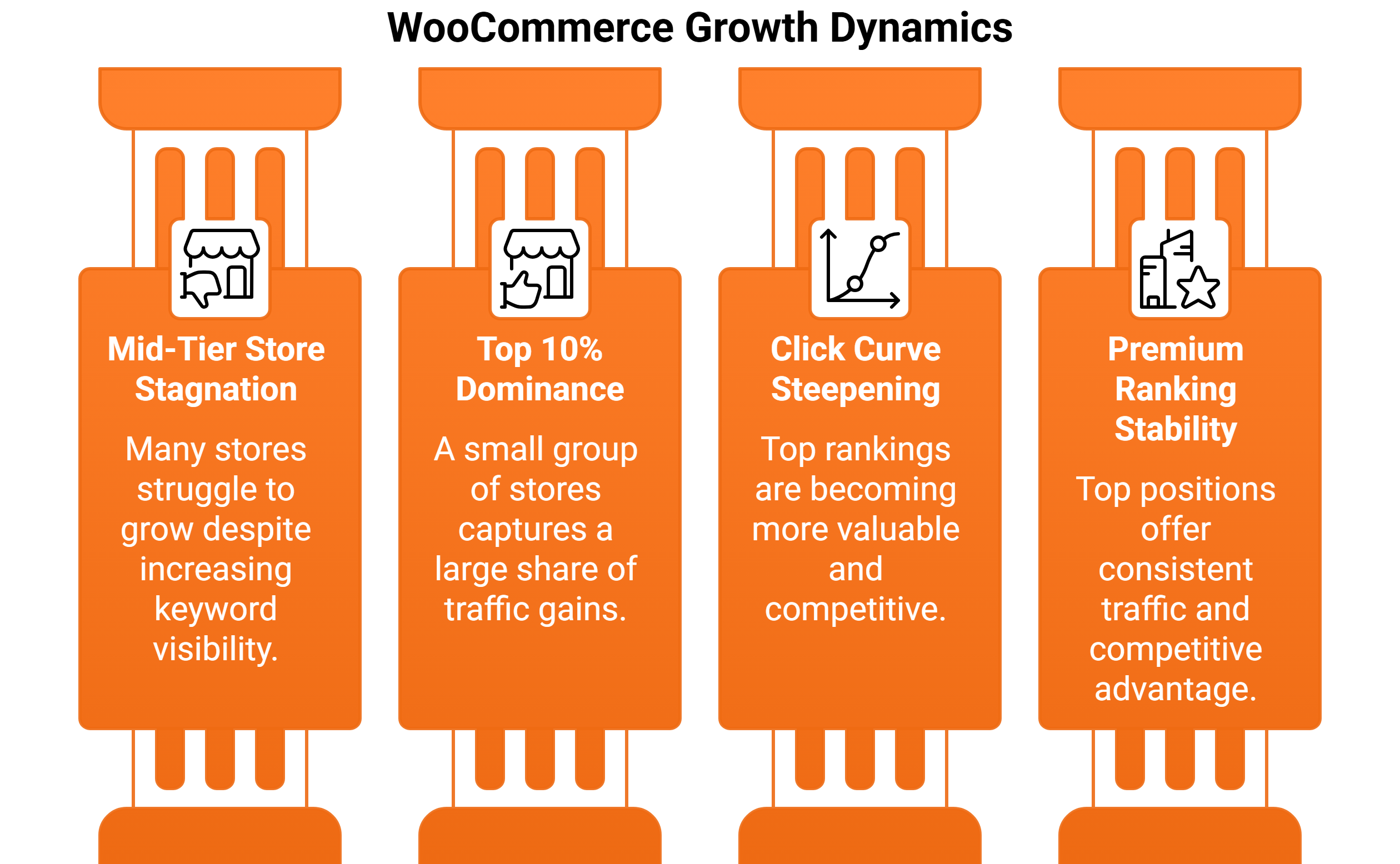
WooCommerce is growing at the platform level, but it’s not evenly capturing the upside. When you break performance down by domain, a separation appears fast. Roughly 26% of WooCommerce stores are growing both traffic and keyword visibility at the same time. On the other end, about 22% are declining across both metrics. The middle is where most stores sit, and it is not stable. Many are adding keywords without improving rank depth, so visibility climbs while traffic stays capped.
The concentration is not subtle. The top 10% of domains account for 72% of net traffic gains across the ecosystem. That number matters because it shows the trend is not random movement. It is structural. Premium rankings are consolidating toward stores that reinforce them aggressively, and when that happens, everyone else feels friction. Keyword counts can grow and indexation can expand, but if your most valuable pages are not climbing into stronger positions, growth spreads thinner instead of compounding. That is why many WooCommerce merchants feel busy but not ahead. The ecosystem is moving forward, but not at the same speed for everyone.
The Click Curve Is Steepening
Rankings do not carry equal weight. Across the WooCommerce ecosystem, the top 3 rankings grew by about 24.5% over the last 12 months. The competition for premium placements is likely getting more intense when the top grows more quickly than the others. For many buying terms, positions 1 through 3 absorb the majority of engagement. Positions 4 through 10 divide what remains. Once you drop outside the Top 10, visibility may increase impressions, but it rarely translates into consistent sessions.
This is where individual stores feel disconnected. A category page moving from position 12 to 8 can inflate visibility metrics without meaningfully changing traffic. A commercial page slipping from position 3 to 6 can reduce sessions noticeably, even though it is still technically “on page one.” Most dashboards treat both movements as minor adjustments. Revenue does not.
Premium rankings tend to stabilize and compound because higher click-through reinforces relevance signals and protects position over time. Pages that hover mid-page one fluctuate more often and are easier to displace. When competitors secure Top 3 positions for core commercial terms, they are not just capturing traffic; they are building insulation. Stores stuck between positions 5 and 10 remain exposed to small downward movements that chip away at demand.
That is why the central question is not how many keywords you gained this quarter. It indicates how much of your highest-intent search demand resides in premium positions and whether that share is strengthening or eroding.
How Taxonomies and Filters Split Ranking Power
Rank depth is shaped by how your store is structured.
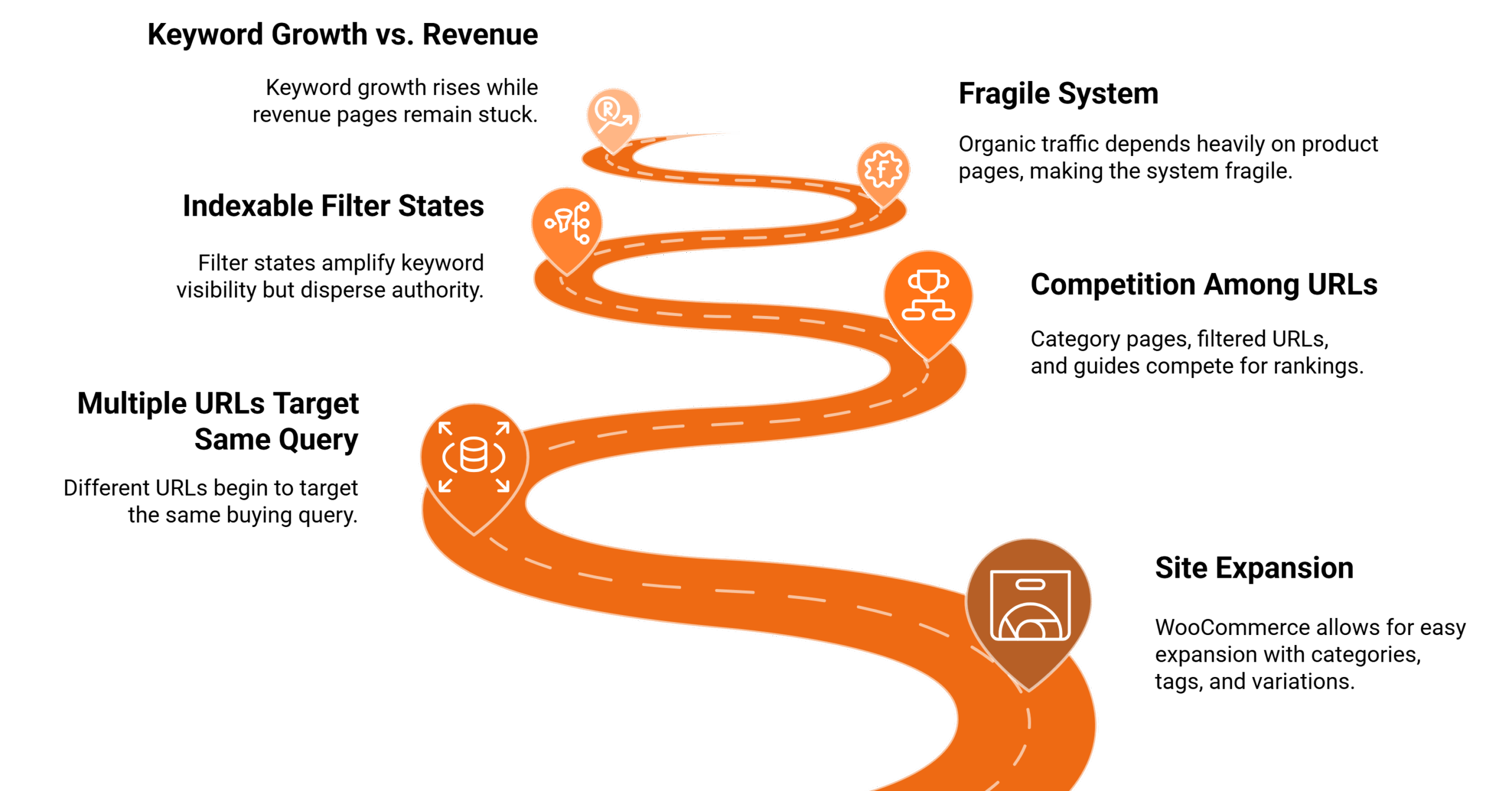
WooCommerce makes expansion easy. Categories multiply, tags pile up, filters generate new URLs, and product variations add more pages. The site grows outward, but intent does not get consolidated.
Over time, multiple URLs start targeting the same buying query. The main category competes with a filtered version, a collection page overlaps with the hub, a guide targets the same term, and variants echo the same signals. Google does not see coverage; it sees competing answers.
A common pattern looks like this: the category ranks around 6, a filtered URL sits near 9, and a “best ” guide floats between 11 and 18. Rankings rotate because no single page is reinforced as the owner of that intent.
Indexable filter states amplify the problem. They inflate keyword visibility while draining internal link equity and crawling attention away from your revenue hubs. Instead of strengthening category pages into premium positions, authority gets dispersed across thin variations.
When organic traffic depends heavily on product pages, the whole system becomes fragile. Products go out of stock, SKUs change, and inventory turns. Category hubs can hold and compound demand; product pages rarely do.
This is why keyword growth can rise while revenue pages stay stuck: expansion keeps creating new competitors inside your own site.
SERP Layout Changes Are Shrinking Mid-Page-One Clicks
Search results are no longer a clean list of ten blue links. Product grids, comparison modules, featured snippets, and AI-generated summaries shape what people see first. In many cases, a shopper forms an opinion before scrolling to traditional organic results.
That changes the value of mid-level rankings. A page sitting in position 7 can be technically “on page one” and still live below multiple features that absorb attention. Your rank might look stable, but the click opportunity can shrink.
The gap is widening. Pages in the top 3 tend to earn visibility across more of the SERP surface area. Pages between positions 5 and 10 compete in a smaller, more crowded window, which is why “mid-page one” feels weaker than it used to.
This is another reason ranking depth matters more than keyword expansion. If traffic is stuck, the priority is not adding more terms; it is pushing your highest-intent pages into premium positions and removing whatever is keeping them from holding there. In WooCommerce, this usually means category hubs, not products or thin filter states.
How to Find What’s Capping Your Organic Growth
Before you add new content, launch new categories, or chase more keywords, pause and diagnose where your current growth is coming from. Many WooCommerce stores stall because their strongest category pages stop climbing, even while total keyword visibility rises. The goal here is to confirm whether your visibility sits in rankings that produce consistent traffic or spreads across positions that look like progress but do not move sessions.
Audit Your Revenue Hubs First
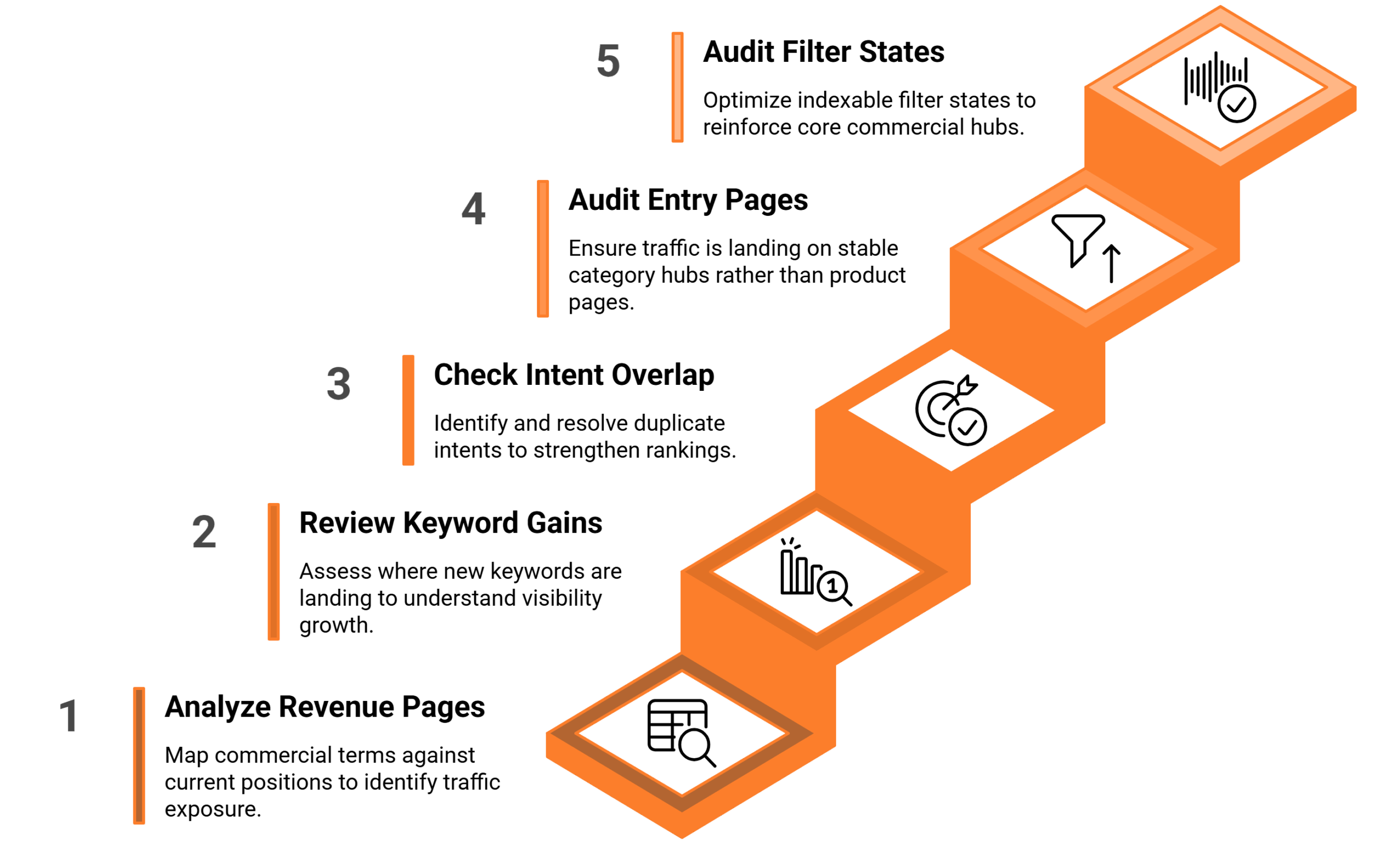
Begin with the category pages that drive organic sales. Map their primary commercial terms against current positions. If most sit between positions 5 and 10, your traffic is exposed. A small slide can reduce sessions without setting off obvious alarms, because that band is fragile.
Measure Rank Depth, Not Keyword Count
Only when it appears in clickable rankings does keyword growth become significant. Look at your recent gains and where they sit today. Are new terms breaking into the Top 3, or clustering outside page one? Visibility growth beyond page one expands footprint, but it rarely changes traffic in a measurable way. If most gains live between positions 11 and 30, you already have your answer.
Eliminate Internal Ranking Conflicts
When multiple URLs chase the same commercial phrase, rankings rotate instead of strengthening. The authority is split among a category page, a filtered variation, and a long-form guide targeting the same intent, so none of them becomes the clear owner.
Assess the Stability of Your Organic Base
Look at where organic sessions land. If a large share enters through product pages rather than category hubs, your base is less stable than it appears. Products cycle through inventory changes, pricing shifts, and availability issues. Category hubs can accumulate demand over time and hold it.
Audit Indexable Filters and Taxonomy Pages
Check whether filter states and taxonomy pages are indexable at scale. Thin variations can inflate keyword visibility while quietly absorbing internal link equity that should be reinforcing your core commercial hubs.
The Four-Question Rank Audit
If you want a quick read on where you stand, answer four questions:
- Which revenue-driving terms are in the Top 3?
- Which are stuck mid-page one?
- Which has slipped just outside Page 1?
- Which URLs compete for the same intent?
When you focus on ranking depth and authority distribution instead of total keyword count, the pattern becomes obvious. You can see whether you are building upward or just spreading wider.
What Good SEO Looks Like on WooCommerce in 2026
If visibility is expanding but traffic is not compounding, the answer is usually less concentration. Most WooCommerce stores already have enough pages indexed. The issue is concentration.
Good SEO on WooCommerce in 2026 looks disciplined. Category pages are treated like revenue assets, not just product grids. They carry clear intent, they get reinforced through internal linking, they are updated as competitors evolve, and when they earn premium positions, they are protected instead of ignored. Overlap gets cleaned up; if three URLs chase the same commercial term, one becomes the clear authority, and the others support it or get consolidated so signals stop splitting.
Indexable filter states and thin taxonomy pages are controlled because they can inflate keyword counts while quietly draining crawl attention and internal equity away from the pages that pay the bills. Internal linking becomes intentional; new content is used to strengthen primary commercial hubs, not just expand the site outward. The goal is simple and measurable: move your most valuable pages from positions 5 to 10 into premium slots, then keep them there.
If you want to know whether you are dealing with a fixable ranking depth issue or a real ceiling in your category market, contact us. We will review your keyword-to-traffic distribution, identify where rankings are clustering outside click territory, and map what to consolidate first so visibility starts turning into consistent traffic.