

With the beginning of 2026, OpenAI started the year like a fuse, quietly lighting a new chapter for ChatGPT. The company says it is starting to test ads inside the product, a clear signal that one of the most-used AI tools is entering a new phase of monetization. This first rollout is limited to users in the United States on the Free and Go plans, while Plus, Pro, Business, and Enterprise remain ad-free.
OpenAI previewed this direction publicly in January 2026, describing the program as a small test with firm guardrails. The big distinction, at least based on what OpenAI has said so far, is placement and influence: ads are shown separately from answers, and they are not supposed to shape what ChatGPT says. Instead, they appear after a response and only when the conversation suggests a relevant product or service. That makes this feel less like traditional search or social advertising and more like ads triggered by conversational context. For many brands, this is less about adding a new placement and more about navigating AI transformation, where advertising, discovery, and decision-making start to merge inside conversational systems.
Because this is a new format, a lot of people are understandably unsure how it actually works in practice, how results are measured, and what pricing looks like. This article stays focused on the mechanics. We will walk through how ads appear, what data advertisers can see, and what is currently known about how pricing is structured.
What ChatGPT Ads Are
ChatGPT ads are not baked into answers, and they are not disguised as recommendations. When an ad appears, it shows up after ChatGPT responds, in a clearly labeled sponsored section below the answer. The response itself is unchanged.
These ads only surface when the conversation points toward a product or service that could reasonably be relevant. If someone is asking for help planning a trip, researching tools, or comparing options, an ad might appear. If the conversation stays informational or touches sensitive topics, nothing shows up.
OpenAI says ads will appear on Free and Go and remain off for paid tiers. OpenAI has also described guardrails around who sees ads and where ads can appear. Users under 18 are excluded, and ads will be kept out of sensitive categories such as health, mental health, and politics.
The other important thing to understand is that these ads are not trying to pull attention away from the conversation. They exist as an optional layer beneath it. You can ignore them completely and still get the full answer you came for.
How ChatGPT Ads Work
Most people want to know one thing: how do ads actually show up in ChatGPT?
When an ad appears in ChatGPT, it shows up after the response is delivered. The answer always comes first. Ads are placed below the response in a separate, clearly marked section, so there’s no confusion about what is sponsored and what is not.
Advertising is one way to expand access without requiring most users to subscribe. What’s notable is how deliberately OpenAI is approaching that shift.
When OpenAI announced ad testing in the United States, it emphasized structural safeguards designed to preserve trust. As reported by WIRED, ads are displayed separately from answers, clearly labeled as sponsored, excluded from sensitive categories, and removed entirely for paid tiers. OpenAI has also stated that ads do not influence how responses are generated.

The company has been explicit about the risk involved. If users believe advertising affects answers, the value of the product breaks down. This is why ads are positioned as an optional layer below the conversation rather than integrated into it.
Whether an ad appears at all depends on the conversation itself. The system evaluates the conversation’s context to determine whether a relevant ad should appear. OpenAI describes ad matching as contextual to the conversation, rather than built around advertiser access to user profiles. Instead, ads are matched based on the conversation’s topic and intent signals.
If someone is asking for advice, comparing options, or exploring services, an ad may surface. If they are learning, venting, or talking through something personal or sensitive, it will not. OpenAI has been explicit about keeping ads out of health, mental health, political, and other regulated conversations.
The formats being tested are intentionally simple. So far, most examples look like sponsored product or service listings. In some cases, especially around shopping or travel, these appear in a compact group rather than as a single listing. OpenAI has also signaled that ads may become more interactive over time, allowing users to ask follow-up questions directly, but always within a clearly labeled sponsored context.
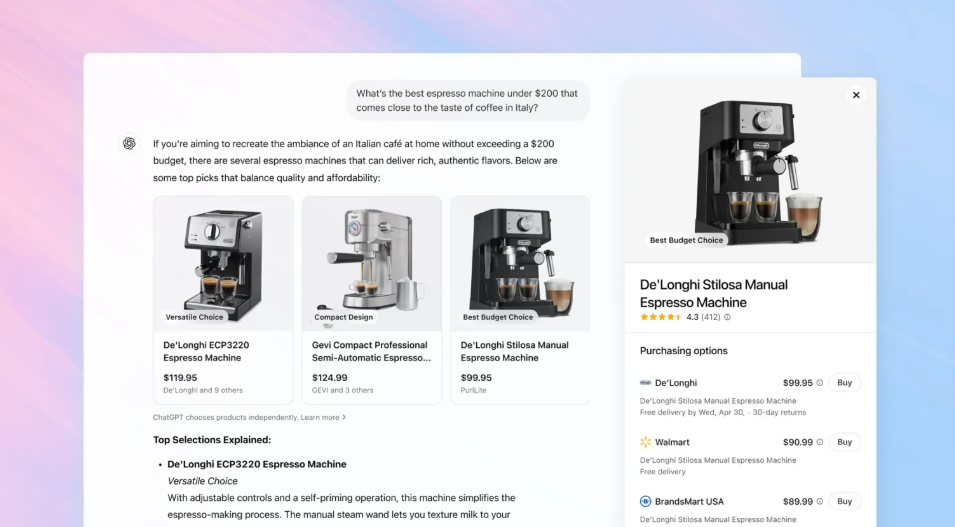
What matters here is that ads do not drive the conversation. They respond to it. The chat still moves at the user’s pace, and the ad sits quietly underneath, available but not intrusive.
Tracking and Reporting
In early tests, tracking for ChatGPT ads exists, but it is intentionally limited. Advertisers do receive performance data, but it looks very different from what they are used to on platforms like Google or Meta.
What advertisers can see today is basic, aggregated reporting. That typically includes how many times an ad was shown and how many times it was interacted with. The numbers are totals, not tied to individual users or sessions.
What advertisers do not get is just as important. There is no user-level data. There are no demographics, no interest profiles, and no visibility into who saw an ad beyond the aggregate counts. There is no standard conversion tracking or attribution path, and advertisers cannot follow a user from a conversation to a later purchase or signup. If you are used to dropping a pixel and watching the funnel light up, ChatGPT will feel unfamiliar. It does not allow tracking pixels, third-party trackers, or external analytics integrations, and OpenAI has framed that as a deliberate design choice.
Another point OpenAI has emphasized is that conversations inside ChatGPT are private and not exposed to advertisers. Ads are matched to the topic of the conversation, not to a profile of the person having it. In a chat-based environment where research, comparison, and decision-making can all happen without a click, traditional attribution becomes difficult to define and easy to misuse.
In practice, this means ChatGPT ads behave more like an influence channel than a performance one. They can introduce a product at the moment someone is thinking about a problem, but they do not offer the feedback loop needed to optimize toward cost per acquisition or return on ad spend. Any impact is more likely to show up indirectly, through brand recall, branded search, or later actions that cannot be cleanly tied back to a single ad impression.
Understanding this upfront matters. ChatGPT ads are not built to be optimized the way search or social campaigns are, and treating them that way will only lead to confusion.
The Measurement Problem
Measurement is the right place to focus because the issue is not missing data. It’s that the usual measurement models don’t fit the way conversational AI influences decisions.
In search and social advertising, performance is measured through visible actions. A user clicks an ad, visits a site, and converts. That path can be tracked, optimized, and attributed. ChatGPT changes that flow. Research, comparison, and recommendation often happen entirely inside the conversation, without a click.
An ad may be seen, considered, and remembered without triggering any immediate action. A decision can happen later, through a direct visit, a branded search, or an offline purchase. From a reporting standpoint, that influence is invisible.
This is why ChatGPT ads do not support traditional attribution models. It is not a temporary limitation or a missing feature. It reflects how decision-making shifts when answers and recommendations are delivered conversationally rather than through links.
Understanding this measurement problem upfront is essential. Without it, advertisers risk judging the channel by metrics it was never designed to produce.
Pricing and Buying Model
Early reporting suggests ChatGPT ads may be priced on a CPM basis, with rates discussed in the $50 to $60 range. OpenAI has not published official pricing publicly, and the numbers being discussed reflect early reporting.
The premium is easier to understand when you think about where the ad shows up. Don’t think of this as passive inventory. Think of it as a placement that appears while someone is actively evaluating options. That can make sense for brands that win on consideration and trust, but it’s a poor fit for teams that need clean, last-click attribution to justify spend.
Access is still controlled. OpenAI has not described a broadly available self-serve platform, and early campaigns appear to run through managed setups. In practice, the first hurdle is eligibility: what categories are allowed, what topics are excluded, and how tightly you can control adjacency. This is where working with an AI ad agency that understands platform constraints matters more than creative volume or bid tactics.
The smarter way to interpret early pricing is not as a performance guarantee but as a cost of learning. If you test this channel, the goal should be to understand lift, not chase immediate ROAS. The teams who will get the most out of early experiments are the ones who already have strong brand search demand, clear landing pages, and a measurement plan that can capture directional impact over time.
For now, in the early stage of ChatGPT ads, it makes sense to treat them as a premium, limited-access placement. Over time, if inventory expands and self-serve opens, pricing will likely normalize, but the measurement model will still look different from what advertisers are used to.
What’s Still Unclear
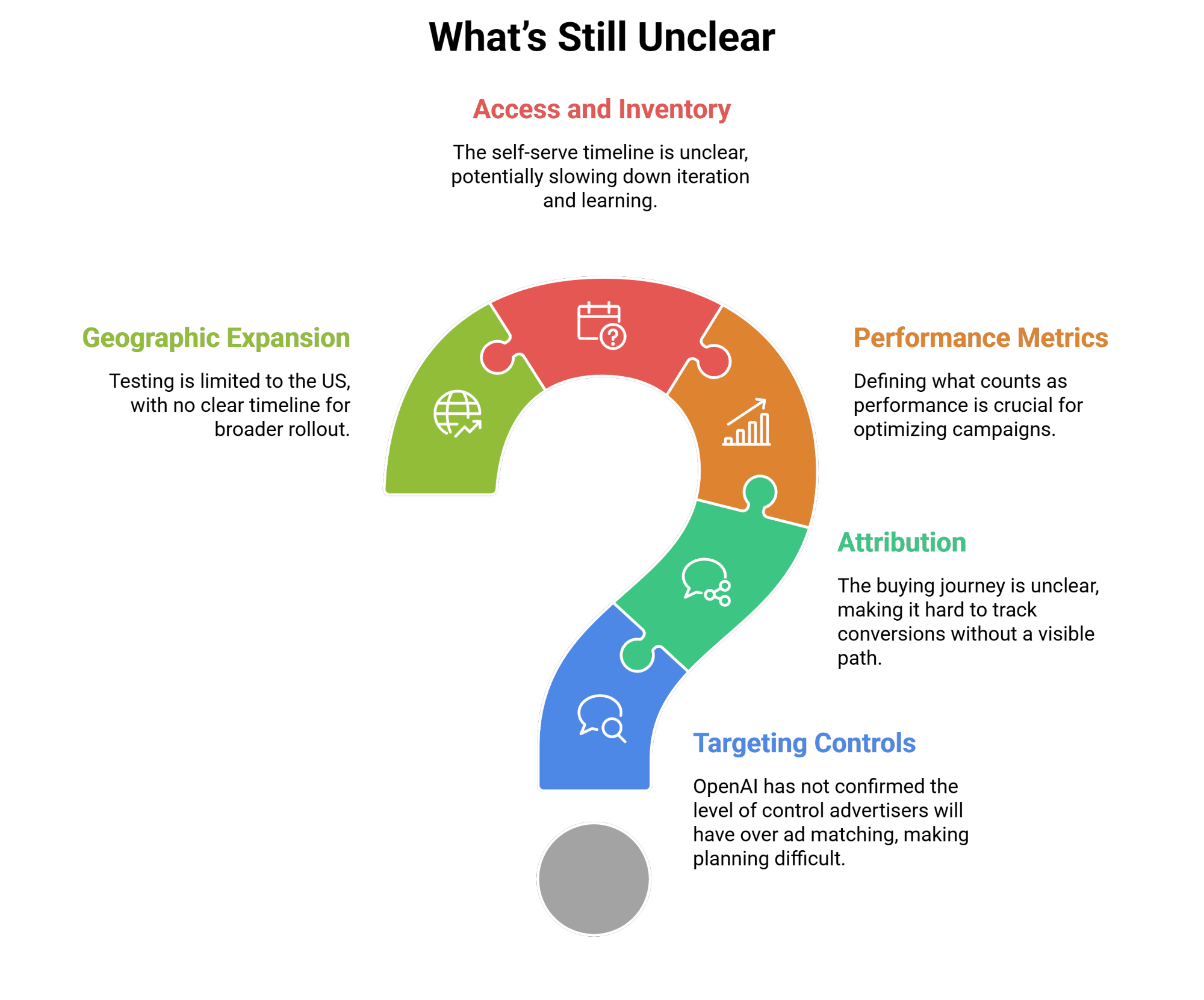
Even with the announcements and early testing, some of the most important details are still not fully spelled out. That matters, because the missing pieces are not minor settings. They affect how you plan, how you measure, and whether you can even justify running a test in the first place.
Targeting Controls
OpenAI has been clear that ads are matched to what the conversation is about. The part that is still fuzzy is how much control advertisers will have around that match. Today, most teams rely on guardrails as much as they rely on targeting. Categories, exclusions, adjacency rules, brand safety filters, and even the ability to say “do not show me near this kind of intent.” OpenAI has not confirmed what that control layer will look like yet, and without it, planning feels like buying into a room where you do not get to choose the corners.
Attribution and the Buying Path
Attribution is another open question. OpenAI has drawn a firm line around privacy and limited reporting, and it has suggested measurement may evolve, but how far that can go without breaking trust is still unknown.
The bigger issue is that the buying journey itself gets messy inside a conversation. With search or social, you can usually point to the moment where somebody left the platform. A click, a landing page, a checkout session, a form fill. ChatGPT does not always create that moment. A person can see an ad, register the brand, keep talking, and then come back later through a direct visit, a branded search, a different device, or even an offline purchase. If you are used to tying spend to a visible path, that takes some mental rewiring.
Here’s the difference in how the journey often looks:
Traditional path:
Search → Compare → Click → Visit site → Purchase
AI-assisted path:
Ask AI → Get a recommendation → Purchase later, sometimes without a click
Once you see it laid out like that, the measurement problem feels less like a missing feature and more like the shape of the channel.
What Counts as Performance Here
Even if reporting expands over time, there is still a basic question underneath it: what are you actually supposed to optimize for? Impressions and clicks are straightforward, but conversations are not. If someone sees the sponsored unit, does not click, and then asks a follow-up question inside the chat, is that a win? If someone reads it, remembers the name, and converts two weeks later, does that get counted anywhere? Those definitions matter because they decide whether this becomes a brand channel, a test-and-learn channel, or something that eventually supports performance goals.
Access, Inventory, and How Buying Works
The self-serve timeline is still unclear. Managed campaigns make sense at the beginning, but they change how teams operate. It slows iteration, it limits experimentation, and it makes rapid learning harder. That matters here because this format already demands testing. Without quick cycles, you can end up with a channel that feels expensive simply because it is hard to learn.
Geographic Expansion
Geographic expansion is also unresolved. Testing is still confined to the United States, and OpenAI has not given a clear timeline for broader rollout. Europe is an obvious question mark, not because of demand, but because regulation will shape what is possible and how fast it can happen.
What This Means for Your Next Move
These uncertainties do not mean the platform is unstable. They simply reflect how early this advertising model still is. For advertisers, that changes the job. The question is not how fast you can launch; it is whether you can run a test you will actually learn from, given the limits on targeting, attribution, and access. If you want help evaluating whether ChatGPT ads make sense for your goals right now, or whether PPC services are a better fit, contact us to talk through whether a test is worth running and what you should have in place before spending a dollar.