

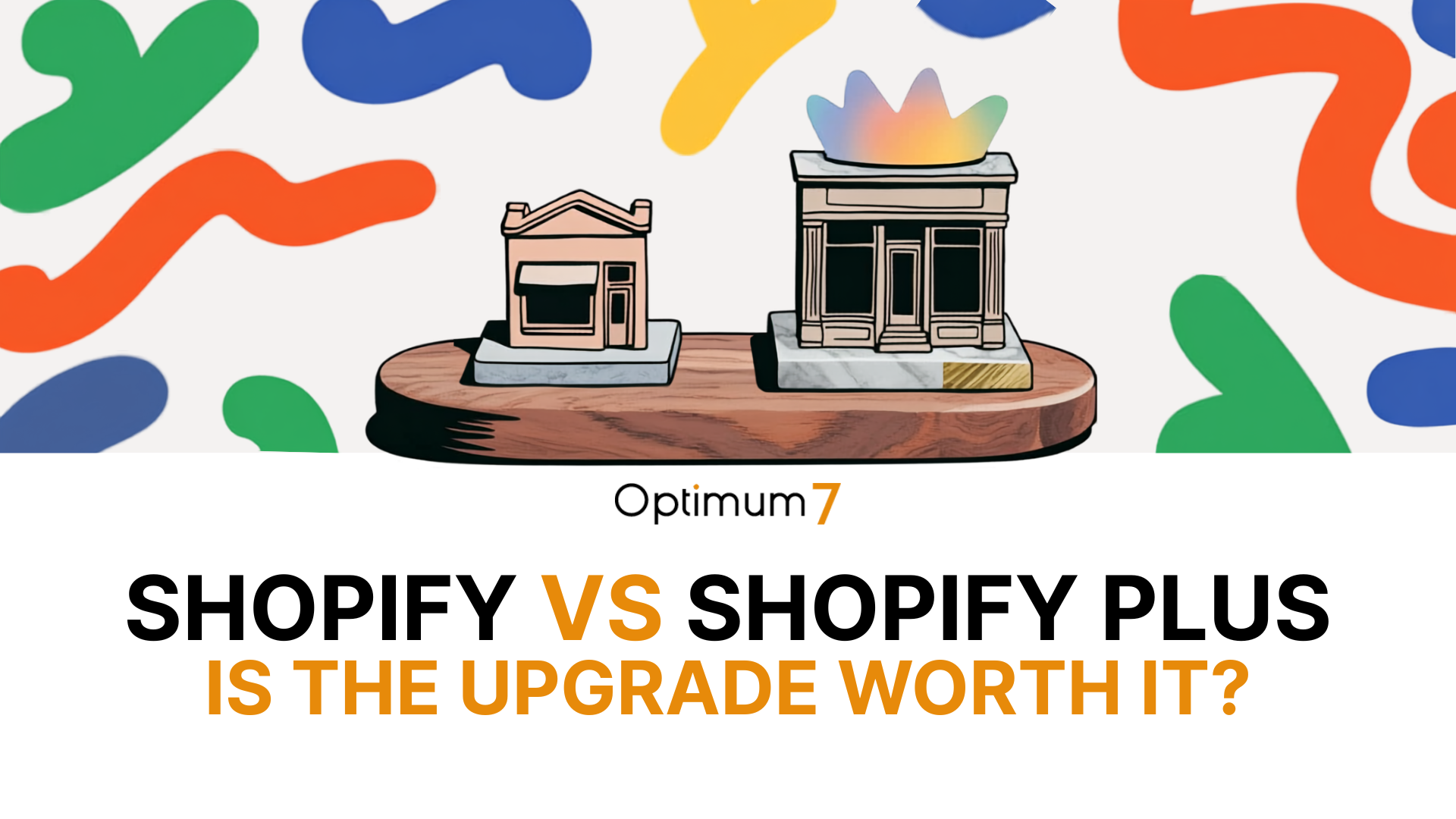
TL;DR: Shopify Plus starts at $2,300 per month on a three-year term. The fee buys checkout code access, the lowest card rates Shopify offers, deeper B2B tools, and nine expansion stores. Between $1 million and $2 million in annual revenue, the math starts favoring the upgrade; below that, Advanced at $399 usually wins.
Should you move to Shopify Plus, and is it worth it? Optimum7 has heard that question from Shopify merchants for over a decade, and the honest answer keeps moving. Both plans share the same core platform, the same themes, and the same app store. The $2,300 per month question is control: who can touch the checkout, how deep B2B pricing goes, and how many storefronts one contract covers.
The answer changed more in the past two years than in the previous five. checkout.liquid is gone, Shopify Scripts stopped executing on June 30, 2026, core B2B features reached every plan in April 2026, and Plus pricing now runs on one-year or three-year contract terms. This comparison reflects the 2026 numbers, with documented client results where the argument needs proof.
Duran Inci and the Optimum7 team first worked through this question in the Surge Session episode below. The sections that follow update every figure and feature line for 2026.
The Core Differences Between Shopify and Shopify Plus
Shopify Plus is the same product with the ceiling removed. Stores on Basic, Grow, and Advanced run identical storefronts, themes, and apps; the differences concentrate in four places: checkout access, transaction economics, B2B depth, and multi-store management.

| Capability | Standard Shopify (Basic, Grow, Advanced) | Shopify Plus |
|---|---|---|
| Monthly price | $27 to $399 ($19 to $299 on annual billing) | From $2,300 on a 3-year term; $2,500 on a 1-year term |
| Checkout control | Branding settings, Thank You and Order Status pages, public checkout apps | Information, shipping, and payment pages via Checkout Extensibility |
| Fee for outside payment gateways | 2% Basic, 1% Grow, 0.6% Advanced | 0.2% |
| B2B selling | Company profiles, payment terms, volume pricing, up to 3 active catalogs | Unlimited catalogs, direct company assignment, deposits and partial payments |
| Storefronts | One store per plan | Main store plus 9 expansion stores included |
| Staff accounts | 5 on Grow, 15 on Advanced | Unlimited |
| Discount and shipping logic | Public apps from the Shopify App Store | Custom Shopify Functions apps and Launchpad |
Shopify Plus Pricing in 2026

Shopify Plus costs $2,300 per month on a three-year term or $2,500 per month on a one-year term, which puts the platform fee at $27,600 to $30,000 a year before apps, development, or payment processing. Higher-volume operations leave the flat fee entirely: Shopify’s pricing page notes that complex, high-revenue businesses switch to a variable platform fee based on revenue and business model.
The fee looks worse than it nets out, and that was already true when Plus cost $2,000 back in 2022. Plus carries the lowest Shopify Payments card rates of any plan. Stores running an outside gateway pay Shopify just 0.2% per transaction on Plus, against 2% on Basic, 1% on Grow, and 0.6% on Advanced.
Third-Party Gateway Fee by Shopify Plan
Extra fee Shopify charges per transaction when you use an outside payment processor
2%
1%
0.6%
0.2%
Fee applies on top of your gateway’s own processing rate. Shopify, 2026.
Run the arithmetic on the Advanced-to-Plus jump. The plan gap is about $1,901 per month on the three-year term. A store processing through an outside gateway saves 0.4 percentage points on every dollar, so at roughly $475,000 a month in card volume, the fee savings alone cover the entire upgrade. Below that volume, the platform fee has to earn its keep through conversion gains, wholesale terms, or multi-store consolidation.
Checkout Customization Is Still the Strongest Plus Advantage
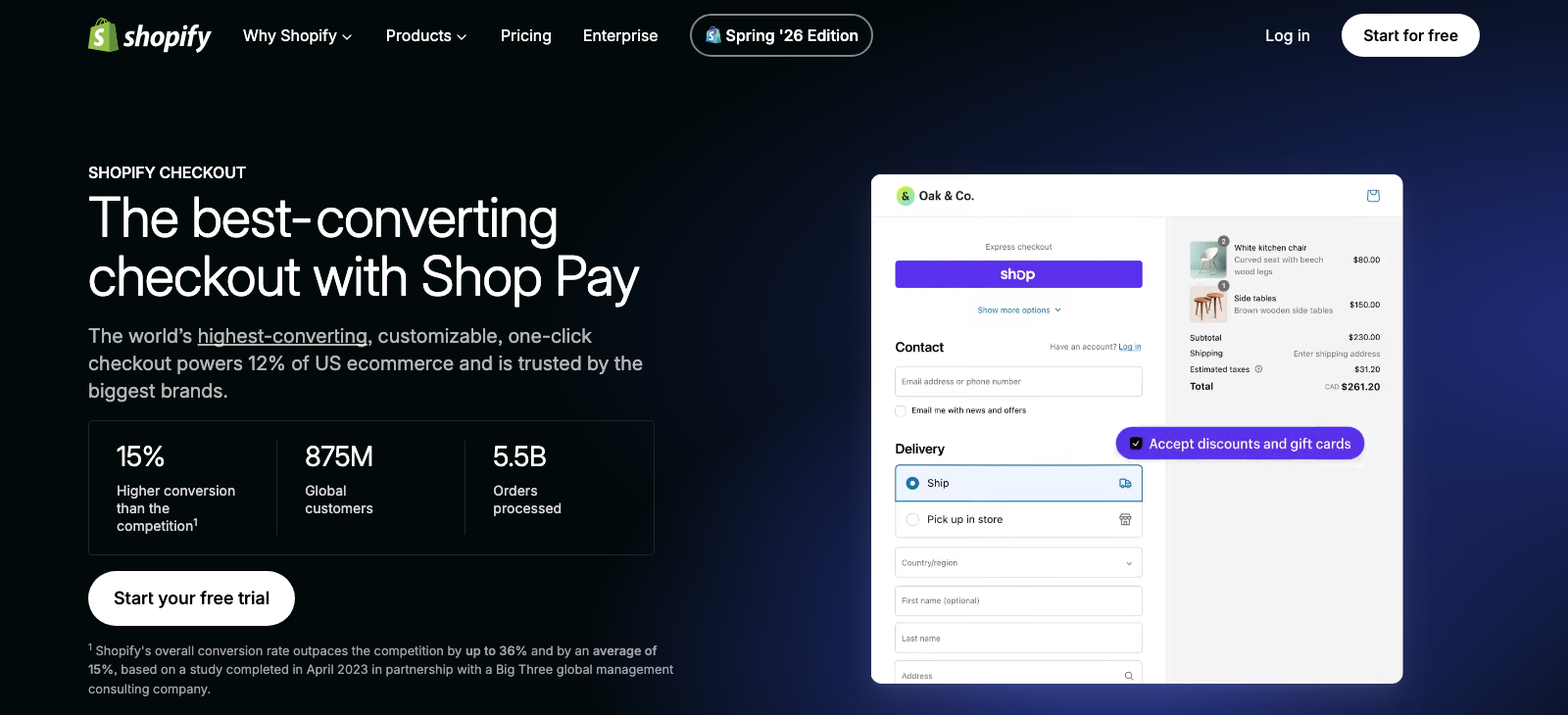
Checkout access is the sharpest line between the plans. Standard plans customize branding, the Thank You page, and the Order Status page. Only Plus stores can modify the information, shipping, and payment pages through Checkout Extensibility, and only Plus stores can run custom apps built on Shopify Functions APIs; every other plan is limited to public apps from the App Store.
The ground under this advantage moved twice. Shopify retired checkout.liquid for the checkout pages in August 2024, then shut down Scripts entirely: editing ended April 15, 2026, and execution stopped on June 30, 2026. Plus stores that never rebuilt their Scripts-era discount or shipping logic have already lost it, which makes this the right moment to rebuild those customizations on Functions.
What does code-level checkout access buy in practice? Optimum7 has built each of these for Plus merchants:
- E-signature agreements at checkout. Appliance and warranty sellers display a dynamically generated agreement populated with the product details, shipping address, and customer name, signed before payment completes.
- Address-type validation for regulated products. CBD distributors are barred from shipping to residential addresses, so the checkout calls a third-party API to classify each address and blocks residential destinations with a corrective message.
- One-click post-purchase upsells. True one-click offers require custom fields inside the checkout flow itself, which standard plans cannot expose.
Each of these now ships as a custom Functions app. Optimum7’s custom ecommerce development services cover scoping and building this class of checkout functionality for Plus stores.
B2B and Multi-Store Features by Plan
B2B stopped being a Plus exclusive on April 2, 2026, when Shopify released company profiles, payment terms, volume pricing, vaulted credit cards, and up to three active catalogs to Basic, Grow, and Advanced at no added cost. Comparison guides written before that date, including the earlier version of this post, overstate the gap between the tiers.
Plus still owns the depth. Four capabilities remain exclusive to the plan in 2026:


The operational ceilings widen in the same direction: Plus supports 200 inventory locations against 10 on standard plans, includes 20 POS Pro retail locations, and removes the 15-seat staff account cap that Advanced carries. The multi-store capability itself handles real scale. When apparel retailer Tees2UrDoor and its wholesale sister brand SugarStitch outgrew BigCommerce, Optimum7 split the operation into dual Shopify Plus instances with a headless frontend, migrating 930,000+ orders and 457,000 customer accounts with zero downtime and zero critical data loss. The retail and wholesale storefronts now run separate workflows under one parent; the full build is documented in the Tees2UrDoor dual Shopify Plus case study.
When Upgrading to Shopify Plus Is Worth It
Optimum7 draws the upgrade line between $1 million and $2 million in annual revenue, and earlier when a specific trigger shows you are outgrowing Advanced: you need checkout control, you sell B2B beyond three catalogs, you run more than one storefront, or you keep hitting API rate limits. Revenue alone justifies nothing; the trigger is what converts the fee into a return.
If a five-figure build returns six figures, what does waiting cost? Take a store doing $1.5 million a year that adds one-click post-purchase upsells after upgrading. A 20% lift in average order value is worth $300,000 in new annual revenue, set against $27,600 in platform fees and a build cost in the $5,000 to $15,000 range. Even at half that lift, the upgrade clears its cost several times over. The stores that get value from Plus underwrite the fee like any other investment: expected lift, payback period, and a build plan.
The ceiling on that conversion work shows up in Optimum7’s own client results.
Results at that level depend on who does the work. The guide to choosing a Shopify Plus agency covers what to vet before signing with any partner, Optimum7 included.
When Standard Shopify Is the Better Choice
Below roughly $1 million in revenue with a straightforward catalog, Advanced at $399 per month is the better buy, and staying put is the correct call even for some seven-figure stores. Public Functions apps now handle discount and shipping logic on every plan, core B2B arrived in April 2026, and the Thank You and Order Status pages accept customization without Plus. A niche store selling a handful of products with no wholesale channel gains almost nothing from the upgrade.
The contract deserves as much scrutiny as the feature list. Plus runs on one-year or three-year terms, and Shopify’s own community forums carry threads from merchants who found mid-term downgrades difficult to arrange. The three-year term saves $200 per month against the one-year price; that $2,400 a year buys three years of commitment to a fee schedule your revenue may outgrow in either direction.
A store that needs enterprise capability and dislikes the Plus contract has alternatives. The Shopify Plus vs BigCommerce Enterprise comparison weighs the closest competitor, and the Shopify migration guide covers what moving a store involves if you are arriving from another platform. Optimum7 handles ecommerce migrations in both directions, including stores stepping down from Plus.
Shopify Plus Pros and Cons
The full comparison compresses into a short list. Every point below is covered in detail in the sections above.
- Checkout code access: the information, shipping, and payment pages open to custom Functions apps.
- Best card economics: a 0.2% third-party gateway fee and the lowest Shopify Payments rates of any plan.
- B2B depth: unlimited catalogs, deposits, partial payments, and direct company assignment.
- Ten storefronts under one fee: a main store plus nine expansion stores from a single admin.
- Operational headroom: unlimited staff accounts, 200 inventory locations, and higher API throughput.
- The fee: $27,600 to $30,000 a year before apps, builds, and processing.
- Contract lock-in: one-year or three-year terms, with documented friction on mid-term exits.
- No storefront speed gain: the plans share the same engine, so the upgrade alone leaves load time unchanged.
- A narrowing gap: since April 2026, standard plans include core B2B, closing part of what the fee used to buy.
Frequently Asked Questions
What is the main difference between Shopify and Shopify Plus?
Both run the same core platform, themes, and app store. Shopify Plus adds code-level checkout customization, custom Shopify Functions apps, unlimited B2B catalogs with deposits, nine included expansion stores, higher API limits, and the lowest card rates Shopify offers. Standard plans cap out at Advanced, which shares the same storefront feature set.
How much does Shopify Plus cost in 2026?
Shopify Plus starts at $2,300 per month on a three-year term or $2,500 per month on a one-year term. Higher-volume businesses move to a variable fee based on revenue and business model. Apps, development, and payment processing add to the base, so realistic budgets land well above the platform fee alone.
Do you need Shopify Plus to sell B2B?
No. Since April 2026, company profiles, payment terms, volume pricing, and up to three active catalogs are included on Basic, Grow, and Advanced. Plus becomes necessary at depth: unlimited catalogs, direct assignment to company locations, deposits, and partial payments remain exclusive to the Plus plan.
Can you customize the Shopify checkout without Plus?
Partially. Every plan can adjust checkout branding and customize the Thank You and Order Status pages, and public checkout apps cover common needs. The information, shipping, and payment pages stay locked on standard plans; modifying them through Checkout Extensibility or custom Functions apps requires Shopify Plus.
Is Shopify Plus faster than regular Shopify?
No. Every Shopify plan runs on the same hosting infrastructure and CDN, so the upgrade alone changes nothing about storefront load time. Speed differences between stores come from theme weight, app scripts, and image handling. Plus raises API rate limits, which accelerates backend integrations while page rendering stays theme-dependent.
At what revenue does Shopify Plus make sense?
Optimum7 draws the line between $1 million and $2 million in annual revenue. Above roughly $475,000 in monthly card volume on an outside gateway, transaction fee savings alone cover the upgrade from Advanced. A specific trigger such as checkout control, B2B catalog depth, or a second storefront justifies moving earlier.
About the author: Duran Inci is the CEO and Co-Founder of Optimum7, an ecommerce development and digital marketing agency. He helps mid-market and enterprise brands scale revenue through conversion optimization, SEO, and custom ecommerce solutions.