

TL;DR: Answer engine optimization gets AI systems to cite your brand when they answer a buyer’s question. This guide shows how to structure pages so AI can lift them, which schema matters, and how to measure presence when the click never happens. One Optimum7 client tripled its top-three rankings yet still lost a quarter of its traffic.
A buyer opens Gemini and types, “best hydraulic filter for a Komatsu PC210.” The answer comes back in four sentences, with three brands named inside it. No blue links clicked. No product page visited. The sale is already leaning toward whichever brand the model pulled into that paragraph. If a buyer asked that question about your category tomorrow, would your brand be in the answer, or would your competitor’s?
This is the part of search that traditional SEO advice keeps missing. Ranking first still matters, but ranking first no longer guarantees the visit. Google, ChatGPT, Perplexity, and Gemini increasingly read your page, synthesize an answer, and hand it to the buyer without sending anyone to your site. Answer engine optimization, or AEO, is the work of making sure that when the machine writes the answer, your brand is the source it quotes.
Optimum7 watched this happen inside a live account. An industrial power-generation brand grew its top-three keyword rankings by 222% over twelve months, saw search impressions climb, and still lost 19% of its organic clicks in the same window. Rankings went up. Traffic went down. The queries were being answered before anyone clicked. That single account is the clearest picture of why this change is real, and this guide is the playbook for responding to it.
What Answer Engine Optimization Is, and Why Rankings Stopped Meaning Traffic
Traditional SEO earns a ranking so a person clicks through and reads your page. AEO earns a citation so an AI reads your page, writes the answer, and names you as the source. The two overlap, because a page has to be crawlable and credible to do either. They diverge on the goal: SEO optimizes for the click, AEO optimizes for the mention when there is no click at all.
The scale of the change is measurable. AI Overviews, the AI answers that sit above Google’s blue links, now reach more than two billion people every month. That is the surface a growing share of your buyers see before they reach an organic result.
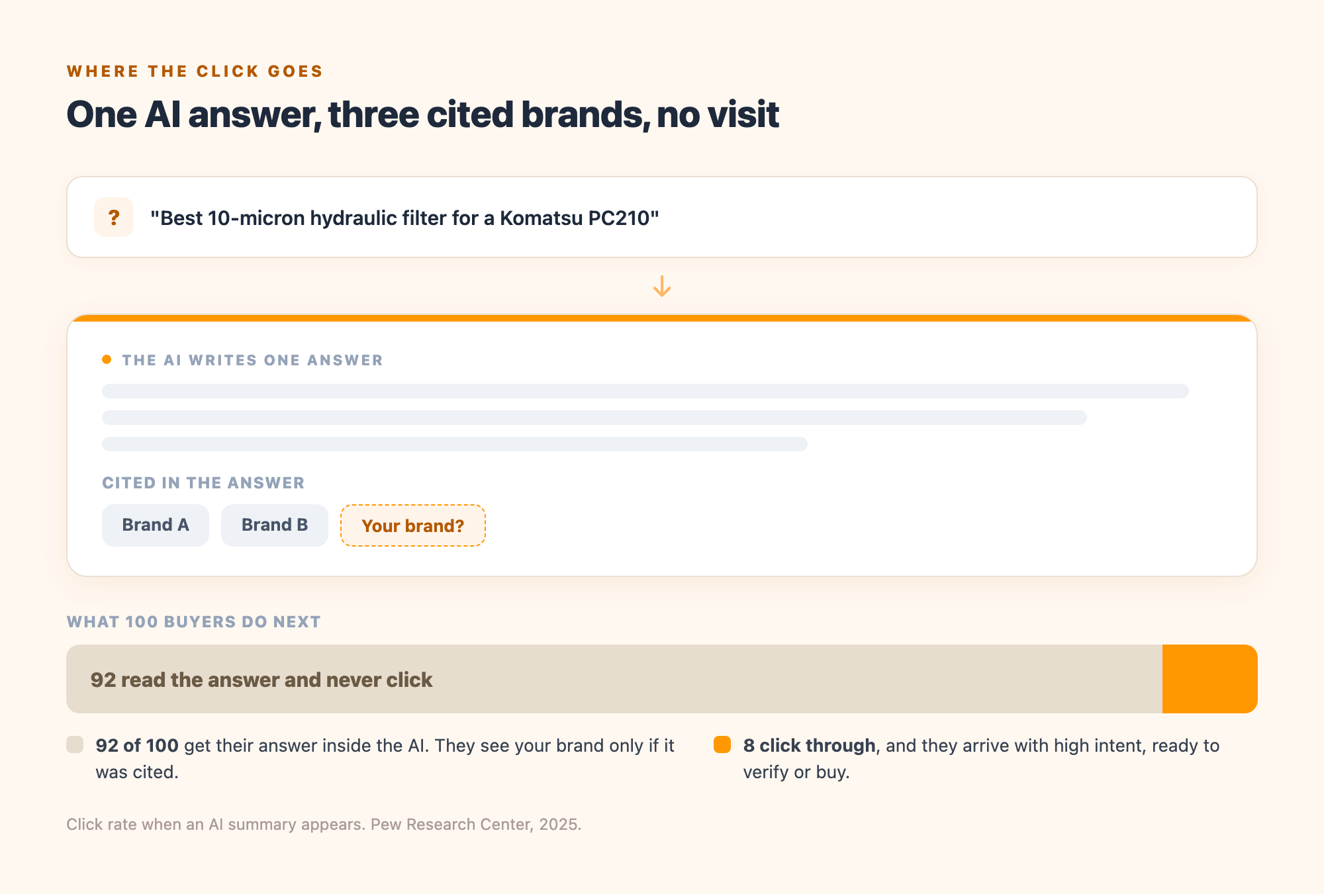
When an AI summary appears, the click almost disappears. Pew Research Center tracked nearly 69,000 real Google searches and found that users clicked a link on just 8% of searches that showed an AI summary, compared with 15% when no summary appeared. Only 1% clicked a source link inside the summary itself. The answer satisfies the question, and the journey ends there.
Share of searches that end in a click
With and without an AI summary in the results
15%
8%
1%
Based on 68,879 real searches. Source: Pew Research Center, 2025.
This is exactly what the industrial power-generation account showed in its own Search Console data. The team concentrated content on purchase-decision queries, built specification and comparison pages, and restructured the material so it would appear inside ChatGPT, Perplexity, and Google AI Mode responses. Rankings and impressions climbed. Clicks did not follow, because the answers were being read inside the AI surface instead of on the site.
The client’s own Search Console data tells the whole story: rankings and impressions climb while clicks fall, because the answer now happens inside the AI. That reads like a loss until you look at what the remaining visits are worth. The buyers who still click arrive later and more decided, and that upside deserves its own section.
AI Traffic Converts Higher Than Google Organic
The zero-click story reads like a loss until you look at what the remaining visits do. AI-referred visitors tend to arrive later in the buying process, after the model has already narrowed their options, so they convert at rates well above generic organic traffic. A smaller number of higher-intent sessions can outperform a larger number of top-of-funnel clicks.
For B2B, the behavior is already mainstream. Gartner found that 45% of B2B buyers now use generative AI to research vendors and products, and 69% still turn to a sales rep to validate what the AI told them. The AI shapes the shortlist; the rep closes the confidence gap. If the answer that builds the shortlist leaves your brand out, the rep never gets the call. Would you rather be one of three names an AI hands a buyer, or the fourth option they never hear?
The takeaway reframes the whole exercise. The goal is no longer to win the click at any cost. The goal is to be the source the model trusts when it assembles the shortlist, because that is where the high-intent buyer forms an opinion. The rest of this guide is about earning that position. For the ranking fundamentals underneath it, Optimum7’s guide to how SEO works covers the crawl-and-index foundation that AEO builds on.
How to Structure Blog Posts and Pages So They Are Liftable
A page is liftable when an AI can pull a clean, self-contained answer out of it without stitching together half-sentences from four paragraphs. The biggest predictor of a citation is placement: the answer sits in one place, stated plainly, near the top. Word count and keyword density matter far less.
Research backs the specific tactics. A Princeton and IIT Delhi study on generative engine optimization tested real content changes across AI answers and found that adding cited sources, direct quotations, and statistics raised a page’s visibility in generated responses by up to 40%. Fluent, factual writing that states things directly gets lifted. Vague, hedged writing gets skipped.
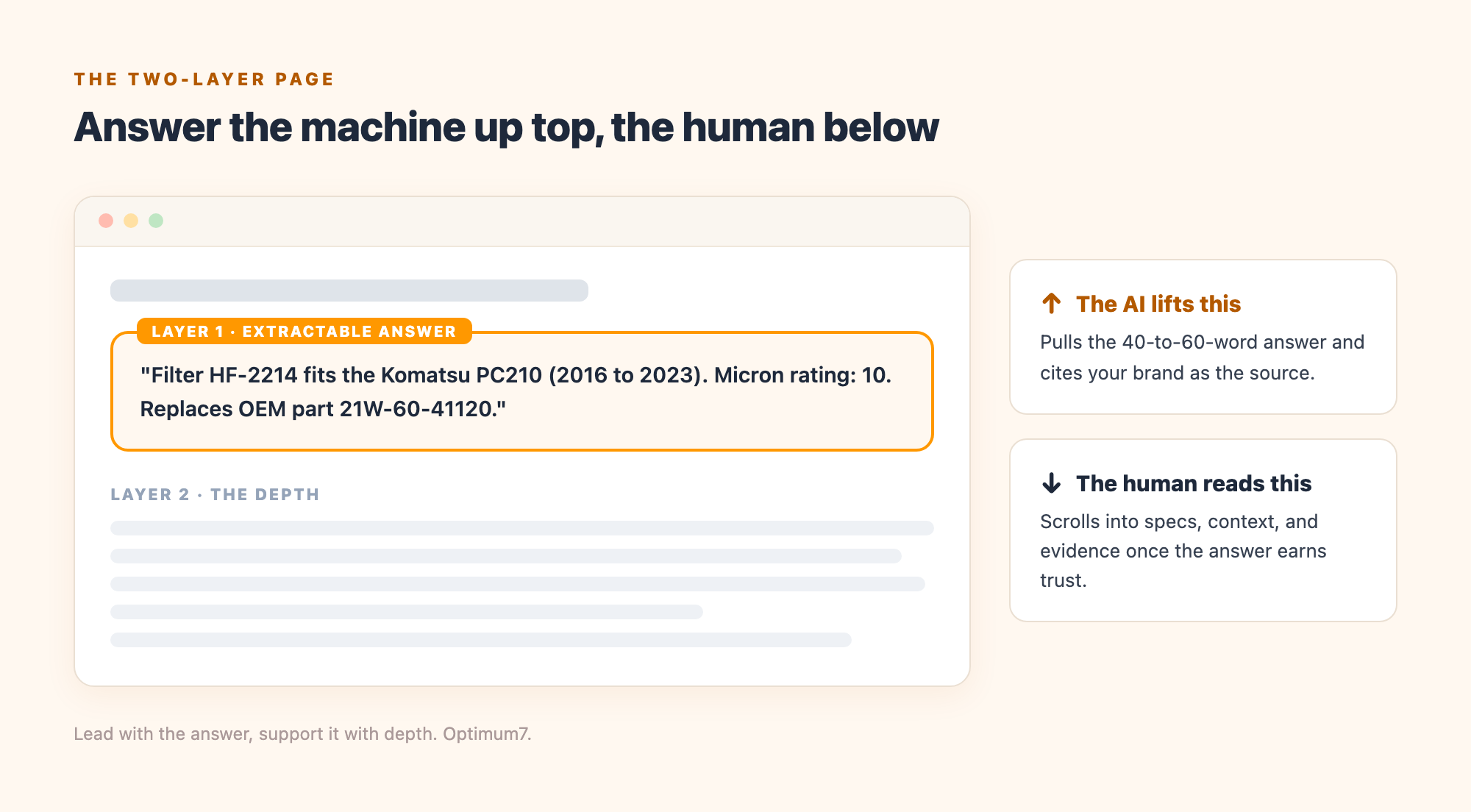
Lead every page with an extractable answer
Open with the direct answer to the question, written as a complete thought in 40 to 60 words. This is the extractable answer: a block an AI can lift verbatim and attribute to you. Put the depth, the caveats, and the supporting detail beneath it. Human readers get a fast answer and the option to keep reading; the machine gets a clean unit to quote.
What is the ideal length for getting cited?
Answer engines favor tight, self-contained passages. A 40-to-60-word direct answer at the top of a section is the sweet spot for a clean lift, followed by 200 to 400 words of supporting depth per subsection for context and ranking. A page can run 3,000 words and still get cited, as long as each section leads with a passage the model can extract without editing. Structure carries the citation; size helps only once the structure is there.
Write headers the way buyers phrase the question
Answer engines match content to prompts, and prompts are questions. A header that reads “Hydraulic Filter Compatibility by Excavator Model” mirrors how a buyer asks, so the model maps the query to your section. A header that reads “Our Product Range” tells the machine nothing. Phrase headings as the question, then answer it in the first line beneath.
Format specs as labeled tables
Compatibility, dimensions, pricing, and part numbers belong in labeled tables and short definition lines, not buried in sentences. A model extracts a clean value from a labeled table with high confidence. It has to guess when the same value is wrapped in a paragraph. The comparison below shows the same fact written two ways.

| How it is written | What the AI can do with it |
|---|---|
| Buried: “Our range of hydraulic filters suits a wide variety of machines, and plenty of customers running mid-size excavators have found them a great fit for their equipment.” | No model, no part number, no clear yes or no. The model cannot confirm compatibility, so it skips the page and quotes a competitor that stated it plainly. |
| Liftable: “Filter HF-2214 fits the Komatsu PC210 (2016 to 2023). Micron rating: 10. Replaces OEM part 21W-60-41120.” | A confirmed compatibility fact with model, years, spec, and cross-reference. The model lifts it directly and names your brand as the source. |
Optimum7 covers the on-page mechanics of this in more depth in the guide to SEO for AI-based search engines, and the content-structuring fundamentals in building a content hierarchy for SEO.
Schema Markup for Answer Engine Optimization, and Its Real Limits
Schema markup is worth doing, and it is oversold. Optimum7 uses structured data on every technical product build, because it powers rich results, feeds product data to shopping surfaces, and removes ambiguity about what a page contains. On the industrial fasteners account below, schema was part of a program that doubled page-one keywords after migration. What schema does not do is force an AI citation on its own.
Google is explicit about this. Its own documentation on AI features states there is “no special schema.org structured data that you need to add” to appear in AI Overviews or AI Mode. Eligibility comes from being indexed and snippet-eligible, the same foundation that earns a normal search result. Schema clarifies and qualifies your content; the citation itself still depends on clear answers and real authority.
Use schema where it earns its keep: to disambiguate specs, mark up FAQs so each question and answer is a discrete unit, and describe products so price, availability, and attributes are machine-readable. Match the markup to the content type on the page.

| Schema type | What it clarifies | Use it on |
|---|---|---|
| FAQPage | Isolates each question and answer as a discrete, quotable unit | Support pages, buying guides, category explainers |
| Product & Offer | Makes price, availability, SKU, and attributes machine-readable | Product and collection pages |
| HowTo | Marks an ordered procedure the model can reproduce as steps | Installation, replacement, and setup guides |
| Article & Author | Attributes content to a named, credentialed author and date | Blog posts, technical references, expert commentary |
| DefinedTerm | Anchors a glossary definition as the canonical meaning of a term | Industry glossaries and specification wikis |
For a deeper walkthrough of structured data on technical catalogs, see Optimum7’s guide to schema SEO for industrial ecommerce.
Answer Engine Optimization for Ecommerce and Industrial B2B Stores
AEO advice is usually written for blogs, so it skips the pages that sell: product pages, collection pages, and spec sheets. For a Shopify, BigCommerce, or industrial catalog, the citable asset is the structured product fact. When a buyer asks an AI for “the best 10-micron hydraulic filter for a mid-size excavator,” the model is assembling that answer from whichever pages state compatibility, micron rating, and cross-reference numbers most clearly. Optimum7’s guide to AI-powered parts portals for manufacturers shows how distributors structure that data at scale.
Industrial spec sheets and datasheets are among the most citable content a manufacturer or distributor owns, because they are dense with the exact facts AI answers need. That density is also a risk. Answer engines misread ambiguous spec data, and in technical categories a wrong extraction is worse than no extraction.
Two Optimum7 industrial accounts show what happens when a catalog is built so machines can extract its facts cleanly. Both put in the technical foundation, clean indexation, schema, and clear compatibility data, that AEO depends on.
Not every page is equally exposed, and the smart move is to defend the pages AI is most likely to intercept while conceding nothing on the pages that still earn the click. Informational and “best of” queries are where AI answers dominate; transactional pages with clear purchase intent hold up better, because the buyer still wants to see the product, the price, and the checkout. Optimum7’s ecommerce content marketing checklist maps which content types to build for each stage.
The catalog structure that makes this possible, clean faceted navigation and precise indexation across thousands of SKUs, is the same work that powers on-site AI search. Optimum7’s guide to AI-powered search and filter functionality covers the catalog side, and the broader platform decision sits in the guide to choosing an ecommerce platform.
Earned Media and Off-Site Signals AI Engines Cite
Perfect page structure is necessary and insufficient. Answer engines pull heavily from off-domain sources, and each one weights those sources differently. A Peec AI analysis of 30 million citations across the major AI engines found that Reddit is the single most-cited source, followed by YouTube and LinkedIn. Your tidy product page competes with a Reddit thread and a review site for the same slot in the answer. For product-level tactics, see Optimum7’s guide to getting your products recommended by AI.
The engines behave like separate audiences. Treating “AI search” as a single target is a common failure. Each engine sources and cites differently, so the same page can be quoted by one and ignored by another.

| Engine | Where it pulls from | What earns a citation |
|---|---|---|
| Google AI Overviews | Google’s own index, weighted toward pages that already rank | Snippet-eligible pages with clear, extractable answers near the top |
| ChatGPT | Bing’s index for live retrieval, plus training data and licensing deals | Established authority and third-party mentions, on top of on-page clarity |
| Perplexity | Real-time web search, refreshed constantly | Fresh, entity-rich pages with specific names, models, and numbers |
| Gemini | Google’s index and Knowledge Graph, tied to entity relationships | Strong entity signals and consistent brand information across the web |
This is why earned media and third-party presence matter as much as your own pages. AI reflects the authority you have already built across review sites, forums, and trade press, and it rarely manufactures visibility from a single page.
One caution the polished guides skip: getting cited and getting cited well are different outcomes. Models index unmoderated opinion, and positive and negative mentions get pulled into answers at similar rates. A brand can be lifted into an answer as the cautionary example. Monitoring what the engines say about you, covered next, is how you catch that before it costs a deal.
How to Track AI and LLM Mentions of Your Brand and SKUs
The click was the metric that made SEO measurable, and AEO breaks it. When the answer happens off your site, sessions undercount your influence. The industrial generator account is proof: by clicks alone the year looked like a decline, while rankings, impressions, and AI presence all grew. You need metrics that capture presence, since visits alone undercount it.


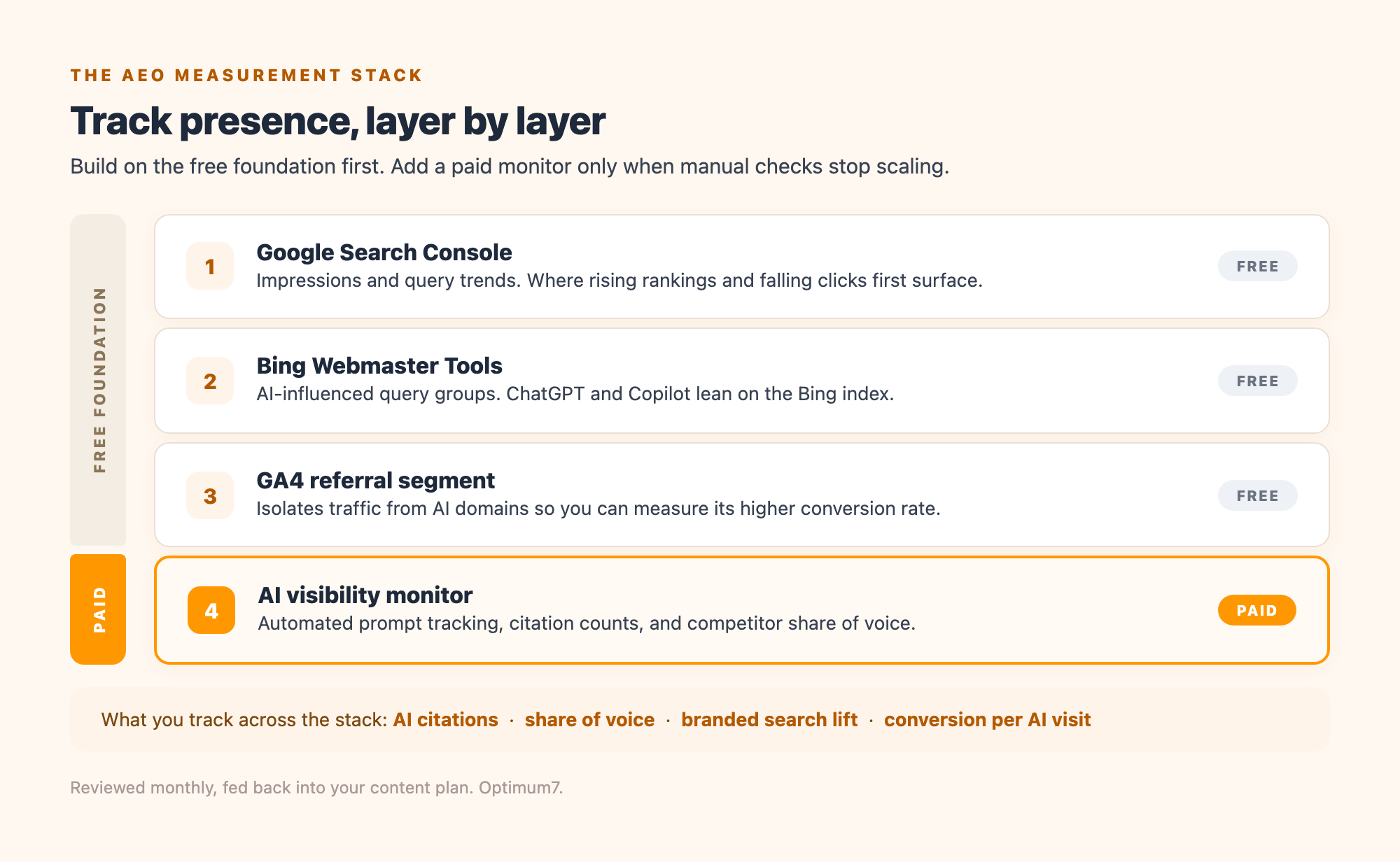
The tracking stack is more available than teams expect, and much of it is free. Google Search Console still shows impressions and query trends, which is where the generator brand’s paradox first surfaced. Bing Webmaster Tools reports grouped, AI-influenced queries, useful because ChatGPT and Copilot lean on Bing’s index. A referral segment in GA4 isolates traffic from AI domains so you can measure its conversion rate. Paid AI-visibility monitors add automated prompt tracking and competitor share of voice on top of that foundation. Start with the free layer, then add a paid monitor when the manual checks stop scaling. Optimum7’s overview of the best AI tools for SEO and content marketing breaks the categories down further.
Put the whole program in order, and the implementation sequence looks like this.
Citation Instability: Why AI Answers Change Overnight
A citation you earn today can vanish tomorrow, and this is the part AEO guides routinely skip. Practitioners running daily tests report that AI answer sets move far faster than search rankings, and that Google’s AI Mode and ChatGPT agree on their top recommendations less than half the time. A page-one ranking can hold for weeks; an AI citation can turn over within a day.
The response is durability, not one-off wins. Broad, consistent presence beats a single perfectly-tuned page, because the model is sampling a wide set of sources and re-sampling constantly. Depth of coverage, consistent brand facts across the web, fresh content, and earned mentions on multiple cited platforms are what keep you in the rotation when any single answer reshuffles.
Run this check before you publish anything you want an AI to cite.
Answer engine optimization is the next layer on a healthy search foundation, not a replacement for it. The brands winning AI citations are the ones that already do the technical and content work well, then structure it so a machine can lift it. If you want a partner to build that foundation and the AEO layer on top, Optimum7’s SEO services team does exactly this work for ecommerce and industrial B2B brands. Contact us to see where your catalog stands today.
Frequently Asked Questions
What is the ideal word count for getting cited by answer engines?
There is no fixed word count. What matters is a self-contained answer of 40 to 60 words at the top of each section, followed by 200 to 400 words of supporting depth. A long page gets cited when each section leads with an extractable passage; a short page fails if the answer is buried. Structure decides citation, not length.
Is answer engine optimization different from SEO?
They share a foundation and differ in goal. SEO earns a ranking so a person clicks through; AEO earns a citation so an AI names you as the source, often with no click. Both need crawlable, credible content. AEO adds extractable answers, clear structure, and off-domain presence on top of the SEO fundamentals.
Does schema markup help with answer engine optimization?
Schema helps, within limits. Google states no special structured data is required to appear in AI Overviews or AI Mode. Schema clarifies your content, powers rich results, and makes product data machine-readable, which supports extraction. It qualifies your content and never forces a citation on its own. Treat it as one input alongside clear answers and earned authority.
How do I optimize FAQ content for answer engines?
Give each question its own heading, phrased the way buyers ask it, then answer in a self-contained 40-to-60-word paragraph directly beneath. Keep one idea per answer, add a source or a specific number where you can, and apply FAQPage schema so every question and answer reads as a discrete, quotable unit an engine can lift.
How do I track AI and LLM mentions of my brand or SKUs?
Start free: Google Search Console for impressions and query trends, Bing Webmaster Tools for AI-influenced queries, and a GA4 referral segment for traffic from AI domains. Add a paid AI-visibility monitor for automated prompt tracking and competitor share of voice once manual checks stop scaling. Track citations, share of voice, and branded search lift monthly.
What are the best tools for answer engine optimization?
Think in categories, not brands. You need query and prompt research, a schema validator, a rank and AI-answer tracker, and a citation monitor that checks what the engines say about you. Google Search Console and Bing Webmaster Tools cover the free foundation; paid AI-visibility monitors add automated prompt tracking and share-of-voice reporting when your program scales.
Which answer engine should an ecommerce brand prioritize?
Start with Google AI Overviews, because they reach the largest audience and draw from the index you already optimize for. Add Perplexity if your catalog is technical and fast-changing, since it favors fresh, entity-rich pages. ChatGPT rewards established authority and third-party mentions, so your earned-media work moves it more than on-page edits do. Its paid surface has separate rules, covered in Optimum7’s breakdown of how ChatGPT ads work.
How is answer engine optimization different for B2B versus B2C?
B2B buying runs on specifications and validation, so spec sheets, compatibility data, and comparison content are the citable assets, and 45% of B2B buyers already research vendors with AI before talking to a rep. B2C leans on reviews, product attributes, and “best of” queries. Both reward clear, extractable facts; the source material and buyer journey differ.
About the author: Duran Inci is the CEO and Co-Founder of Optimum7, an ecommerce development and digital marketing agency. He helps mid-market and enterprise brands scale revenue through conversion optimization, SEO, and custom ecommerce solutions.