

TL;DR: Shopify Plus starts at $2,300/month on a three-year term or $2,500/month on a one-year term, with payment processing, apps, and development bringing the all-in cost to $5,000 to $25,000+ per month depending on revenue. For a brand scaling past $1M to $2M a year, the platform’s conversion and automation tools usually earn back the spend.
Shopify Plus is the tier growing brands move to when a standard Shopify plan stops keeping up. Shopify Plus pricing starts at $2,300 a month, and the full monthly cost depends on your sales volume, your apps, and how custom the store is. So how much does Shopify Plus cost per month, and at what point does it start paying for itself? This guide answers both.
Shopify’s pricing changed recently, so older guides are out of date: the base climbed to $2,300 to $2,500, and the third-party payment surcharge is now 0.20%. Optimum7 is a certified Shopify Plus development and migration agency that has replatformed over 1,000 ecommerce stores, so these figures come from building and running real Plus stores. Here is what Plus charges in 2026, what the price includes, and the revenue level where the upgrade earns its keep.
Why Growing Brands Move to Shopify Plus
Brands move to Shopify Plus when a standard plan stops keeping up with their growth. It is the same platform underneath, with more room: deeper customization, real automation, higher capacity, and enterprise-grade support. The upgrade usually happens once a store has outgrown plugin workarounds and wants a platform that scales without a rebuild.
The move often comes from a heavier platform. Brands on Adobe Commerce or a legacy system migrate to Plus to shed server maintenance and unpredictable costs, trading deep custom infrastructure for a hosted platform that stays fast and current on its own. Optimum7 runs those ecommerce migrations, and the pattern is consistent: teams spend less time keeping the store alive and more time selling on it.


Shopify Plus Costs $2,300 to $2,500 Per Month in 2026
The base license is the one number Shopify quotes you directly. On a three-year commitment it is $2,300 a month; on a one-year commitment it is $2,500 a month. Both bill monthly, with hosting, security, and platform updates included. The largest stores move from the flat rate to a variable platform fee.
Above roughly $800,000 in monthly sales, Shopify switches the largest stores to a variable rate. Shopify does not publish the exact percentage; agency partners report it at about 0.35% of monthly sales on a three-year term, with a ceiling near $40,000 a month. Once it triggers, the percentage applies to your entire monthly sales figure, and you pay the greater of the flat fee or the variable rate. For a store under that threshold, the flat fee is the number that matters.
The license also covers one primary store and nine expansion stores. Additional storefronts beyond that run $300 a month each, or a revenue share across all of them, per Shopify’s pricing page. A brand running several regional stores plans that line on top of the base fee.
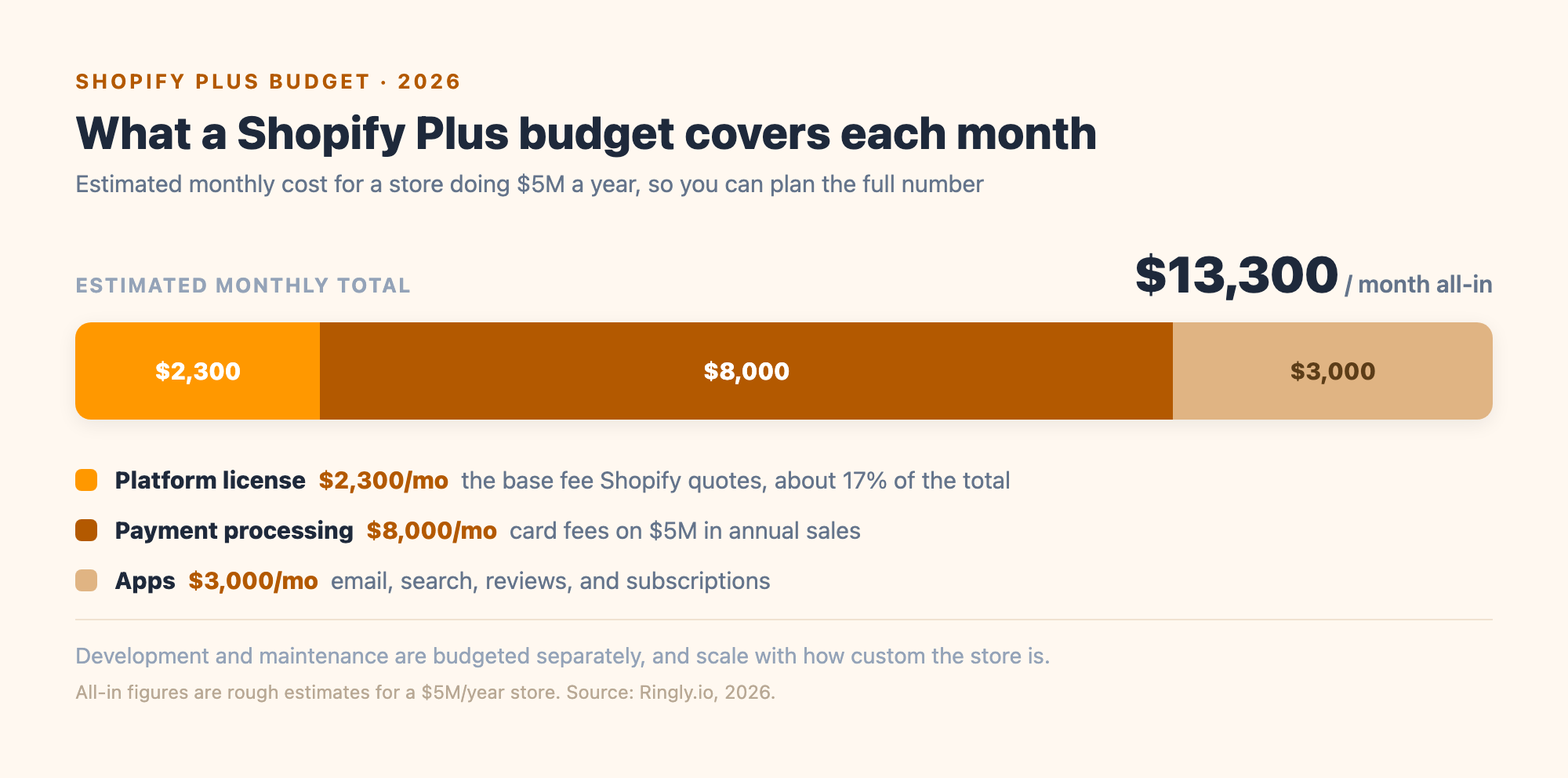
Beyond the license, three things shape the monthly bill: payment processing, apps, and development. Each scales differently, which is why two stores on the same plan can pay very different amounts. Knowing how each one moves is what lets you budget the real monthly number with confidence.
Payment Processing: Shopify Payments vs a Third-Party Gateway
Every order carries a card-processing fee, and on Plus that fee depends on one decision: staying on Shopify Payments or moving to a third-party gateway. Stay on Shopify Payments and you pay only the negotiated card rate, which for a US online credit card typically runs around 2.15% plus $0.30. Route payments through Stripe, PayPal, or Authorize.net, and Shopify adds a 0.20% surcharge on every transaction on top of your processor’s own cut.
That surcharge is small per order and larger in aggregate. On a store doing $5 million a year through a third-party gateway, the 0.20% line alone is roughly $10,000 a year paid to Shopify on top of the processor’s fee. Keeping payments on Shopify Payments is the simplest way to hold that line down.
Apps: A Real Shopify Plus Stack, Priced Out
A mid-size Plus store usually runs email and SMS, search and filtering, reviews, subscriptions, and a helpdesk, and each is a separate monthly line. The table below prices a representative stack.
| Function | Example tool | Typical monthly cost |
|---|---|---|
| Email and SMS | Klaviyo | $150 to $500+ |
| Search and filtering | Searchspring or Algolia | $300 to $800 |
| Reviews and UGC | Yotpo | $200 to $600 |
| Subscriptions | Recharge | $500+ plus a transaction share |
| Helpdesk | Gorgias | $300 to $750 |
A lean stack lands around $1,500 a month; a fuller operation runs $2,000 to $5,000 or more. These are representative list-price ranges, and each app scales with your order and contact volume. Optimum7’s migration for tile retailer Otto Tiles, for example, layered in Yotpo, Gorgias, and Trustpilot as part of the build.
Development and Maintenance: Build and Migration Costs
Development is the layer with the widest spread, because it depends on how custom your store is. A largely themed build with light customization can run $30,000 to $100,000; an agency-led migration onto Plus with data cleanup, custom features, and integrations commonly runs $100,000 to $250,000. The variable that moves the number most is where you are migrating from.
A move off a legacy platform carries more hours than a modern one. Optimum7’s work shows the range: the Kiyonna migration pulled a fashion retailer off an aging Miva install, while the Otto Tiles project moved two live WooCommerce storefronts, US and UK, with 3,039 orders and 1,541 customer records transferred at 100% accuracy and zero downtime. Same destination, very different scope and cost. For a full pre-move checklist, see the Shopify Plus migration and re-platforming guide.
What Shopify Plus Costs at $1M, $5M, and $20M in Revenue
The all-in cost is best read against revenue, because processing and apps both scale with sales. A store doing $1 million a year lands near $5,800 a month all-in. At $5 million it is roughly $13,300. At $20 million, where the variable platform fee has kicked in, it is around $42,000. The platform license barely moves across those tiers; the transaction and app layers do almost all the work.
All-in Monthly Cost by Annual Revenue
Platform fee plus payment processing plus apps
Rough all-in estimates; actual cost varies with app stack and development. Ringly.io, 2026.
Notice the shape of that curve. Moving from $1 million to $20 million multiplies revenue by twenty, but the monthly bill only multiplies by about seven, because the license and much of the app stack are fixed. At scale, the platform cost grows slower than the business does.
Is Shopify Plus Worth It? The Revenue Where It Pays Off
Shopify Plus starts to make financial sense somewhere between $1 million and $2 million in annual revenue, and it clearly pays off above $3 million. Below that, the roughly $70,000 to $150,000 all-in annual cost has too little volume to spread across, and the standard Advanced plan at about $399 a month covers what a smaller store needs. The upgrade is worth it when the Plus-only features drive enough incremental revenue to cover that gap.
The features that justify the jump are the ones that move conversion and free up the team: Checkout Extensibility, unlimited staff accounts, higher API limits, and the automation tools that run promotions without a developer. The upside is real when the storefront is built to use them. Optimum7 rebuilt the storefront for laptop retailer Vaio on Shopify Plus, a front-end redesign in Liquid and JavaScript with no backend changes, and the conversion numbers moved sharply.

For a store sitting right at the break-even, the deciding factor is how well the build converts. A store that upgrades to Plus and ships the same underperforming storefront simply pays more for the same result. The return comes from conversion rate optimization and the custom work the platform enables. If you are weighing the upgrade, Optimum7’s Shopify Plus development team can model the all-in cost against your revenue before you commit; start with a conversation.
How Shopify Plus Compares on Cost
Shopify Plus is rarely the cheapest option on the license line, and that is by design. What it sells is predictability: a flat fee and a hosted platform you do not maintain. Adobe Commerce and WooCommerce can cost less to license and far more to run. The table sets the entry points side by side.

| Platform | Starting cost | How you pay | Strongest fit |
|---|---|---|---|
| Shopify Plus | $2,300 to $2,500/mo | Flat license; variable fee at very high volume | High-growth D2C that wants low maintenance |
| Adobe Commerce | Custom quote, GMV-based | GMV-tiered license, plus hosting and development | Deep B2B and heavy customization |
| BigCommerce Performance | $1,499/mo and up | Flat license; no platform transaction fees | Stores watching transaction costs |
| WooCommerce | Free core software | Self-hosted: you pay hosting, plugins, and development | Technical teams that want full control |
Read the middle column closely. Adobe Commerce looks comparable at the license line and then absorbs six figures in hosting and engineering; WooCommerce is free to install and expensive to run well. Shopify Plus concentrates the cost into one predictable fee, which is why brands leaving Magento in 2026 most often land there. If you have not settled on a platform yet, our guide to comparing the major ecommerce platforms weighs them on more than cost, and the BigCommerce vs Shopify Plus comparison goes deeper on those two.
Frequently Asked Questions
How much is Shopify Plus per month?
Shopify Plus is $2,300 per month on a three-year term or $2,500 per month on a one-year term. Once you add payment processing, apps, and development, the all-in monthly cost usually lands between $5,000 and $25,000, scaling with your revenue. The largest stores move from the flat rate to a variable platform fee.
Can you negotiate Shopify Plus pricing?
The base rate is largely standardized, so there is little room on the headline $2,300 to $2,500 fee. The real negotiation happens at renewal and around the variable fee for high-volume stores, usually through your Merchant Success Manager. Large or fast-growing merchants have the most room to push.
Does Shopify Plus charge transaction fees?
Shopify charges no separate transaction fee if you use Shopify Payments; you pay only the card-processing rate. Route payments through a third-party gateway such as Stripe or PayPal and Shopify adds a 0.20% surcharge per transaction, on top of that processor’s own fees.
Should you choose the one-year or three-year term?
The three-year term carries the lower monthly rate and suits stores with steady, predictable revenue. The one-year term costs a little more and keeps you flexible, which is the safer choice for seasonal sales or a store new to this scale. Match the term to your revenue and confirm the terms before you sign.
Can you downgrade from Shopify Plus?
Downgrading mid-term is rarely possible; Shopify generally holds you to the term you signed. That makes term length the main decision, so size it to your business up front. Merchants discuss the specifics in Shopify’s community forum.
How much does a Shopify Plus migration cost?
It depends on your source platform and catalog size. A lighter build can run $30,000 to $100,000; a full agency-led migration with data cleanup, custom features, and integrations commonly runs $100,000 to $250,000. Legacy platforms with messy data sit at the higher end.
What is the cheapest way to run Shopify Plus?
Keep payments on Shopify Payments to avoid the 0.20% surcharge, hold the app stack to what earns its fee, and pick the three-year term once your revenue is stable enough to commit. The largest savings come from a lean app list and a store that converts.
About the author: Duran Inci is the CEO and Co-Founder of Optimum7, an ecommerce development and digital marketing agency. He helps mid-market and enterprise brands scale revenue through conversion optimization, SEO, and custom ecommerce solutions.