

TL;DR: Paid ads are largely banned for CBD, so organic search and AI answers are the channels a hemp brand can own. This guide walks through CBD keyword research, compliant content, technical SEO, backlinks, local visibility, and getting cited by AI, with real Optimum7 client results at each step.
Google will not run your CBD ads. Meta rejects them. Amazon will not list the products at all. For a CBD or hemp brand, the paid shortcuts that every other ecommerce store leans on are shut at the door. So if a shopper cannot reach you through a search ad, a marketplace listing, or a promoted Instagram post, where are they supposed to find you? For the brands that keep growing, the answer is organic search.
CBD sellers also lose ground they assumed was safe. Payment processors freeze accounts, storefronts get suspended after a policy review, and merchant listings quietly disappear. Organic search visibility is the one asset a regulated brand fully controls: rankings you earn, content you host, and citations that travel with your domain. CBD SEO is how you build that asset, and it compounds instead of resetting every time an ad budget runs dry.
This piece runs start to finish, from the keyword and content foundation through the technical work Google rewards, the backlinks and local signals that build authority, and the newer question every CBD founder should be asking: how do you get named inside an AI answer when you cannot pay to be there? Use the map below to jump to the part you need.
Why CBD Brands Depend on SEO More Than Any Store
A CBD brand reaches almost every buyer through organic search, because the paid alternatives are closed. Google Ads permits only topical, hemp-derived CBD in three US states under a certification program, and bans the rest. Meta and Amazon prohibit CBD outright. When advertising is off the table, the store that ranks is the store that gets the sale.
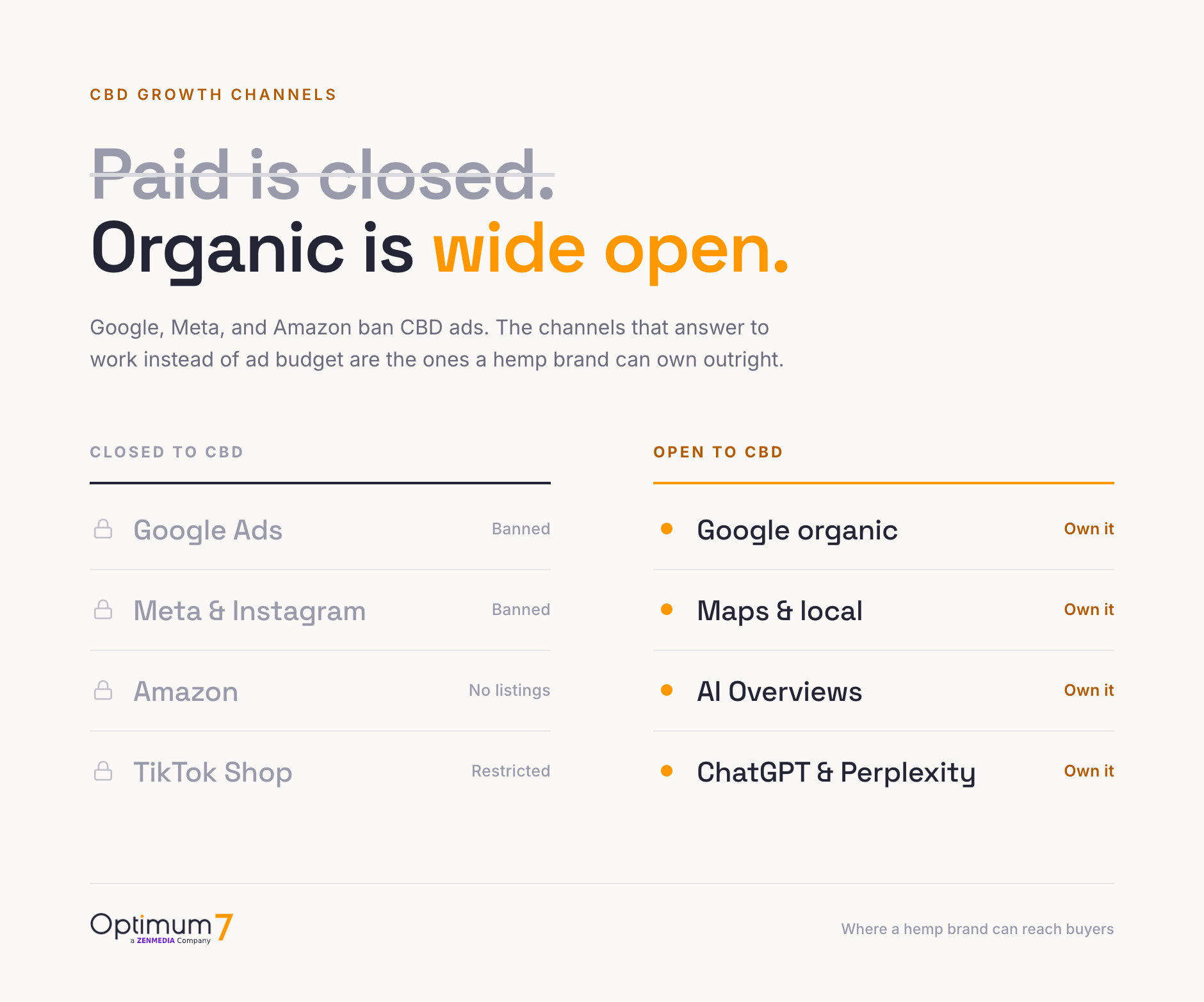
The picture above is the whole reason this guide exists. Every paid door that powers a typical ecommerce launch is either bolted shut or cracked open in a handful of states. Google organic listings, Google Maps, AI Overviews, and answer engines like ChatGPT and Perplexity stay open to CBD, and they reward useful work a focused brand can produce on its own schedule. That is a rare structural advantage for the brands willing to earn it.
Deplatforming makes the case sharper. CBD sellers routinely report payment processors placing sudden holds, storefronts suspended within hours of enabling checkout, and merchant feeds delisted after a compliance review. When the tools you rent can be pulled without warning, the visibility you own becomes the safest place to invest. A ranked page, a domain with authority, and content that answer engines cite do not disappear because a policy team flagged your category.
Can You Advertise CBD on Google, Meta, or Amazon?
Mostly, no. Google Ads allows only topical hemp-derived CBD products with THC content of 0.3% or less, requires LegitScript certification, and limits targeting to California, Colorado, and Puerto Rico. Ingestible CBD, supplements, and inhalants stay prohibited. Meta restricts ingestible CBD advertising, Amazon blocks CBD listings entirely, and TikTok Shop restricts hemp products. For a typical CBD catalog, paid search and social stay closed as growth channels.
That restriction is why understanding how search engines crawl, index, and rank pages is the most valuable thing a CBD founder can learn. Paid channels reward the biggest budget; organic search rewards the most useful, most authoritative page for a query. That is a game a focused CBD brand can win, and this guide walks through every move. If SEO is new to you, start with the fundamentals of SEO and come back.
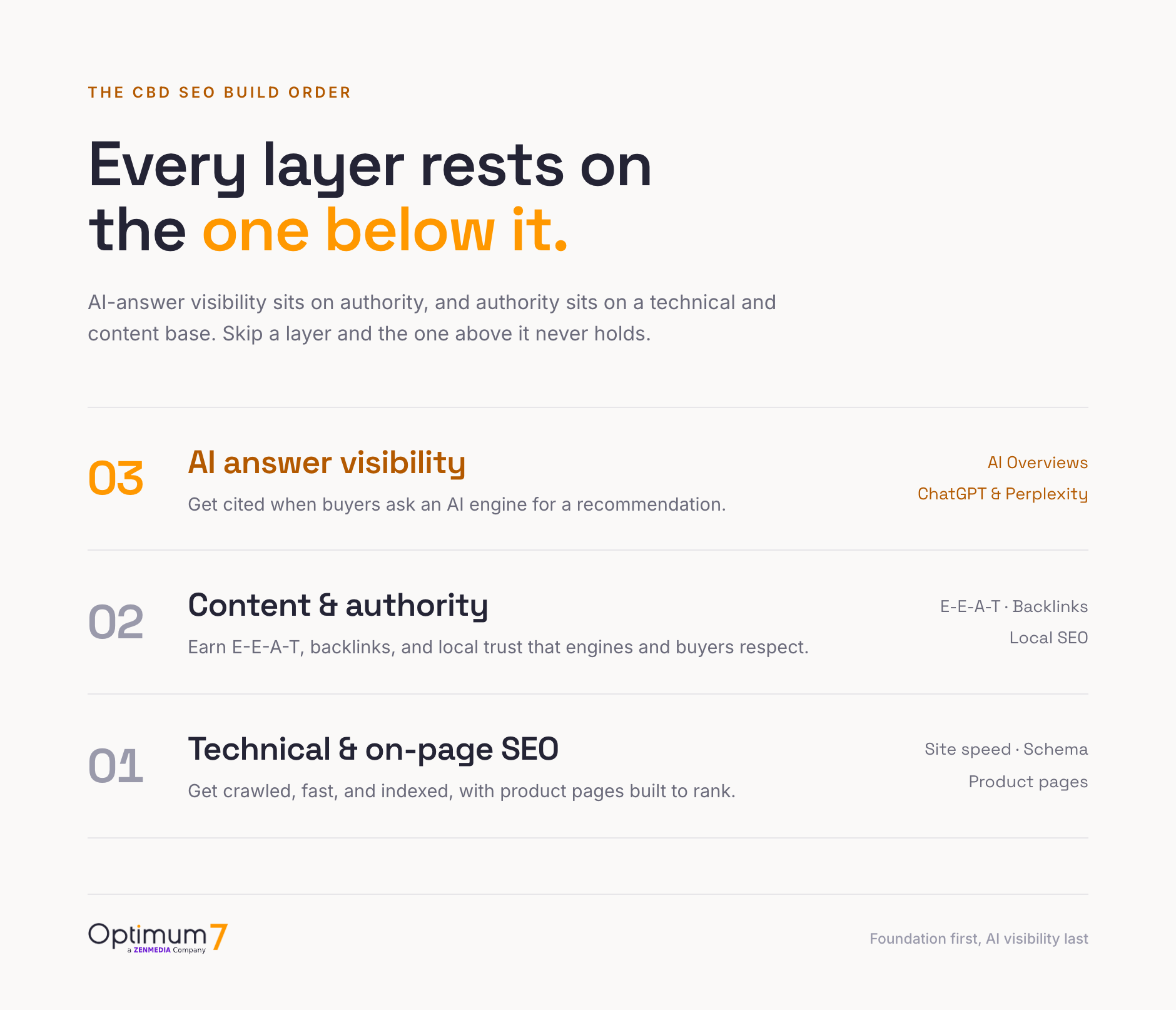
The rest of this guide builds CBD visibility in three layers, each resting on the one below it. A technical and on-page foundation gets your store crawled, fast, and indexed. Content, backlinks, and local trust build the authority Google rewards. AI-answer visibility sits on top, where a strong brand earns citations inside ChatGPT, Perplexity, and Google AI Overviews. Skip a layer and the one above it never holds.
How to Do CBD Keyword Research
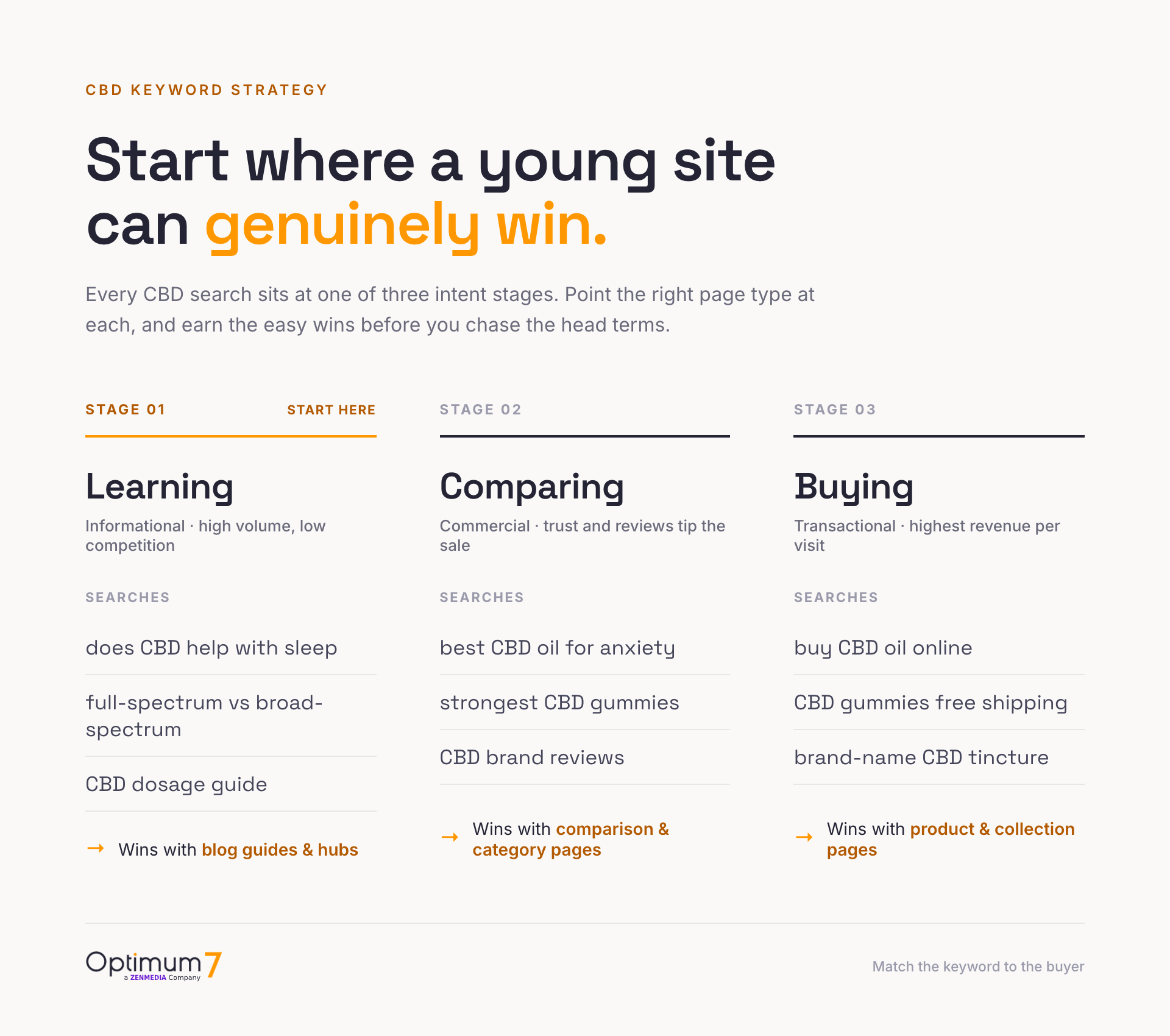
Good CBD keyword research maps every target term to where the buyer is in their decision, then points the right page type at each one. A new hemp site that chases CBD oil on day one will lose to brands with a decade of authority. The faster path is to win specific, lower-competition questions first and build toward the head terms as your domain strengthens.
Head terms are brutal for a reason. Pull any broad CBD keyword into a research tool and the difficulty score often pins at the ceiling, meaning it will take heavy on-page work, links, and content depth to move. A tool view like the one below tells you when a term is a long game and when it is winnable now.
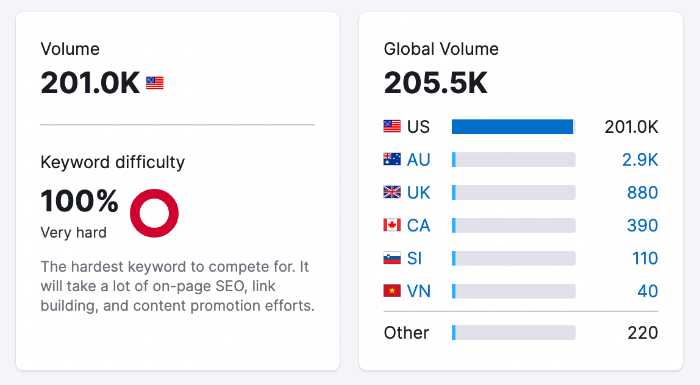
Prioritize by intent and difficulty together. Long-tail informational queries carry real volume, face far less competition, and let a young site rank while it earns the authority to compete for the money terms. Optimum7 builds every CBD keyword map in the same priority order: capture the winnable terms first, then climb toward the head terms.

| Keyword type | Example | Competition | Page that wins it |
|---|---|---|---|
| Long-tail informational | does CBD help with sleep | Low | Blog guide or education hub |
| Commercial | best CBD oil for anxiety | Medium | Comparison or category page |
| Head and transactional | CBD oil, buy CBD gummies | Very high | Product and collection pages |
Build the map with the searcher’s exact language, including the terms people use interchangeably: CBD, hemp, and cannabis all show up in the same buyer’s search history. Free tooling gets you surprisingly far here; a set of free SEO browser extensions will surface volume, difficulty, and related questions without a paid subscription while you validate the strategy.
Content That Ranks in a Regulated, YMYL Niche
CBD content is judged more strictly than almost any other niche because it sits in Google’s Your Money or Your Life category, where health and safety are on the line. Pages that could affect a reader’s wellbeing are held to a higher E-E-A-T standard: experience, expertise, authoritativeness, and trust. Thin, generic articles that restate the same claims as every other hemp blog do not rank, and increasingly do not get cited by AI either.
Four things separate CBD content that earns rankings from content that stalls. Each one is a signal both Google’s systems and human readers use to decide whether your brand is a credible source or filler.


Technical SEO and Site Speed for CBD Stores
Technical SEO is the work that lets Google crawl, render, and trust your store, and for CBD sites it carries extra weight. Compliance disclaimers, age gates, and heavy lab-report PDFs pile onto every page, and each one can drag down load speed. A fast, clean, crawlable site is table stakes before content and links can do their job.
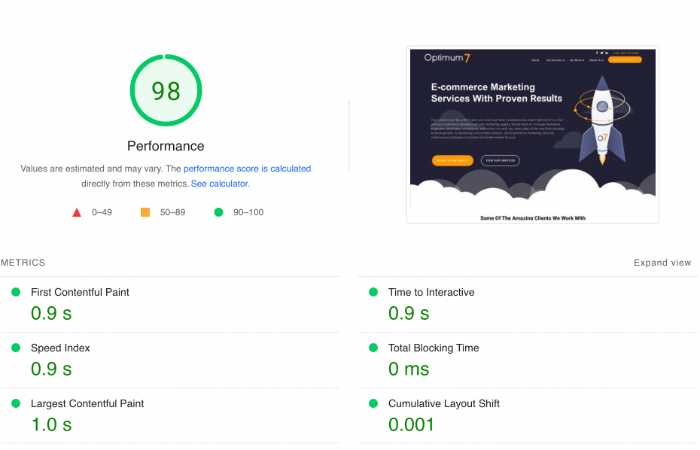
Google confirms Core Web Vitals as a ranking signal, and the score above is what a tuned ecommerce build looks like: a fast first paint, a quick largest-contentful-paint, and near-zero layout shift. On CBD stores the common culprits are unoptimized product photography, an age-verification script that blocks rendering, and lab PDFs loaded on page instead of linked. Fixing those tends to lift both rankings and the conversion rate on the traffic you already have.
Beyond speed, get the crawl fundamentals right: a clean URL structure, correct canonical tags, an XML sitemap, no orphaned product pages, and 301 redirects preserved on every migration so hard-won rankings survive a replatform. If you want the deeper mechanics, Optimum7’s guides to technical SEO basics and speed optimization for Shopify and BigCommerce break down each fix.
Product and Category Page SEO for CBD Catalogs
Product and category pages are where CBD SEO turns into revenue, and where duplicate manufacturer copy quietly caps what a store can rank for. Descriptions copied across dozens of retailers create duplicate content that Google ignores. Original copy, structured data, optimized imagery, and a category page that teaches something are what earn the commercial and transactional rankings that convert.
Treat each page type deliberately. Category pages should carry real supporting content, not a wall of product tiles. Product pages need unique descriptions, spectrum and dosage details, lab links, and review markup. Product imagery should use descriptive, keyword-aware alt text and compressed files so it ranks in image search without slowing the page.
Large CBD catalogs also live or die on findability. When a shopper cannot filter to the exact spectrum, strength, or format they want, they leave. Optimum7 has repeatedly seen advanced on-site search move the numbers, which is why faceted navigation built without creating SEO issues and AI-powered on-site search and filtering belong in any serious CBD build.
Moore Pet Supplies is a clear example of what happens when catalog structure, search, and content are fixed together. Optimum7 consolidated multiple storefronts, migrated the data with redirects intact, and layered in advanced Elasticsearch-based search and filtering across a catalog of thousands of SKUs.
Meta Titles and Descriptions That Earn the Click
Meta tags are your listing in the results page. Keep title tags under roughly 60 characters with the primary keyword near the front, and write descriptions that give a specific reason to click instead of restating the title. On CBD pages, a description that signals lab-tested quality or a specific benefit tends to lift click-through on rankings you already hold.
Building Backlinks and Authority for a CBD Site
Backlinks are still how a CBD domain earns the authority to rank for competitive terms, and in a restricted vertical they matter more because you cannot buy visibility any other way. The durable approach is editorial: guest contributions, digital PR, supplier and industry relationships, and content genuinely worth citing. Link schemes and paid networks invite penalties that are brutal to recover from in a YMYL niche.
Gray and Sons, a luxury retailer facing entrenched competitors and low visibility, shows what disciplined authority building does over a focused window. Optimum7 combined keyword research, guest blogging, and genuine backlink development with on-site conversion work.
Start authority work by understanding who already links to your competitors, then earning placements from the same publications and better ones. A bulk backlink analysis shows exactly where a competitor’s authority comes from, and hands you a target list of hemp directories, industry blogs, and journalists worth pitching.
Local SEO for CBD Shops and Dispensaries
If you sell CBD from a physical location, local SEO puts you in the map pack where nearby buyers are already searching with intent. A shopper looking up a CBD store near them is close to a purchase, and the businesses that claim and optimize their local presence capture that demand before competitors relying on organic listings alone. Have you claimed and verified your Google Business Profile yet, or is it still the auto-generated stub Google created for you?
Local visibility for a regulated product follows a repeatable setup. Work through the checklist below to establish the signals Google uses to rank a physical CBD business.
Getting Your CBD Brand Cited in AI Answers
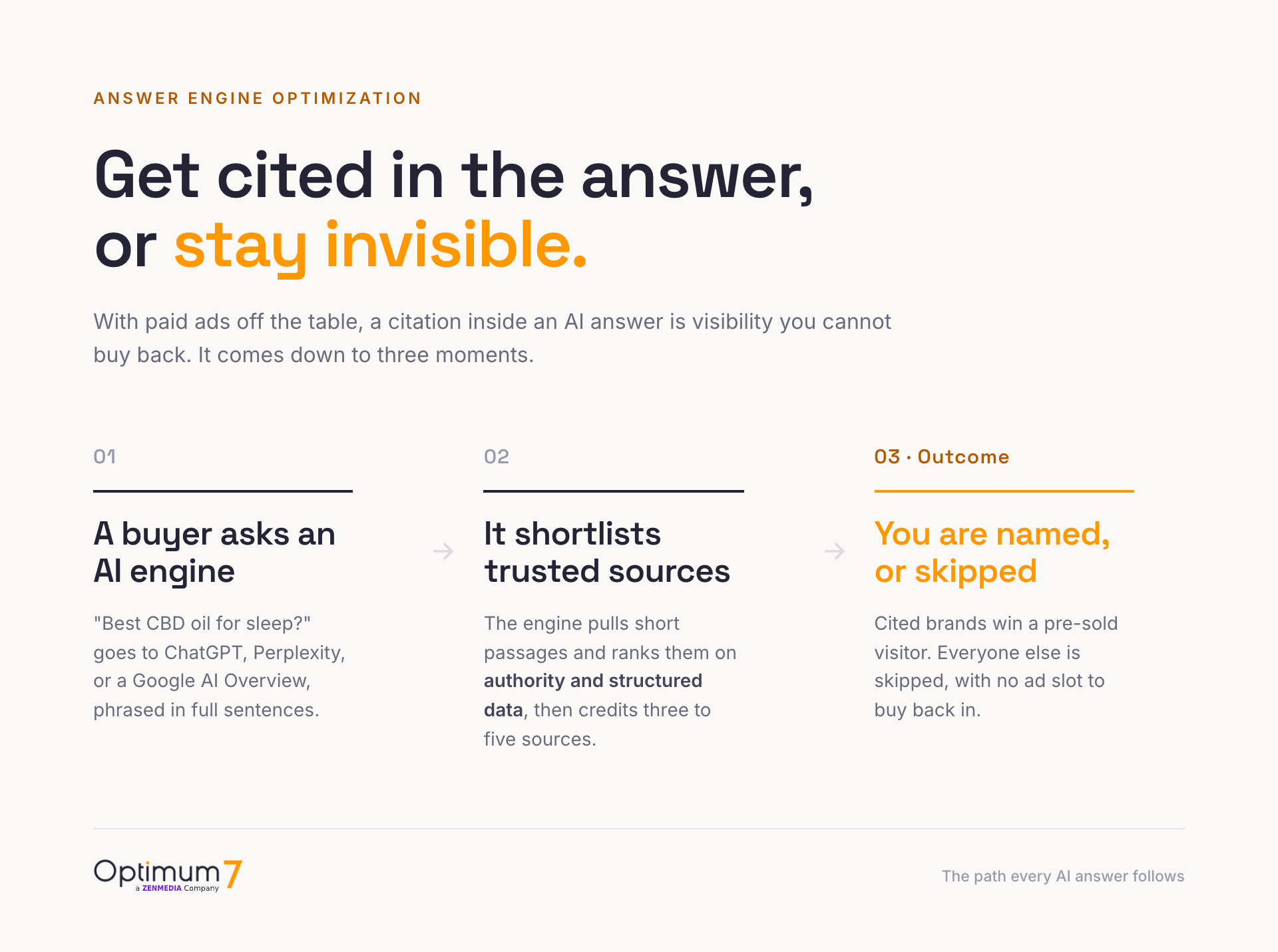
A growing share of CBD buyers now get their answer from an AI engine before they ever reach a results page, and a citation there is visibility you cannot pay to appear in. When ChatGPT, Perplexity, or a Google AI Overview names two or three CBD brands in response to a question, those brands win a pre-sold visitor while everyone else stays invisible. For a category locked out of paid placement, this is the visibility layer to take seriously.
The stakes are rising because search behavior has already changed. When two-thirds of searches resolve without a click to a website, the brands named inside the answer capture the attention that used to flow to the blue links below it.
Earning citations runs on the same fundamentals as SEO, tightened for machine reading. An answer engine pulls short candidate passages, ranks them on authority and structured data, and credits three to five sources in the final answer. Answer questions directly in clean, self-contained passages an engine can lift. Publish original data and clearly sourced claims. Add schema so your content is machine-readable, and build the topical authority that makes an engine treat your domain as a reliable source. Optimum7’s guide to answer engine optimization covers the mechanics, and the shift toward AI-driven product discovery shows where this is heading.
Pool Depo proves the point. It competes in a crowded retail category against established players and manufacturer storefronts, and Optimum7 grew it with organic content and structured, well-sourced pages that both shoppers and engines can trust.
A CBD SEO Roadmap for a New or Stalled Site
SEO for a CBD store follows a sequence, and doing it in order is what prevents wasted effort. Content without a technical foundation does not rank, and links pointed at thin pages are money burned. Optimum7 runs the same six steps on every CBD engagement, from a clean base to the AI-answer visibility that increasingly decides who gets found.
Platform choice sits underneath all of it. CBD brands get dropped by processors and hosts, so the store needs a stack that will not collapse under a compliance review. Montkush moved from BigCommerce to Shopify with Optimum7 to reach a wider range of apps and steadier support, and the migration preserved data and SEO equity through the transition. If you are weighing a move, compare the tradeoffs in BigCommerce versus Shopify Plus and the wider question of choosing the right ecommerce platform.
When to Hire a CBD SEO Agency
Hire specialist help when the work outgrows your team’s time or expertise, which for a scaling CBD brand tends to hit around technical audits, large-scale content production, and authority building at the same time. The right partner knows the compliance lines, has moved rankings in regulated verticals, and shows real client outcomes instead of vague promises. The wrong one recycles generic SEO and ignores the FDA and platform realities that define this category.
Vet an agency on evidence and fit. Ask for documented results in restricted or YMYL niches, confirm they understand CBD advertising and compliance limits, and check that they treat AI-answer visibility as part of the work now. A useful starting comparison of established teams lives in Optimum7’s roundup of leading Shopify marketing agencies.
Optimum7 has built organic growth for regulated and competitive ecommerce brands for years, pairing technical development with content and authority work that compounds. To map a CBD SEO plan against your catalog and goals, explore Optimum7’s SEO services or book a CBD SEO strategy session with the team.
Frequently Asked Questions
Can you advertise CBD on Google Ads?
Only in a narrow case. Google Ads permits topical, hemp-derived CBD products with 0.3% THC or less, requires LegitScript certification, and limits targeting to California, Colorado, and Puerto Rico. Ingestible CBD, supplements, and inhalants remain prohibited, which is why organic search is the primary acquisition channel for CBD catalogs.
How long does CBD SEO take to work?
CBD sites typically see meaningful movement in three to six months, with compounding gains after that. Long-tail informational terms rank first, while competitive head terms follow once content depth, technical health, and backlinks build enough authority. A new domain takes longer than an established one with existing trust.
What are the best CBD keywords to target first?
Start with specific, long-tail informational and question-based terms tied to your products, such as spectrum comparisons, dosage questions, and use-case searches. They carry real volume, face far less competition than head terms like CBD oil, and let a young site rank while it earns authority for the higher-value commercial and transactional keywords.
Is CBD or cannabis SEO different from regular SEO?
The mechanics are the same, but the constraints are stricter. CBD sits in Google’s YMYL category, so E-E-A-T and compliance carry more weight, paid ads are mostly unavailable, and medical claims create real penalty and legal risk. The upside is that a category locked out of paid competition rewards disciplined organic work more than most.
Can AI search really send CBD traffic?
Yes, and it already does. As more searches resolve inside AI answers, brands cited in those answers capture attention that once went to organic listings. Optimum7 has seen referral traffic from AI-driven sources climb sharply for clients with structured, well-sourced content, a channel that matters more for a category shut out of paid placement.
About the author: Duran Inci is the CEO and Co-Founder of Optimum7, an ecommerce development and digital marketing agency. He helps mid-market and enterprise brands scale revenue through conversion optimization, SEO, and custom ecommerce solutions.