

The Quiet Instability in Magento Rankings
The first sign is usually a drop you can handle. It is a slow loss of confidence. You look at a keyword that used to sit comfortably in the top 3, and now it oscillates, week after week, without a clear reason. Revenue is still coming in; nothing is “broken,” but the predictability you used to build plans around is gone, and that is where Magento SEO starts getting expensive.
Magento teams are not short on effort. Development budgets stay active, content keeps shipping, technical audits continue, and from the inside, the work looks steady. Yet rankings that once held for months now move more often. A category page that lived in position 3 drifts to 7, recovers briefly, then slides again. A transactional keyword drops off page one, returns, then weakens under pressure. Usually, you can’t say, “This is when it collapsed.” Forecasting becomes less reliable, and organic performance starts feeling harder to trust, even when the team is doing the work.
This decline is not isolated. In our Magento performance report, we analyzed 2,080 Magento domains over 12 months. 52.2% experienced worsening average ranking positions. Over the same period, platform-wide organic traffic declined by -15.90%. When more than half of a platform is losing positional stability while total traffic contracts, the issue moves beyond individual execution. It signals platform-level pressure where small movements cost more and recovery windows narrow.
Decline can often be traced to specific gaps. Volatility behaves differently. It compresses margins quietly, forces paid acquisition to cover organic inconsistency, and complicates executive reporting because performance changes without a clean inflection point. Organic visibility stops behaving like a growth channel you can plan around. It becomes a position you have to maintain.
What the Platform Data Actually Shows
The fastest way to see whether volatility is costing you revenue is not impressions or total keyword counts; it is where your highest-intent terms sit and whether they stay there.
Take your top 10 revenue-driving category pages. For each one, list the 3 to 5 commercial terms that drive buying intent. Mark where they sit today: positions 1 to 3, 4 to 10, or outside page 1. If most of your revenue intent is in positions 4 to 10, you are visible but not secure. And if those terms keep falling off page one and returning weeks later, you do not have a growth problem; you have a stability problem.
This indication points to a retention issue, not an indexing gap. The issue is holding page-one positions long enough for results to compound.
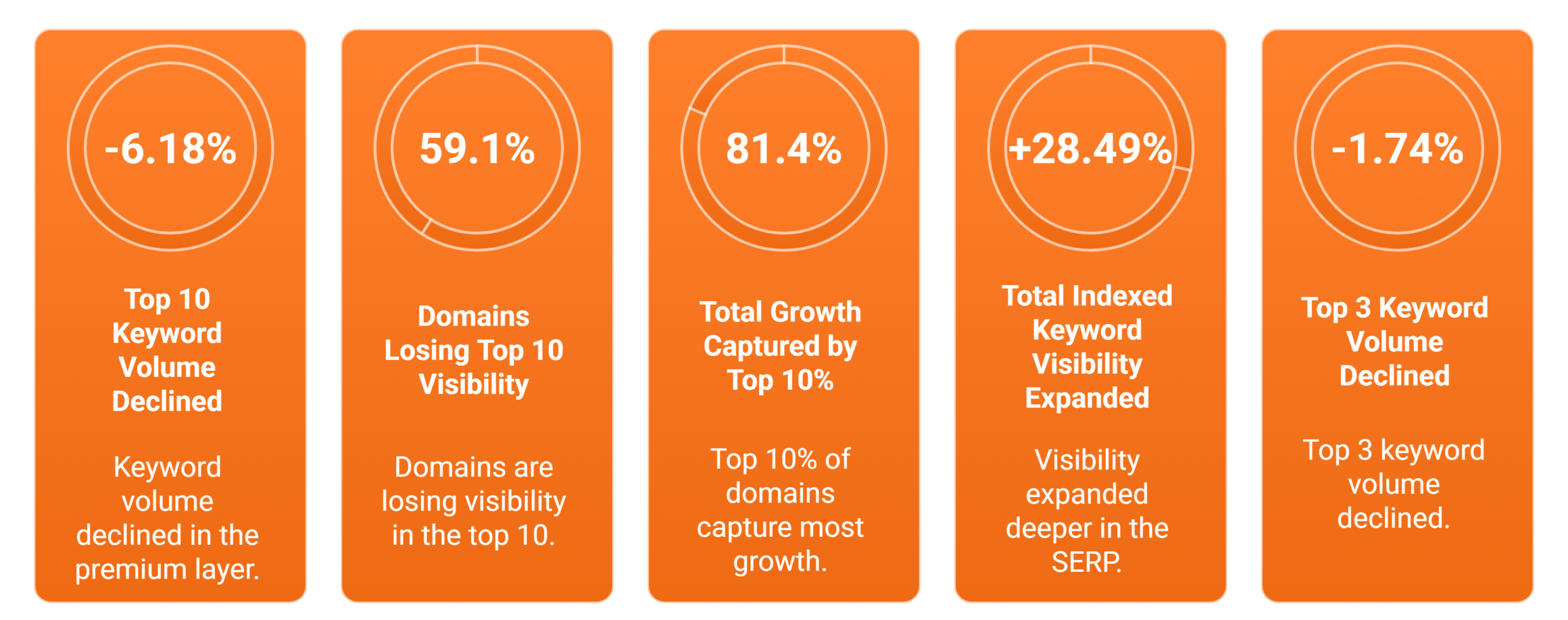
The premium layer shows the squeeze. Top 10 keyword volume declined by -6.18%, and 59.1% of domains are losing Top 10 visibility. At the same time, 81.4% of total growth is captured by the top 10% of domains, which means premium placements are being held by a smaller tier for longer.
This is why keyword growth can mislead you. Total indexed keyword visibility expanded by +28.49% in parts of the dataset, yet the top 3 keyword volume declined by -1.74%, and the top 10 declined by -6.18%. Visibility is expanding deeper in the SERP while weakening at the top.
Inside a store, it looks like progress until it doesn’t: more pages, more terms, more coverage, while core commercial phrases slide from position 2 to 5, from 5 to 9, or slip off page one and require recovery.
Page-One Stability Is Becoming a KPI
For years, Magento SEO was treated like an expansion. Broader keyword coverage, more indexed pages, rising impressions, and traffic followed. That playbook still creates activity, but it no longer guarantees control. You can publish supporting content, optimize filters, and grow total keyword footprint while your revenue-driving categories stay trapped in a narrow band of rankings, visible but exposed.
The difference shows up fast when positions move. A term sliding from position 2 to 6 may still technically be “on page one,” but the commercial impact is immediate. When that drift repeats across multiple core phrases, performance compresses quietly, and growth stops compounding, even though visibility and keyword charts still trend up.
That is why snapshots matter less than retention. For your revenue-driving terms, how consistently have they remained on page one over the last quarter? How often do your highest-intent phrases hold positions 1 to 3 without repeated drift? When retention is strong, expansion multiplies results. When retention is weak, expansion increases surface area without increasing leverage. In 2026, Magento performance is measured less by how wide your footprint becomes and more by how reliably your core positions hold under pressure.
Why Wins Are Concentrating at the Top

Volatility does not affect every Magento store the same way. When rankings begin to move more frequently and overall traffic contracts, the advantage shifts toward stores that already hold premium positions. The difference between position 2 and position 6 stops being incremental and starts becoming structural. Small positional shifts create an outsized impact because click share is not evenly distributed across page one.
Platform data shows that growth is concentrating inside a smaller tier of domains. The top 10% is capturing a disproportionate share of net gains. That concentration changes how competition feels. Stronger domains are not just ranking well; they are holding premium placements long enough to build outward from them. Stability allows expansion to compound.
For stores operating between positions 4 and 10, the experience is different. Rankings appear active in reporting tools. Pages are visible. But mid-page-one placement is no longer a comfortable zone. It is transitional. Movement within that band generates activity without leverage. When positions fluctuate in that range, effort increases, but the relative ground becomes harder to gain.
This is where the middle trap forms. If a store cannot consistently hold positions 1 to 3 for its highest-intent terms, it competes inside a narrower window of click share while stronger domains defend the top layer. Over time, volatility reinforces those leaders because durability compounds authority. Supporting content strengthens already-stable pages. Internal linking reinforces priority categories. Expansion builds from a secure base.
When positions drift instead of holding, expansion tends to dilute instead of reinforce. Rankings rotate. Recovery cycles repeat. Gains fail to accumulate.
Competitive pressure compounds at the top because premium positions attract stronger engagement signals and earn more staying power.
The Dual-Decline Pattern Is a Structural Warning
Instability becomes more concerning when it stops looking like fluctuation and starts appearing as sustained regression.
Within the Magento ecosystem, a significant portion of domains are not only experiencing ranking movement, but they are also losing traffic and losing keyword visibility at the same time. In the dataset, 38.0% of domains fall into this dual-decline category. That is not a marginal segment. It represents a structural portion of the platform.
What makes this pattern important is not the label itself but what it implies.
When traffic and keyword footprint both contract, the issue rarely points to a single underperforming page. It usually signals accumulated pressure: technical debt that has not been addressed, index bloat from faceted navigation, diluted internal linking, overlapping content, or authority spread too thin across expanding structures. The store is not simply drifting inside page one. It is gradually losing coverage.
Volatility is often the early signal. Positions move more frequently, recovery cycles shorten, and click-through softens. Over time, that instability creates sustained downward pressure. Page-one terms slip to page two. Supporting pages lose depth. The internal authority model weakens.
At that stage, adding more content usually disrupts control. The system grows wider while resilience declines.
Why 2026 Makes Stability Harder Than It Used To
Magento has always required discipline. The platform requires large catalogs, layered navigation, parameter-driven URLs, custom templates, and integrations. Complexity was manageable when ranking environments were more forgiving. If authority was strong and content expanded steadily, recovery was usually possible.
The margin for drift is narrower now.
Search results rotate more frequently. Competitive layers at the top are more compressed. Fewer domains hold premium positions for longer periods, and they defend them aggressively. At the same time, click distribution has tightened. Attention is absorbed earlier on the results page, which reduces the buffer that mid-page-one positions once had.
When a click opportunity compresses, positional durability becomes leverage, and Magento’s architecture either concentrates it or leaks it.
Magento’s complexity can amplify that pressure. Faceted navigation can create index sprawl. Parameter-driven URLs can fragment authority. Internal linking patterns often distribute equity broadly instead of reinforcing revenue hubs. These issues do not necessarily trigger penalties, but they reduce resilience. In a volatile environment, reduced resilience shows up as frequent drift.
Expansion alone is no longer protective. Growth without structural clarity increases surface area while making stability harder to maintain.
In 2026, the environment rewards density, alignment, and durability more than volume.
What Stabilization Actually Requires in 2026
Stability does not come from publishing more. It comes from tightening the system around what already drives revenue.
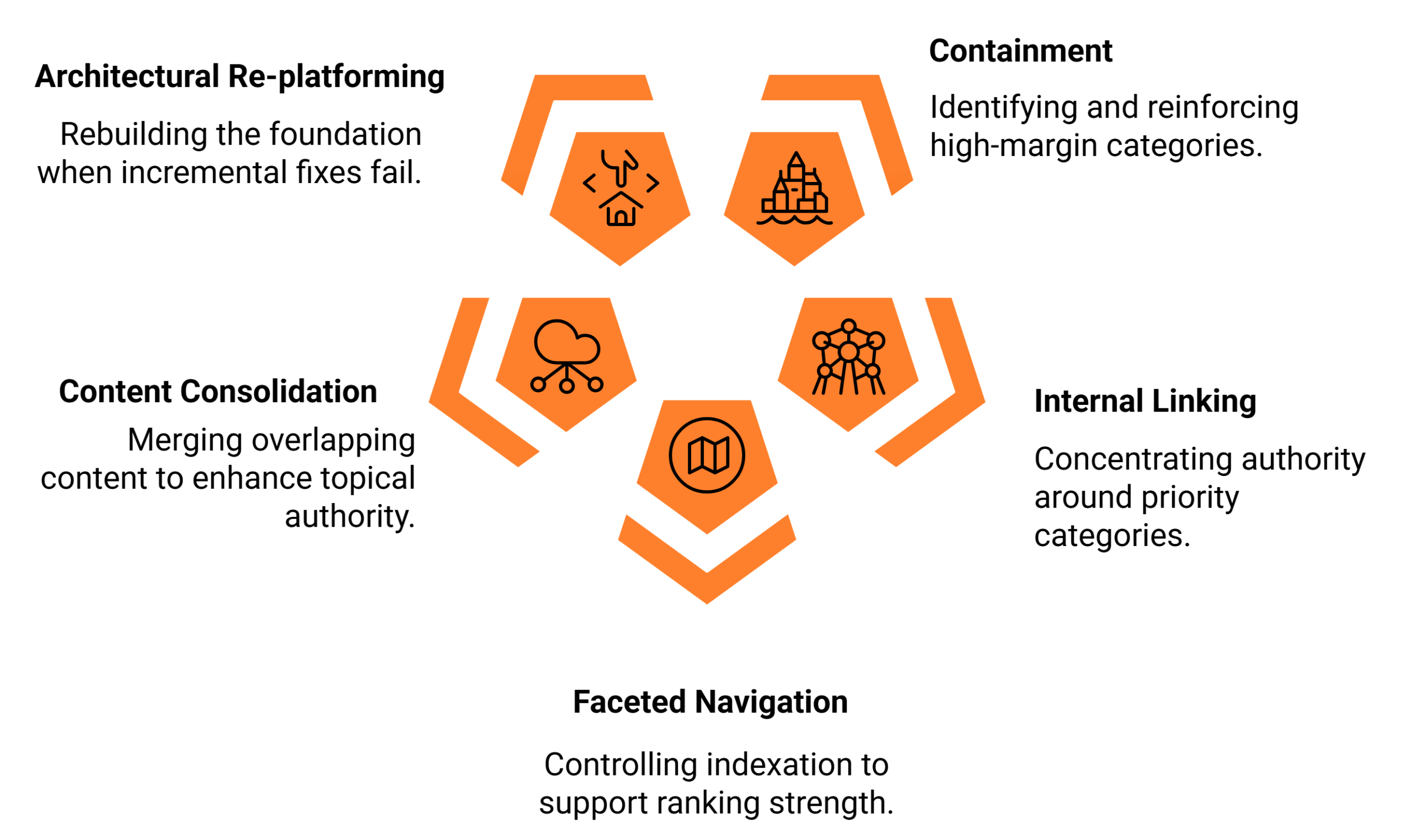
The first step is containment. Identify the categories that carry margin and review how stable their primary commercial terms have been over the last 60 to 90 days. If positions move frequently, the solution is usually less content. It is reinforcement.
Internal linking must concentrate authority around priority categories rather than distributing equity evenly. Faceted navigation needs to be controlled so indexation supports ranking strength instead of diluting it. Overlapping content should be consolidated so topical authority becomes denser, not wider. Stability begins with structural clarity.
For some Magento stores, that tightening is enough. Their architecture is fundamentally sound, and the problem is execution drift. Once authority is concentrated and index sprawl is reduced, core positions begin to hold, and expansion compounds again.
For others, instability exposes deeper architectural constraints. Years of parameter expansion, duplicate taxonomy, legacy modules, and fragmented hierarchy make authority difficult to concentrate. In those environments, incremental fixes often produce short lifts followed by renewed volatility because the structural foundation remains unchanged.
At that point, the question shifts from optimization to architecture.
If holding page-one positions requires disproportionate development effort each quarter, or if structural limitations prevent authority from consolidating effectively, the long-term cost of maintaining the current system may exceed the cost of reworking it.
Re-platforming is not a trend decision. It is an operational one. Rebuilding the foundation becomes a strategic choice, not a reactive one, when structural tightening alone cannot achieve resilience.
In a volatile ranking environment, uncontrolled complexity becomes expensive.
How to Diagnose Whether You’re Stable or Just Busy
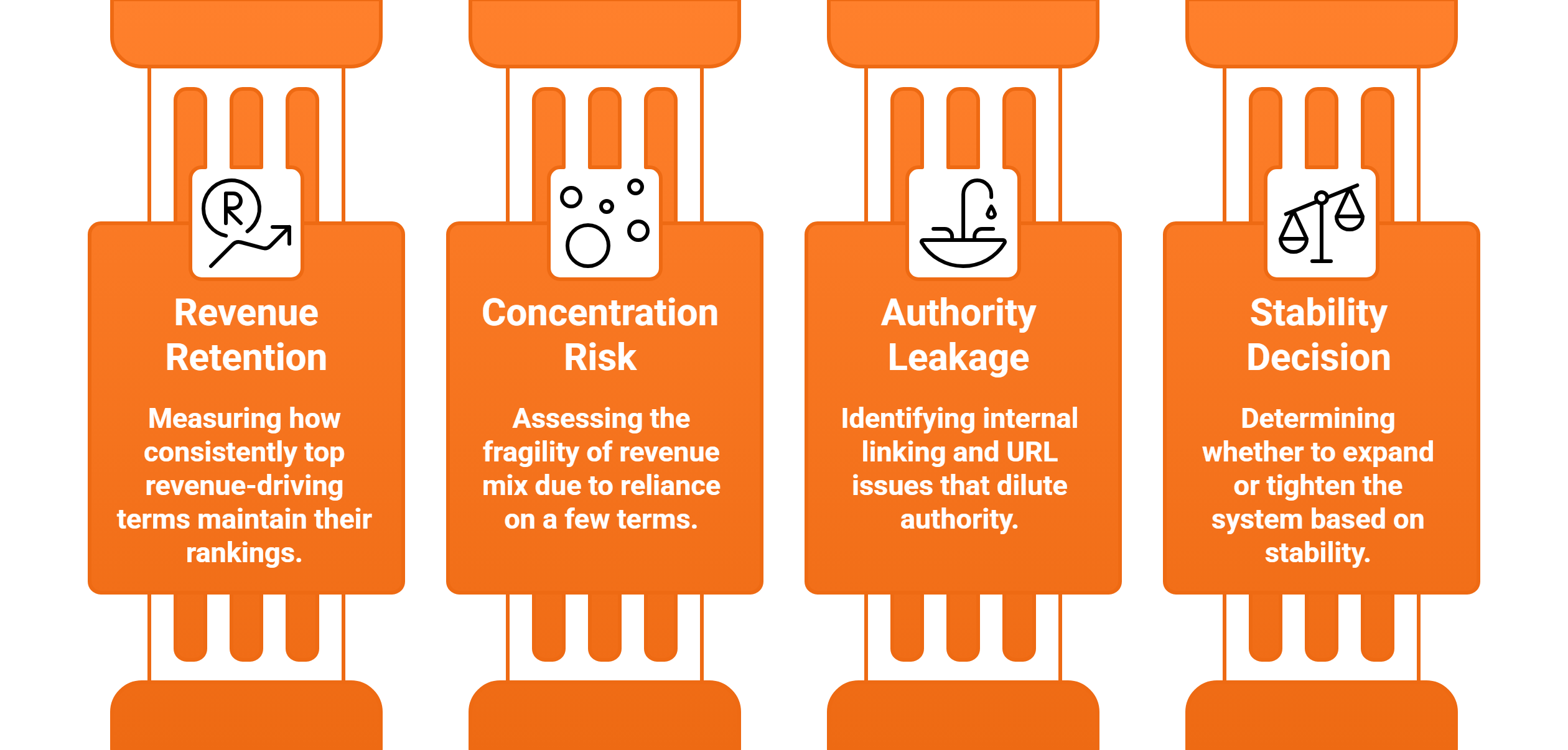
Before making structural decisions, you need an honest view of durability. You should not base your decisions on a dashboard that boasts of keyword growth or a single-month traffic increase, but rather on evidence that your most crucial positions can withstand pressure.
Measure Revenue-Term Retention
Begin with your revenue core, your top commercial categories, not blog posts or edge-case product pages. Pull the primary 3 to 5 transactional terms that drive margin for each category, then review the last 90 days of rank history. You are looking for retention patterns: how often those terms stayed on page one, how often they slipped, and whether recovery was quick or slow. If the rankings repeatedly fall out of premium positions, even briefly, you are not just tracking movement; you are watching demand leak. Frequent drift plus slow recovery is what instability looks like in real life.
Identify Concentration Risk
Next, assess how fragile your revenue mix is. Some stores look fine until you realize most organic revenue is tied to a small cluster of terms sitting in vulnerable ranges. When your traffic depends on a few phrases that bounce between positions 3 and 8, small movements create a disproportionate impact. The goal is to understand whether your performance is distributed across multiple stable category hubs or concentrated in a handful of rankings that compress the business the moment they slide.
Audit Authority Leakage
Then zoom out to architecture, because volatility is often self-inflicted. Check whether internal links push authority into priority categories or whether equity is spread evenly across everything. Review faceted navigation and parameter-driven URLs, not just for crawl waste but for authority leakage. If indexable variations and overlapping category paths are absorbing internal link equity, your strongest pages will struggle to hold position even with excellent content. This scenario is where many Magento stores create growth in dashboards while weakening the very pages that need reinforcement.
Decide: Stable Base or Stability Gap
If your core categories hold premium positions consistently and page-one losses are rare during high-demand periods, you are operating from strength, and expansion can compound. If rankings drift often, recovery cycles repeat, and your most valuable terms cannot stay anchored, you are not dealing with a growth gap. You are dealing with a stability problem, and the next move should be tightening the system before publishing more.
What Stable Magento SEO Looks Like in 2026
If rankings are moving more often and traffic is tightening across the platform, the goal is less activity. The goal is a structure that can hold page-one positions long enough for everything else to compound.
Stable Magento SEO in 2026 looks disciplined and controlled. Revenue categories are treated like primary assets, not just navigation endpoints. They carry clear commercial intent, they are reinforced through internal linking, and they are protected from internal competition, so Google sees one owner for each core query. When a term breaks into premium positions, the work is not “done”; it is maintained, because stability is where compounding starts.
Index bloat gets managed aggressively. Faceted navigation and parameter-driven URLs are constrained so authority does not leak into thin variations. Overlapping category paths are cleaned up. Supporting content is used to strengthen revenue hubs, not create parallel pages that split intent. Performance and crawl efficiency support the same outcome: fewer distractions for search engines and clearer signals for what deserves to rank.
If you want clarity on where you stand, contact us. We will map your page-one retention risk, identify where authority is being diluted, and show you whether stabilization within your current Magento architecture, which is a popular e-commerce platform, is enough or whether bigger structural changes are required. In a volatile ranking environment, knowing the difference is the first competitive advantage.