

TL;DR: Starting an ecommerce business from scratch comes down to five decisions: what you sell, which model sources it, what you can spend, where you build, and how you get the first sale. This walk-through covers each one with real 2026 costs, platform math, the marketplace question, and the mistakes that close new stores in their first year.
You can launch an online store this weekend. Keeping it alive for a year depends on decisions you make before the first order ships. How much should a first-time store cost to run, and what quietly drains the budget once sales start? Plenty of new sellers pour months into a storefront and a few days into figuring out who will buy from it, then wonder why the traffic never converts.
This guide takes the build in the order it happens: pick a product, prove someone wants it, choose how you will source and ship it, set up the business legally, put it on a platform, and drive the first customers. Each step has a decision that matters more than the tooling, and this covers the decision first.
What It Takes to Start an Ecommerce Business
The barrier to opening a store has never been lower, which is exactly why the barrier to a store that lasts is high. Anyone can spin up a storefront in an afternoon. The businesses that survive are the ones that answered the harder questions first: who is the buyer, why do they pick this product over the ten identical ones a search away, and does each sale make money after ads and shipping.
The demand is not in question. US shoppers are buying online at a scale that reframes ecommerce as mainstream retail, not a side channel, and the share of spending that happens online climbs almost every quarter.
A growing market cuts both ways. The same conditions that let you start also let every competitor start, and the ones who planned their unit economics before launch outlast the ones who bought a theme and hoped. The seven steps below run in the order that keeps a from-scratch store from stalling.
The 7 Steps to Launch an Ecommerce Store From Scratch
Each step below depends on the one before it. Skip demand validation and you build a beautiful store for a product nobody searches for; skip the money setup and you scramble to collect sales tax after you already owe it. Work them in sequence.
Which Ecommerce Business Model Fits You
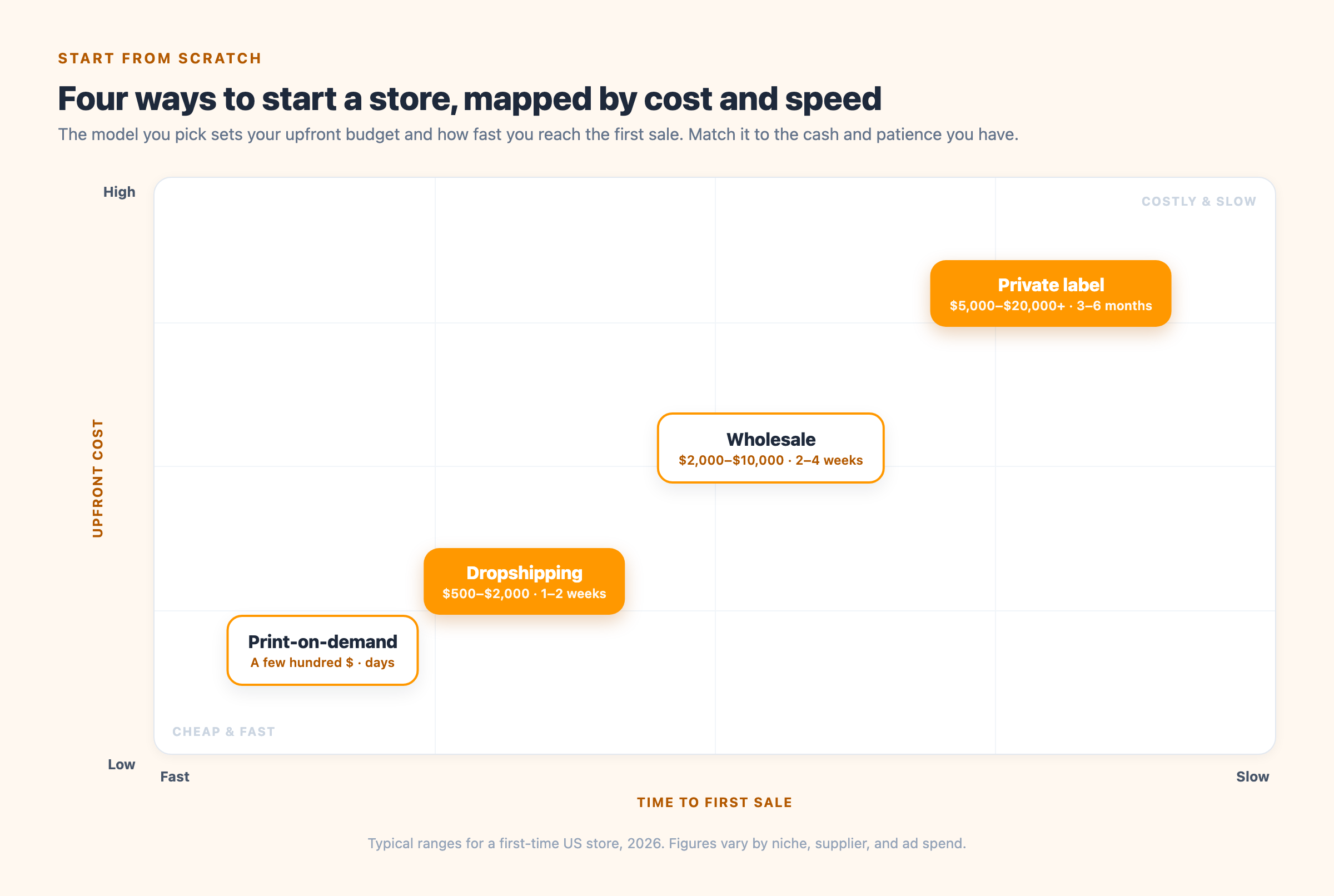
Your business model is the single decision that sets your startup budget, your profit margin, and how fast you can go live. A handmade store on print-on-demand can launch for a few hundred dollars this month; a private label brand with its own inventory can take several months and five figures before the first sale. Match the model to the capital and patience you have.


One 2026 change reshaped the math for anyone sourcing from overseas, and it is the reason beginner dropshipping advice from a few years ago no longer works.
What It Really Costs to Start an Ecommerce Business
There is no single number, because the cost follows the model you chose. A print-on-demand or handmade store can open for a few hundred dollars; a private label brand carrying its own inventory can run past $20,000 before revenue arrives. The honest answer to “how much do I need” is “how are you sourcing,” and the ranges below reflect what first-time owners typically spend to get live.
| Model | Typical startup range | Time to first sale |
|---|---|---|
| Print-on-demand / handmade | A few hundred dollars | Days to weeks |
| Dropshipping | Roughly $500 to $2,000 | 1 to 2 weeks |
| Wholesale | Roughly $2,000 to $10,000 | 2 to 4 weeks |
| Private label | $5,000 to $20,000 and up | 3 to 6 months |
Whatever the model, the recurring costs after launch decide survival more than the one-time setup does. A platform subscription, apps, payment processing at roughly 2.9% plus a fixed fee per order, and an advertising budget to reach buyers all repeat every month, and they are where thin budgets stall. Set aside enough to keep advertising through the months before the store finds its footing.

Choosing Your Ecommerce Platform
For a first store, the platform decision usually comes down to three names: Shopify, WooCommerce, and BigCommerce. The choice hinges on how much you want to run yourself. Shopify is fully hosted and the fastest to launch. WooCommerce is a free plugin for WordPress that trades convenience for control. BigCommerce is hosted like Shopify but bundles more advanced features and charges no transaction fee on top of payment processing. To see where merchants land, the active-store counts tell the story.
Active online stores by platform
Live store counts, August 2026
WooCommerce
4.08M
Shopify
3.06M
Wix
976K
Squarespace
393K
BigCommerce
37K
Active store counts by platform. Store Leads, August 2026.
Store count is popularity, not a verdict. WooCommerce leads on raw numbers because it is free to install, while Shopify tends to carry larger, faster-growing merchants. For a first store, the practical question is simple: do you want a managed platform that handles hosting and security, or an open one you configure and maintain yourself? The comparison below frames the trade-off.
| Platform | Best for | Trade-off |
|---|---|---|
| Shopify | Fastest, fully managed launch; large app ecosystem | Monthly fee, plus extra fees if you skip Shopify Payments |
| WooCommerce | Full control and customization on WordPress | You manage hosting, security, and updates yourself |
| BigCommerce | Built-in advanced features, no added transaction fee | Smaller app selection; steeper first learning curve |
If you want the full breakdown of pricing tiers, migration paths, and which platform suits a growing catalog, Optimum7’s guide on choosing the best ecommerce platform compares the major options in depth. When the store outgrows a template, Optimum7 builds and customizes stores on both Shopify and BigCommerce, so the platform choice does not cap what the business can become.
How to Start an Ecommerce Business Like Amazon
This is one of the most common questions from first-time founders, and it hides two very different goals. “Like Amazon” can mean selling your products on Amazon’s marketplace, or it can mean building a marketplace of your own where other sellers list their products. Those are two different businesses, and the right starting move depends on which one you want.
Selling on a marketplace is the faster path to your first sale. Amazon, Walmart, and Etsy hand you built-in traffic, so a new listing can find buyers without you spending on ads first. The cost is control and margin: the marketplace owns the customer, sets the rules, and takes a commission on every order, often 15% or more. It is a strong way to validate demand, and a weak way to build a brand, because the shopper remembers the marketplace, not you.
Building a marketplace like Amazon, where you take a cut of other sellers’ sales, is a far larger undertaking. It carries a chicken-and-egg problem: sellers will not list without buyers, and buyers will not come without selection, so you have to solve both sides at once. That is a funded, multi-sided software business, not a first store. Founders who say “like Amazon” are usually better served by a hybrid: launch on a marketplace to prove the product and earn early revenue, then build an owned ecommerce store where you keep the margin and the customer relationship. Use the marketplace for reach, and your own store to build something you own.
Getting Your First Customers
A store with no traffic is a closed shop with the lights off. Getting the first customers is the real work of launching, and it usually runs on three channels: search, paid ads, and email. Each pulls a different kind of buyer, and a new store rarely wins on one alone.
Search is the long game with the best economics. Ranking for the terms your buyers type means traffic that keeps arriving without paying per click, and it compounds as your content and product pages earn authority. It takes months to build, so start on day one. Optimum7’s guide on how SEO works covers the mechanics of earning that visibility, and the earlier a new store lays the groundwork, the sooner organic traffic starts carrying its share.
Paid ads buy speed. Search and social ads put your product in front of buyers immediately, which makes them the fastest way to test if a product and its price convert. The catch is customer acquisition cost: if it costs more to win a sale than the sale earns, spending faster only loses money faster. Track what a customer costs to acquire against what they spend, and scale only the campaigns where the second number wins.

The cheapest sale to win is the one you almost lost. Most shoppers who add a product to the cart leave before paying, and recovering even a slice of them lifts revenue without any new traffic spend.
Cart recovery is a launch-day priority, not a later optimization. Offer guest checkout, show shipping cost early instead of surprising people at the last step, and set up an abandoned-cart email flow that follows up automatically. Email then becomes the channel you own outright: no algorithm sits between you and the inbox, and a list you built converts far cheaper than an ad you rent. A store that fixes checkout friction and follows up by email keeps sales the traffic already earned.
The full build, done together, is what moves the numbers. When Optimum7 launched Crystals and Stones as a brand-new store, that meant brand identity, a BigCommerce storefront, a subscription flow, content and SEO, and paid social, all from zero.
Why New Ecommerce Businesses Fail, and How to Avoid It
Stores that close usually fail for one of two reasons: they ran out of money, or they never made money on each sale to begin with. The failure patterns repeat, and every one is avoidable if you name it before launch.
Frequently Asked Questions
How much does it cost to start an ecommerce business?
It depends on your model. A print-on-demand or handmade store can open for a few hundred dollars, dropshipping usually runs $500 to $2,000, and a private label brand carrying its own inventory can cost $5,000 to $20,000 or more. Budget for recurring costs too: platform fees, apps, payment processing, and an advertising budget to reach buyers.
How do I start an ecommerce business with little money?
Choose a model that needs no inventory. Print-on-demand and dropshipping let you list products before you buy them, so your upfront cost is mostly the platform subscription and a small test ad budget. Start with one tightly focused product, prove it sells, and grow by reinvesting the early profit before taking on any debt.
How long before an ecommerce business becomes profitable?
Your first sale can come within weeks, but steady profit usually takes much longer. A store often needs a year or more of building traffic, refining targeting, and improving conversion before it turns a reliable profit. Plan your budget around a slow ramp, and treat the first months as paid learning about who buys and why.
Is dropshipping still worth it in 2026?
It can work, but not the old way. The 2025 end of the $800 de minimis exemption added import duties that erase the margins on cheap goods shipped from overseas. A dropshipping store now needs domestic suppliers, or products priced high enough to absorb the duty and still profit. The model that requires no brand and no margin is the one that no longer works.
How do I start an ecommerce business like Amazon?
Decide which “like Amazon” you mean. Selling on Amazon’s marketplace gives you instant traffic in exchange for commission and control, and it is a fast way to validate a product. Building your own multi-seller marketplace is a funded software business with a two-sided demand problem. A common first move is to start on a marketplace, then build an owned store to keep the margin and the customer.
Do I need an LLC to start an ecommerce business?
You can start as a sole proprietor, but forming an LLC separates business liability from personal assets and opens a business bank account cleanly. It is inexpensive to file in most states and worth doing before real revenue arrives. Pair it with an EIN from the IRS and a plan for where you owe sales tax under economic nexus rules.
What is the best ecommerce platform for beginners?
Shopify is the most common first choice because it is fully hosted and the fastest to launch, so you spend time selling instead of maintaining software. WooCommerce suits people who want full control on WordPress, and BigCommerce fits stores that want advanced features built in with no added transaction fee. Match the platform to how much you want to manage yourself.
About the author: Duran Inci is the CEO and Co-Founder of Optimum7, an ecommerce development and digital marketing agency. He helps mid-market and enterprise brands scale revenue through conversion optimization, SEO, and custom ecommerce solutions.