10 Minute Read

Shopify Migration Case Study – Plants4Home.com

How Optimum7 Migrated Plants4Home from WooCommerce to Shopify Without Losing Data, SEO, or Operational Continuity

The Business

Plants4Home is an online retailer serving home gardeners and plant enthusiasts across the United States. Their customers buy with timing in mind: seasonality matters, regional climate matters, and live plants need to arrive healthy and on schedule. That means buyers expect accurate availability, clear care information, and confidence in the fulfillment process.

Over the years, the business built real operational depth: nearly 1,000 products, more than 20,000 customers, and over 15,000 processed orders. That represented years of purchasing history, repeat-buyer relationships, and business data that could not be handled loosely in a platform move.

By the time the team was ready to migrate, WooCommerce had become a management burden. Plugin dependencies had multiplied to the point that routine updates were causing unpredictable downstream effects. Maintenance that should have been straightforward required navigating a fragile stack of interdependent plugins, and that administrative overhead was taking time away from growth.

Plants4Home needed more than a visual refresh. They needed a more stable, scalable foundation that could support the business without adding operational drag. They partnered with Optimum7 to manage a full migration from WooCommerce to Shopify, with the goal of preserving their data, protecting existing SEO value, and keeping the business running without disruption.

The Objective

The goal was a clean, complete migration that preserved everything Plants4Home had built while launching a Shopify store ready to process transactions from day one.

Success was defined by a short set of non-negotiables:

  • Full product catalog transferred with complete data accuracy across titles, descriptions, images, SKUs, pricing, inventory, and all variant configurations
  • Customer records and historical orders migrated with relationships, statuses, and timestamps preserved
  • 301 redirects implemented for all legacy URLs to protect organic search visibility
  • Informational and policy content migrated with correct formatting and validated internal links
  • A branded, conversion-supportive storefront launched and fully configured for operational readiness at launch

This was not a redesign initiative or a marketing refresh. It was a platform foundation project designed to protect what Plants4Home had already built and give the business a cleaner base to grow from.


Key Business Challenges

Migrating a mature, revenue-generating eCommerce store involves more than moving data from one platform to another. For Plants4Home, the project required managing several compounding challenges simultaneously.

1. A Large Dataset With Zero Tolerance for Structural Error

The volume of data involved in this migration was significant, and the tolerance for error was effectively zero.

Product data that came through with broken variants, incorrect SKUs, or misaligned pricing would degrade catalog quality immediately. Customer records missing billing or shipping information would create fulfillment complications. Historical orders that lost their association with the right customer accounts would make reporting unreliable and customer service harder to deliver.

The real challenge was preserving the relationships between the records: which orders belonged to which customers, which addresses were current, and which product configurations were correct. Those links are what make historical data usable after a migration.

2. Platform Architecture Differences That Required a Ground-Up Rebuild

WooCommerce and Shopify organize data differently enough that a direct import would have created structural problems. Product variants, option sets, taxonomy logic, and URL patterns all required deliberate remapping into Shopify’s native architecture.

Shopify enforces a maximum of 100 variants and 3 options per product. Products that exceeded those limits required restructuring before migration could proceed cleanly. Category structures and product attributes also needed to be rebuilt according to how Shopify organizes catalog data, with years of WooCommerce-specific configurations left behind in the process.

3. Organic Search Visibility Built on WooCommerce URL Structures

Plants4Home had spent years building organic visibility tied to URL structures that Shopify handles differently. Every product page, category page, and content page that had accumulated rankings and inbound links would need to resolve correctly on the new platform, or that equity would erode.

Redirect coverage had to be comprehensive. A missed URL means a broken link for a customer and a dropped signal for a search engine, and either one can take months to recover from.

4. An Active Store That Couldn’t Pause During Migration

The store was processing orders and acquiring customers throughout the migration window. Data kept growing inside WooCommerce after the initial migration pull, and any orders or customer records created during that period needed to be captured before launch.

If the final reconciliation was missed or incomplete, Plants4Home would go live on Shopify with gaps in its data that would only become visible once customers started asking questions.

5. A Conversion-Ready Storefront Without Custom Development Complexity

The project scope centered on implementing a Shopify theme within its native framework. That boundary made theme selection more consequential: the chosen theme needed to carry the full weight of a conversion-ready storefront, with the right structural characteristics to support Plants4Home’s catalog and merchandising goals. Then it needed to be implemented in a way that added genuine conversion value without introducing a custom code that would create maintenance overhead over time.


The Strategic Challenge

Running a migration like this in parallel layers is where most of the risk lives. Data accuracy, SEO preservation, platform configuration, and storefront quality are all interdependent.

When redirect coverage has gaps, the SEO problem doesn’t show up until after launch. When data mapping is off, the customer service complications surface weeks later. Misconfigured payment gateways start impacting revenue from day one. Each layer affects the others, and correcting problems post-launch costs considerably more in time, credibility, and operational disruption than preventing them during the build.

Optimum7’s role was to sequence those layers carefully, maintaining control throughout the process so that speed didn’t create the kinds of problems that would require going back and undoing completed work. The store that went live needed to be complete, stable, and ready to keep growing.

The Strategy

Optimum7 approached the Plants4Home migration in structured phases, with data integrity and operational continuity treated as the baseline requirements at every stage.


1. Product & Business Data Migration

The migration began with a full extraction and review of Plants4Home’s WooCommerce dataset. All product data, including titles, descriptions, images, SKUs, pricing, inventory levels, and variant configurations, was mapped into Shopify’s native structure before import.

Products were reviewed against Shopify’s variant and option constraints, with any items requiring restructuring identified and addressed before the migration ran.

Customer records and historical orders were transferred with their relationships intact. The link between an order and the customer who placed it, with the correct address, product, and status data attached, had to be preserved for the historical data to remain usable for reporting and customer service.

A final data gap import was executed immediately before go-live, pulling in any orders and customer records created in WooCommerce after the initial migration window, ensuring complete continuity at launch.


2. Web Content Migration and SEO Redirect Implementation

All the informational and policy pages, from About Us to shipping and returns, were moved into Shopify and reformatted so they fit the new site properly. Images were checked, internal links were reviewed, and the goal was simple: make sure people could move through the new site without hitting broken pages or missing content.

Every old URL tied to products, categories, and content pages was mapped and redirected with 301s. That way, anyone coming in through an old WooCommerce link was taken to the right Shopify page instead of landing somewhere useless. It also helped preserve incoming traffic and avoided the kind of indexing issues that tend to happen when redirect work is rushed.


3. Theme Selection & Storefront Implementation

Theme selection was treated as a decision that would shape the store well beyond launch. Optimum7 reviewed Plants4Home’s catalog structure, product range, and merchandising needs to find a theme that could handle what the business needed now and still hold up as it grew. Navigation flexibility, site speed, mobile performance, and long-term compatibility with Shopify updates were all part of that evaluation.

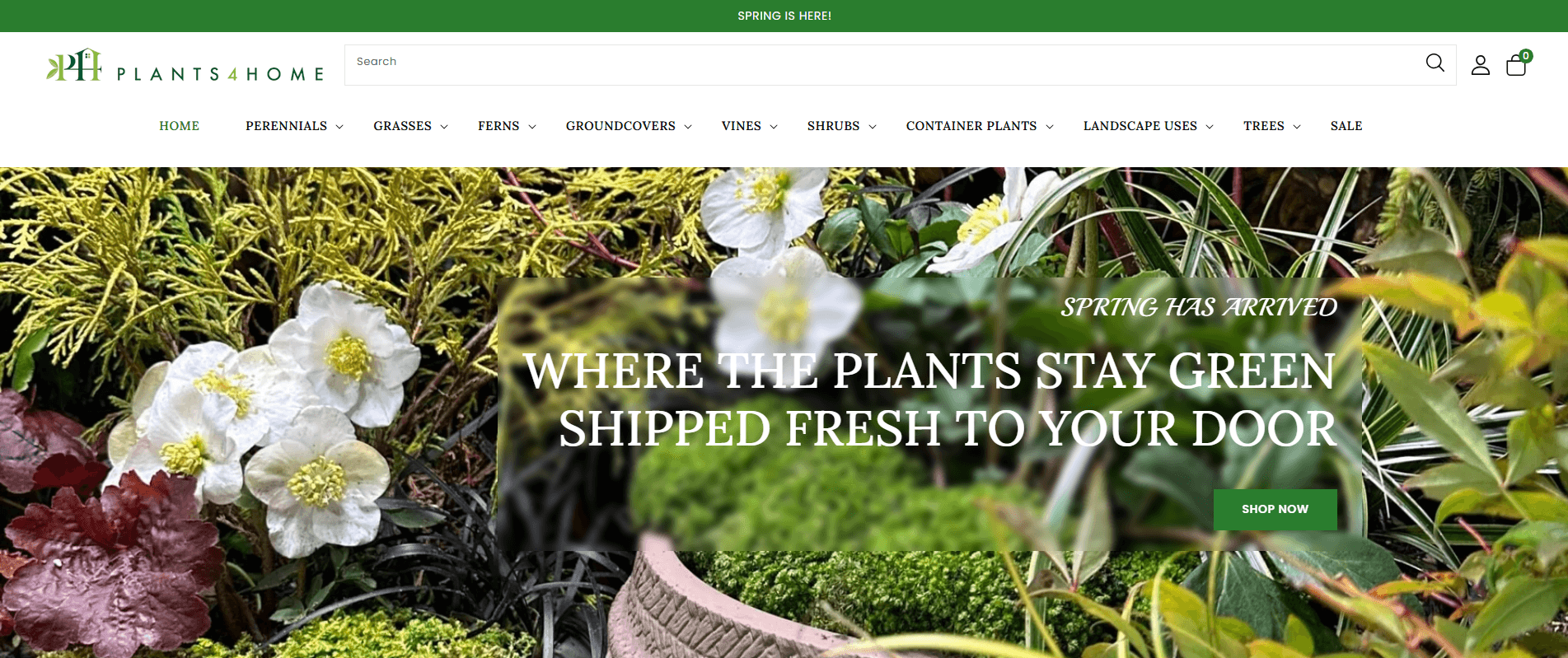
Once selected, the theme was configured using the client’s brand assets and visual references. Navigation, homepage layout, collection structure, and product page formatting were all implemented to reflect how Plants4Home’s customers browse and buy.

Within the theme’s native framework, Optimum7 incorporated conversion-supportive UX elements that improved the browsing-to-purchase journey without introducing custom development:

  • Mobile-first responsive design


  • Clear and visually prioritized call-to-action placement


  • Sticky add-to-cart functionality
  • Soft add-to-cart interactions for smoother browsing


  • Trust-building elements positioned at key decision points

All enhancements stayed within Shopify’s native capabilities, keeping the storefront performant, maintainable, and compatible with future platform updates.


4. Store Configuration and Operational Readiness

Before launch, Optimum7 set up the key Shopify pieces the store needed to run day to day, including payments, shipping zones and methods, tax settings, and the notifications tied to orders and customer communication. The team also tested the full order flow to make sure a purchase could move from checkout through processing and confirmation without anything getting lost or breaking.

To keep things manageable, the store was kept light on apps. The team focused on the tools that were needed most at launch, mainly for email, reviews, support, and order tracking. Each app was chosen because it worked well with Shopify and could still support the business as the store grew. Anything beyond the basics was saved for later, once the store was live and stable.

Tracking was in place from the start. GA4 and Google Ads conversion tracking were set up before the site went live, and the pixel was configured around Google Shopping since that was the main paid channel. That gave the team a clear view of performance from day one, across both paid and organic traffic.

Results

The migration launched cleanly. Every layer of the business came through intact: data, organic visibility, and operations all remained stable during and after the cutover to Shopify.

Key Outcomes

  • Nearly 1,000 products migrated with full data accuracy across all fields and variant configurations
  • 20,000+ customer records transferred with account, address, and purchase history preserved
  • 15,000+ historical orders migrated with correct customer associations, product references, and timestamps intact
  • Comprehensive 301 redirect coverage implemented across all legacy URLs with zero broken link exposure post-launch
  • Informational and policy pages migrated, correctly formatted, and validated for internal link continuity
  • Store processing orders on day one with no post-launch data issues or support escalations related to the migration

Business Impact

Plants4Home is now on a platform that fits the size of the business it has grown into, without the plugin upkeep and unpredictable maintenance issues that had built up on WooCommerce.

Daily store work became easier to manage. Things that used to involve checking plugins, troubleshooting conflicts, or working around extra layers in WooCommerce now happen inside Shopify’s built-in system, which freed up the internal team to spend more time on the parts of the business that matter most.

The new foundation also opens capabilities that were harder to build on WooCommerce:

  • SEO and content programs running on a clean URL structure with redirect coverage that protects existing rankings
  • Email marketing and lifecycle automation through deep integration with Shopify’s order and customer data
  • Paid acquisition through Google Shopping connected to GA4, with clear attribution between ad spend and revenue
  • Catalog growth without the structural constraints and fragility that accumulate in a heavily customized WooCommerce environment

Strategic Outcome

Migrations at this scale succeed or fail based on the decisions made before a single page goes live.

The data work, the redirect mapping, the platform configuration, and the storefront implementation all had to be executed correctly the first time, because fixing them post-launch means disrupting a store that is already open and taking orders.

By treating every layer of the migration as a business continuity decision, Optimum7 delivered a Shopify foundation that is accurate, stable, and structurally ready for growth. Plants4Home didn’t just change platforms. They moved onto infrastructure they can continue building on without looking back.

Share on Social Media
Your AI Visibility Report Awaits