10 Minute Read

BigCommerce B2B Edition Migration Case Study — OmnimaxParts.com

How Optimum7 migrated a wholesale office furniture distributor to BigCommerce B2B Edition, preserving thousands of orders, customer accounts, and full organic search equity through the transition.

The Business

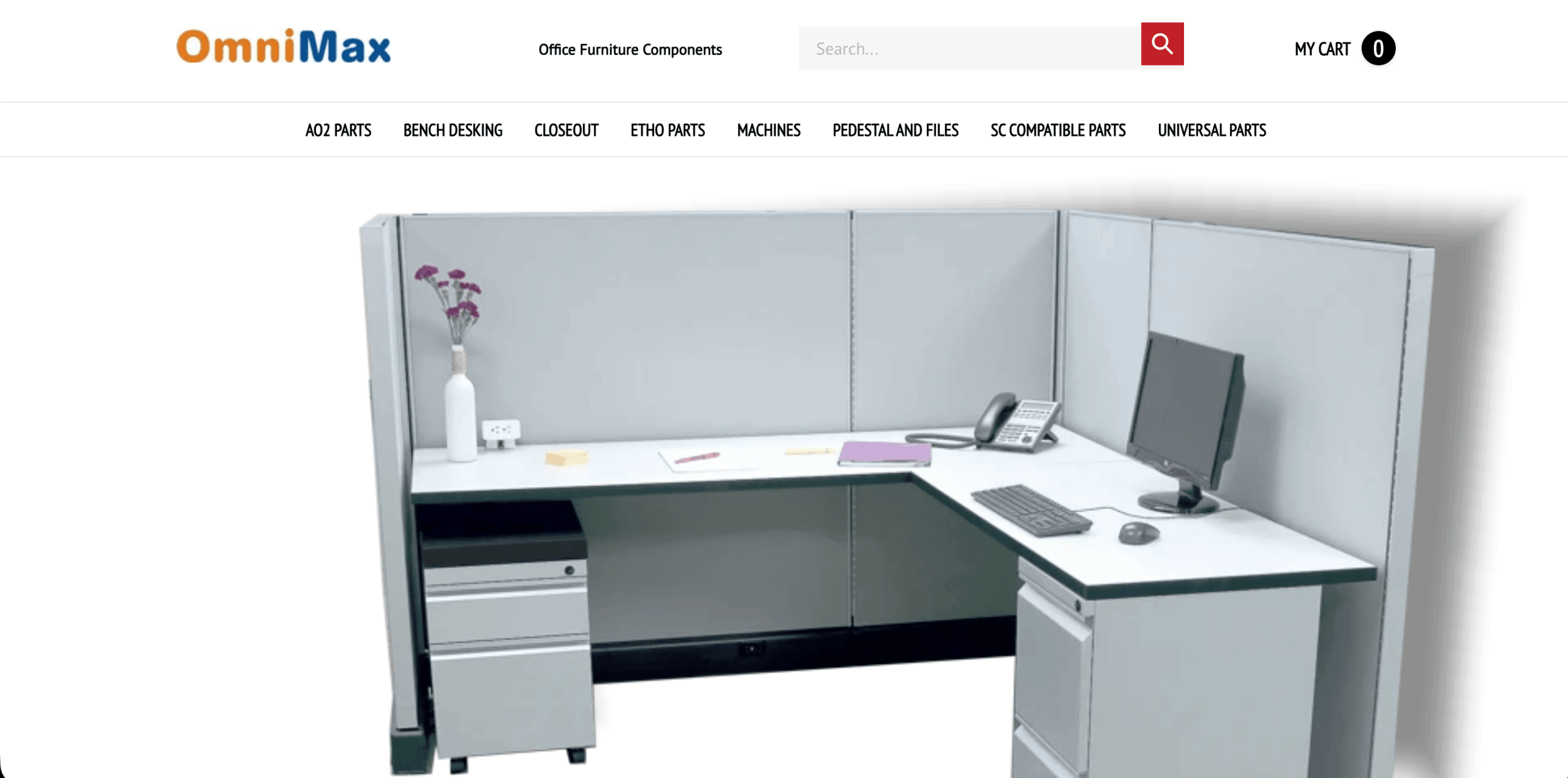
Omnimax USA LLC is a North Texas-based distributor of office furniture components: panels, connectors, pedestals, worksurfaces, electrical components, lighting, and more. Operating from a 60,000-square-foot facility in Anna, Texas, Omnimax serves as the U.S. distribution arm of its China-based parent company, Jiangsu Omni Industrial Import Export Limited. The company warehouses and ships products to dealers, office furniture installers, and procurement teams across the U.S., Canada, and Mexico.

Their catalog is deep and highly organized, and product lines are structured by system compatibility across multiple office furniture families, with hundreds of SKUs per line covering connectors, hardware, fabric, electrical, lighting, storage, and desking components. The customers they have are wholesale buyers who expect account-level pricing, full purchase history, and a buying experience built around how professional procurement actually works. That model demands more from an eCommerce platform than most: negotiated pricing tied to individual accounts, structured category navigation that mirrors how the trade buys, and a backend capable of managing a catalog of significant breadth and variant complexity.

When Omnimax decided to move to BigCommerce B2B Edition, Optimum7 was engaged to execute the full migration: all business data, all content, and all URL structures, without disrupting the live operation in the process.

The Objective

The scope was defined across five workstreams: order migration, customer data migration, product catalog migration, web content migration, and 301 redirect implementation, with a basic BigCommerce B2B Edition template and store setup rounding out the engagement.

The data volume was significant: thousands of orders, customer accounts spread across five pricing tiers, and a product catalog of more than 1,000 SKUs averaging multiple options each. Template customization and third-party app configuration were outside the scope; the focus was clean, accurate data transfer, and a store that functioned correctly for every account holder from day one.

Key Business Challenges

Migrating a live wholesale distribution operation introduced risks at every layer. The complexity was structural, built into the nature of B2B distribution and the depth of Omnimax’s catalog.

1. Account-Level Commercial Relationships That Cannot Tolerate Errors

Each of Omnimax’s customer accounts carries a negotiated pricing agreement, a purchase history, and shipping configurations that reflect an active commercial relationship. Pricing tier assignments live at the account level, not the product level, and they are the foundation of every wholesale transaction. A quiet error in that mapping causes a loud problem: a buyer logs in, sees a price that doesn’t match their contract, and the conversation with their rep becomes about trust instead of their order.

2. A Deep Catalog Organized Across Multiple Furniture System Lines

Omnimax’s catalog is not a flat list of products. It is organized across distinct office furniture system lines, each with its own subcategories, component types, and hardware variants. BigCommerce’s native variant system has a hard architectural limit per product, meaning the existing catalog structure had to be deliberately mapped to BigCommerce’s data model before a single item was imported, ensuring every product rendered with all purchasable options available without hitting platform constraints.

3. Organic Search Equity Built on Legacy URL Structures

Omnimax’s buyers search for specific part numbers, system-compatible components, and product categories. Years of indexed URLs tied to their previous platform represented real, revenue-connected visibility. BigCommerce’s URL architecture differs from most legacy systems, meaning a migration without a comprehensive redirect strategy would orphan indexed pages, break inbound links, and cost Omnimax the search presence they’d built across the exact queries wholesale buyers use to find suppliers.


The Strategic Challenge

B2B migrations fail in the gaps between data layers. Orders, customers, products, pricing, category structure, content, and URLs are each manageable in isolation, but they are not independent: customer records without pricing assignments are commercially incomplete; products without category mappings are invisible in navigation; URLs without redirects become dead ends in search. The sequencing and interdependency of the data were the real problem, not the volume of it.

Optimum7’s approach was to treat the migration as a structured data operation, planning each layer against the others before execution began and validating relationships at every stage. The measure of success wasn’t a completed import; it was a wholesale business environment that functioned correctly on BigCommerce B2B Edition from the moment it went live.

The Strategy

Optimum7 structured the migration across five workstreams, sequencing each layer to protect data relationships and reduce compounding risk.

Order and Customer Data Migration

All orders were transferred to BigCommerce B2B Edition with full fidelity: customer associations, product line items, order status, and transaction records carried through intact. Customer accounts were migrated with complete profiles, including shipping addresses, billing information, and full purchase history. Each account’s pricing tier assignment was mapped to BigCommerce’s native customer group framework, so every wholesale buyer logged into a familiar account with the right defaults already in place.


Product Catalog Migration

The full product catalog was migrated with data integrity across SKUs, variants, inventory levels, images, and SEO metadata. Variant architecture was planned ahead of import to work within BigCommerce’s per-product limits, ensuring every item rendered with all purchasable options available. The category hierarchy was transferred in parallel, with product-to-category associations maintained so buyers navigating by system line or component type found the same organized structure they were accustomed to.


Web Content Migration

All informational pages were moved to BigCommerce with formatting, including images, and internal links were preserved. Keeping that content structurally intact protected both the buyer experience and the SEO value that search engines had already attributed to those pages.


301 Redirect Implementation

A redirect map was built for every legacy product URL, category URL, and content page, and all were implemented in full before launch. No URL was left unmapped. Inbound links, bookmarked pages, and search-indexed URLs all resolved correctly on the new platform, protecting the organic search visibility. Omnimax had built around individual SKUs and system-compatible part categories.


BigCommerce B2B Store Setup and Configuration

The BigCommerce B2B Edition store was set up with the core settings and navigation Omnimax needed to support wholesale buying across its catalog. We also identified a practical app stack for email marketing, customer service, shipping and tracking, and tax compliance, so the team had a solid operational starting point at launch.


Results

Key Outcomes

  • Migration to BigCommerce B2B Edition completed with all business data transferred accurately across orders, customers, products, and content sections
  • Thousands of orders migrated with all associated customer, product, status, and transaction data preserved
  • 2,000+ customer accounts transferred with full purchase history, shipping and billing details, and pricing tier assignments accurately mapped to BigCommerce’s customer group framework
  • 1,000+ products migrated with complete variant, inventory, image, tiered pricing, and SEO metadata, structured within BigCommerce’s variant architecture
  • Full multi-system category hierarchy transferred with all product associations intact
  • All informational pages migrated with content, formatting, and internal links preserved
  • Comprehensive 301 redirect implementation covering all legacy product, category, and page URLs, protecting organic search equity through the platform transition.


Business Impact

Omnimax USA launched on BigCommerce B2B Edition with its wholesale operation intact. Account holders logged in to correct pricing, accurate purchase history, and familiar shipping configurations. The pricing structure that underpins their commercial relationships with dealers and procurement teams now runs natively on BigCommerce B2B Edition, without the workarounds their previous platform required. The full redirect implementation meant the organic search visibility Omnimax had built around specific part numbers, component categories, and system-compatible products that survived the migration without measurable disruption.


Strategic Outcome

At launch, Omnimax USA had something that most wholesale distributors still lack on their eCommerce platforms: a B2B buying environment where the pricing, history, and workflows their customers expect are built into the foundation, not patched on top of it. Every dealer and procurement team that logs into their account finds it working exactly as it should.

With clean data, a platform purpose-built for the wholesale model they operate, and their search presence intact, Omnimax is positioned to grow their eCommerce channel without rebuilding around the platform limitations they left behind.

Share on Social Media
Your AI Visibility Report Awaits