10 Minute Read

SEO Recovery and Organic Growth Case Study – Nexgenof.com

How Optimum7 Rebuilt Organic Visibility in Just 3 Months Across a 150,000+ Page eCommerce Site After a Google Core Update

The Business

Nexgen Outfitters serves a customer who arrives with intent.

Hunters, shooters, and outdoor enthusiasts don’t browse casually. They search with a purpose, preparing for a season, solving a specific gear problem, or narrowing down equipment they trust in real conditions. When they land on a site, they expect clarity fast: accurate specifications, relevant guidance, and confidence that the product will perform outside, not just look appealing on a screen.

Nexgen’s catalog reflects that reality. It combines well-known outdoor brands with proprietary products designed around real-world use. Supporting that catalog is a deep content layer of guides, educational articles, and reviews that help customers make informed decisions without guesswork.

Over time, that combination scaled into something substantial: more than 150,000 URLs spanning products, categories, and content. At that size, organic performance becomes less about individual pages and more about systems. Crawl behavior, internal pathways, and category prioritization start determining what Google sees and what it doesn’t.

When a Google core update in early 2025 significantly reduced Nexgen’s organic visibility, recovery was never going to come from isolated fixes. The site needed a structured reset that could restore relevance and help search engines consistently rediscover the parts of the catalog that matter most.
The Objective

After the core update, Nexgen needed more than a temporary rebound.

The goal was to restore organic visibility in a way that would hold through future updates, not a short-lived spike followed by another drop. At this scale, stability only comes from making the site easier for search engines to understand, prioritize, and revisit over time.

Success was defined by outcomes that mattered both immediately and long-term:

  • Reclaim first-page rankings across priority category searches impacted by the update
  • Restore organic traffic through structural improvements, not reactive tactics
  • Improve crawl efficiency, so Google consistently reaches high-value areas of the site
  • Reestablish category-level relevance in competitive outdoor SERPs
  • Build a repeatable SEO system that scales with the catalog instead of breaking under it


Key Business Challenges

1. Sudden Loss of Visibility After the Core Update

The update caused a sharp decline in top-10 rankings, particularly across category pages that serve as primary entry points for buyers. This wasn’t a localized issue; it reduced discovery across entire product segments.

Minor optimizations would not significantly improve the situation. Priority categories needed clearer intent alignment, stronger topical depth, and better competitiveness against what Google was now rewarding.

2. Crawl and Indexing Inefficiencies at Scale

With more than 150,000 URLs, organic performance depends heavily on how efficiently search engines crawl and prioritize the site.

Some important pages weren’t underperforming because of quality issues, but because the site structure wasn’t consistently signaling importance. Internal link equity was spread thin, and crawlers weren’t always guided toward the pages that should matter most.

3. Intense Competition in Outdoor Search

Outdoor eCommerce is crowded. Marketplaces, major retailers, and content-heavy publishers aggressively compete for category visibility.

Nexgen needed to regain ground without bloating pages, duplicating content, or creating SEO noise that would weaken relevance signals across the site.


The Strategic Challenge

This wasn’t about “fixing rankings.”

Two interconnected systems govern organic performance on a large-scale website:

  • Category relevance: whether key pages clearly match modern search intent and deserve first-page placement
  • Crawl prioritization: whether Google can reliably find, evaluate, and return to those pages

If either breaks down, visibility becomes unstable.

Optimum7’s role was to restore control. Not just to bring rankings back, but to rebuild the conditions that keep them stable: a structure where category competitiveness and crawl efficiency reinforce each other, allowing Nexgen to grow without becoming fragile after every algorithm shift.

The Strategy

Optimum7 implemented a two-layer recovery plan built specifically for scale: rebuild category relevance first, then strengthen crawl pathways so search engines could consistently surface those improvements.

1. Category Content Rebuild for Keyword Recovery

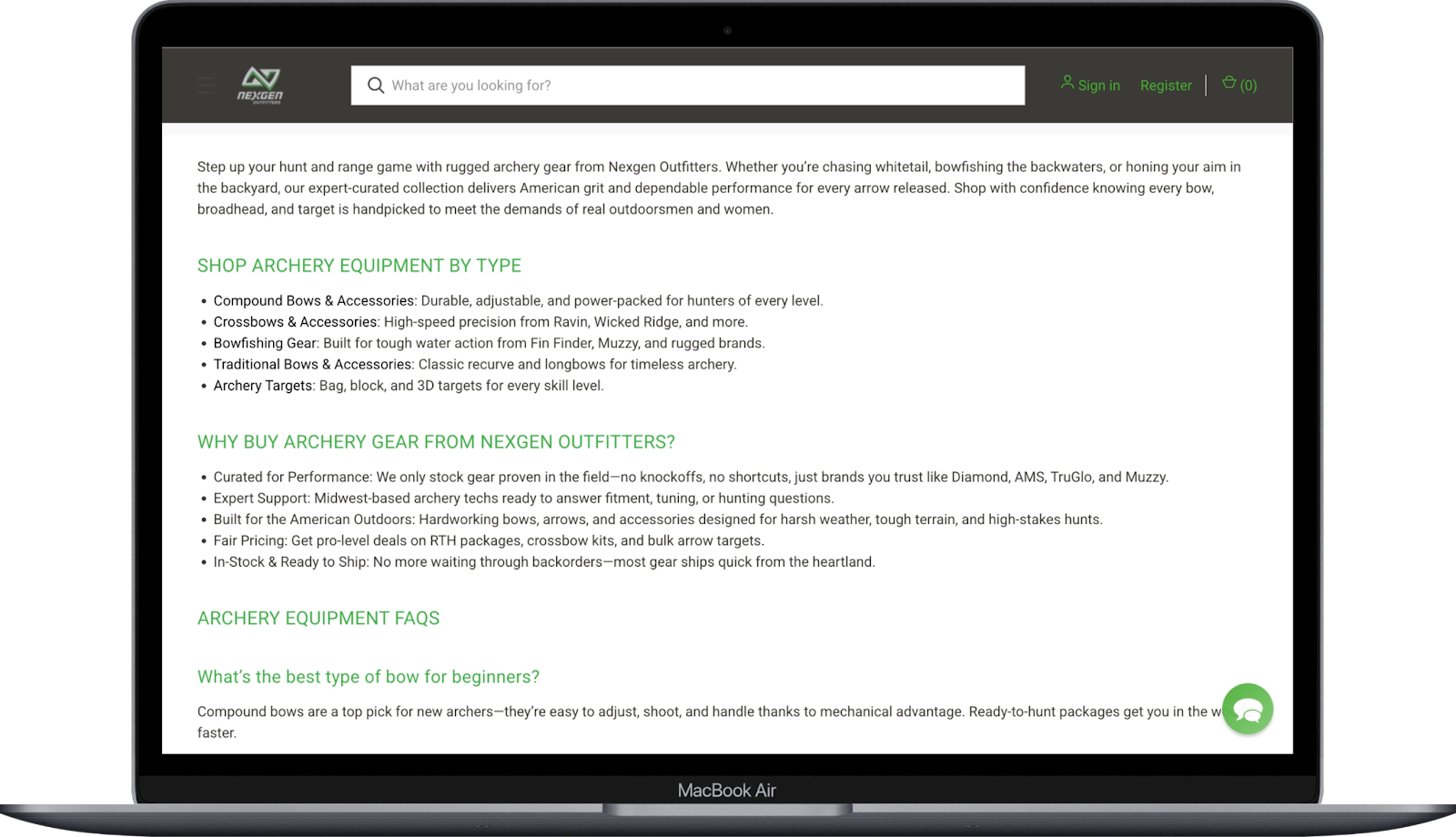
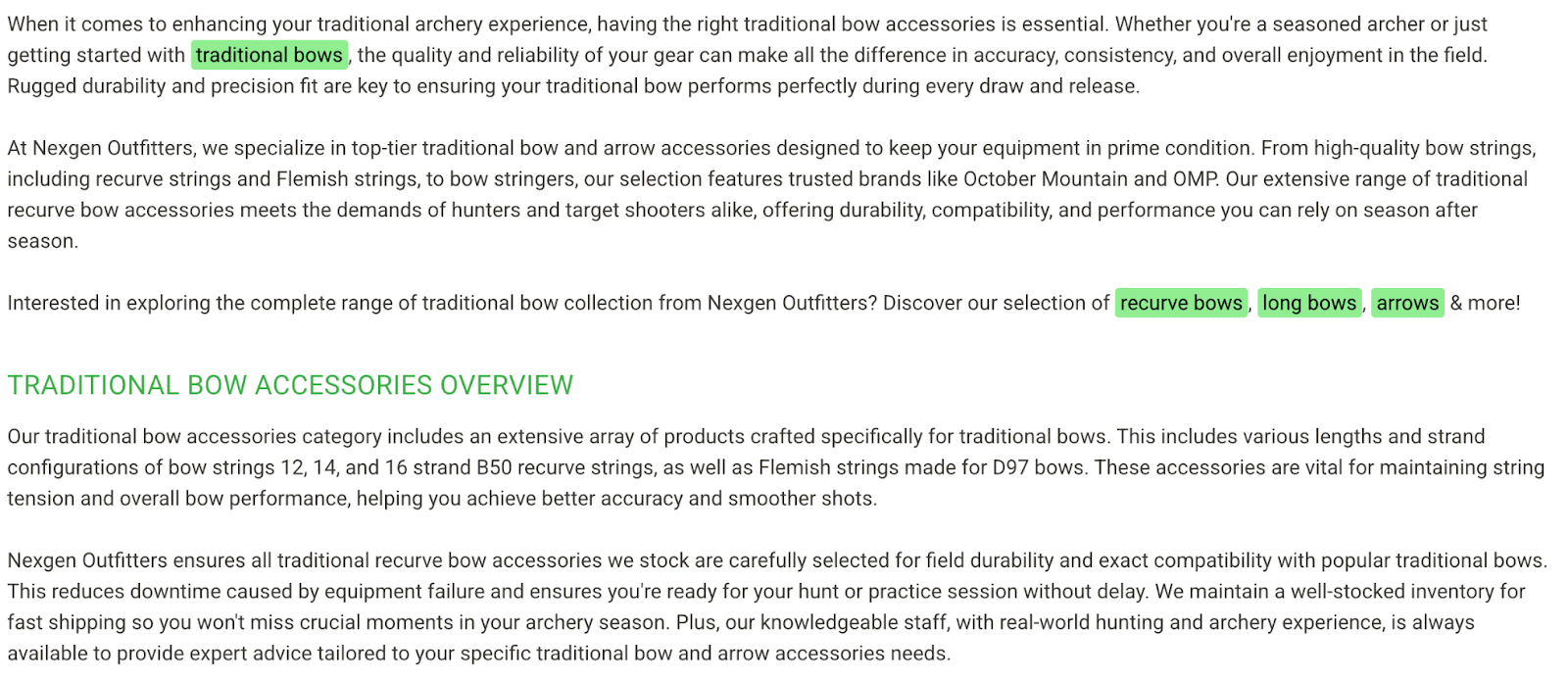
After the update, the thin or generic category copy was no longer competitive. Priority categories were rebuilt to function as true acquisition pages, not filler above a product grid.

This included:

  • Intent-aligned category narratives that reflect how buyers actually search
  • Broader topical coverage to support both head terms and long-tail queries
  • Natural reintegration of lost keywords alongside new ranking opportunities
  • Clear structure that improves readability without turning pages into walls of text

Each category was treated as a ranking asset in its own right, designed to earn visibility rather than wait for it to return.


2. Internal Linking for Crawl and Indexing Control

At this scale, crawl efficiency is a system-level problem.

Optimum7 rolled out a structured internal linking initiative to create clearer, more intentional pathways between content, categories, and key catalog areas. Over four months, more than 100 new content pieces were published, each built with deliberate internal links pointing into priority categories and products.

This achieved two things at once:

  • Improved crawl depth and frequency across important sections of the site
  • Concentrated internal authority signals so that Google could better identify what matters


Rather than spreading relevance thin, the site began reinforcing priority areas consistently.


Results

The recovery showed up where it mattered most: rankings returned, and Google began indexing the catalog more consistently again.

Keyword Growth

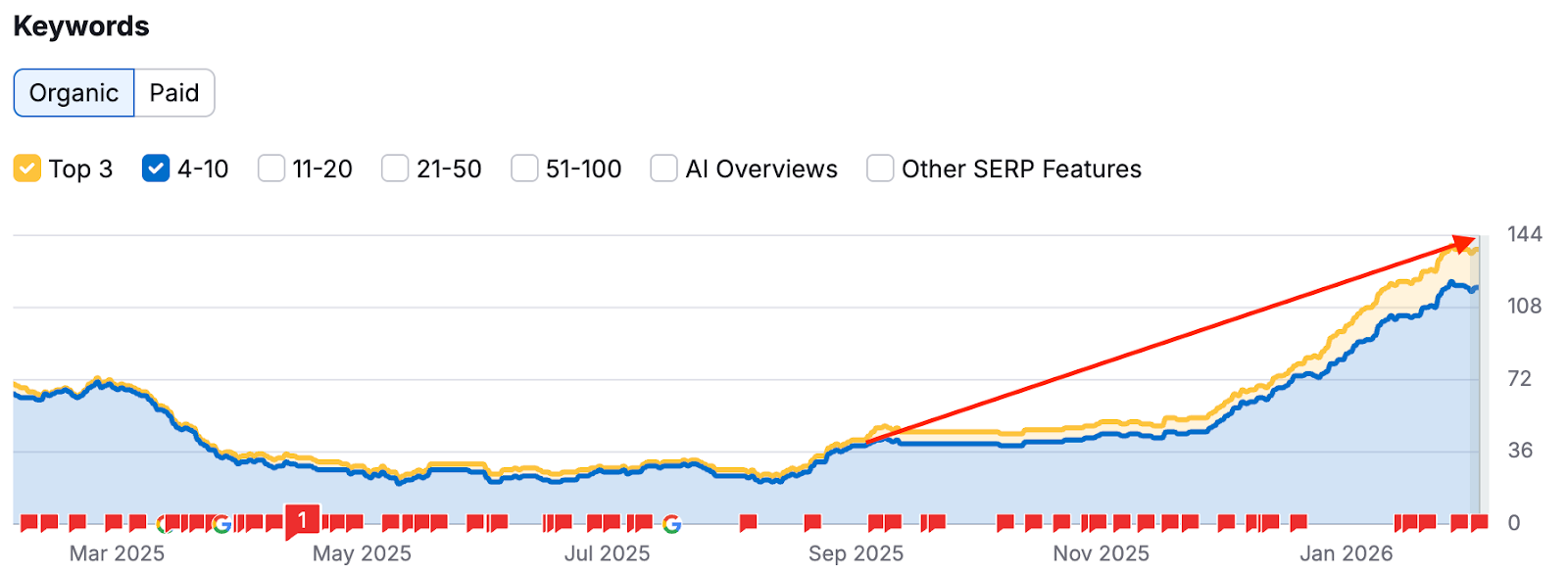
When category rebuilds began, Nexgen had roughly 20-25 keywords ranking on page one. Within four months, that number increased by more than 400%, surpassing 100 first-page rankings by the end of January 2026.

These weren’t vanity terms. They were category-level searches tied directly to buyer intent where falling off page one effectively means disappearing.


Indexing Growth

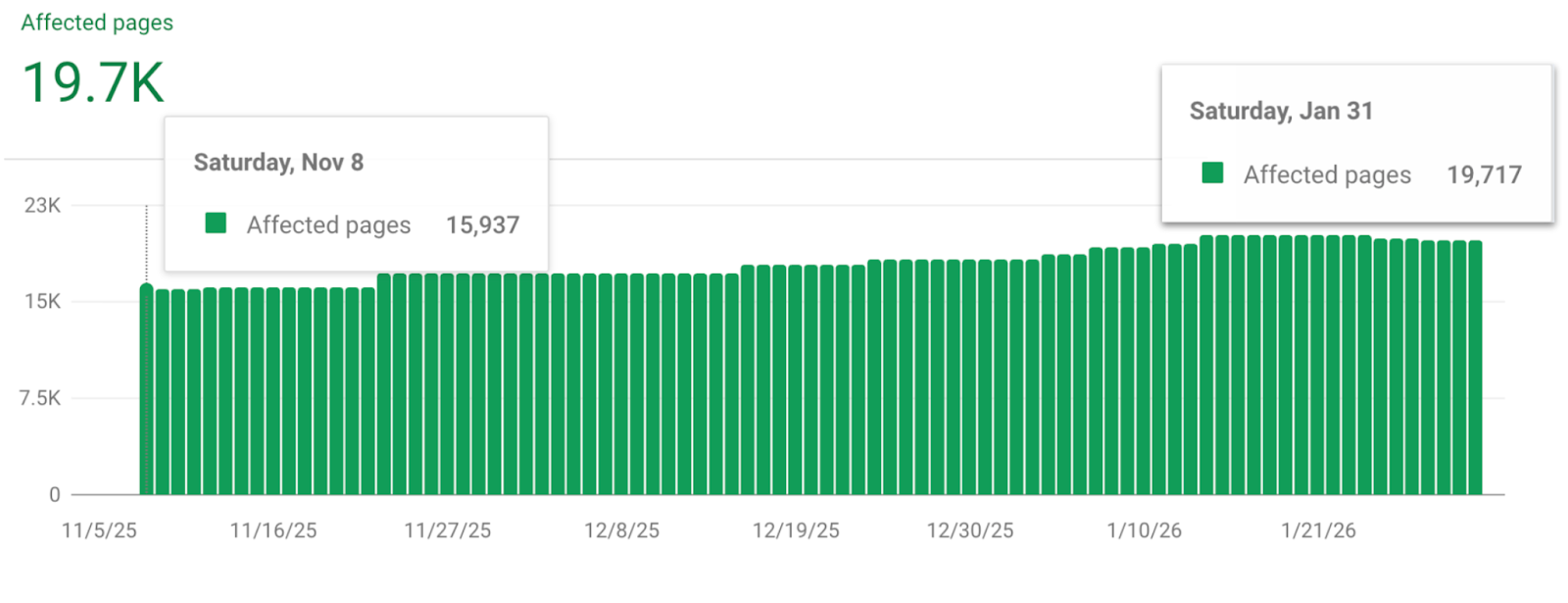
In November 2025, Google indexed approximately 16,000 pages from the Nexgen site. By the end of January 2026, that figure climbed to nearly 20,000 indexed pages.

This expansion matters because it increases the site’s searchable footprint. Thousands of additional URLs became eligible to surface for long-tail queries, niche categories, and product-level searches that only become meaningful at scale.


Strategic Outcome

This was not a recovery based on chance.

Category relevance was rebuilt where rankings are earned, and crawl signals were strengthened so search engines could consistently find and reassess the right parts of the site. The result is an organic foundation designed to handle scale: clearer category competitiveness, stronger internal pathways, and a growth system that expands with the catalog instead of collapsing under it.

Nexgen Outfitters didn’t just regain visibility. They gained control over it.

Share on Social Media
Your AI Visibility Report Awaits