10 Minute Read

Manufacturing SEO Recovery & Growth Case Study — Garrett.com

How Optimum7 stabilized a post-migration site, recovered lost authority, and expanded Garrett’s organic footprint by more than 100% in six months.

The Business

Garrett Metal Detectors occupies a rare position in its market. The company manufactures and sells across two fundamentally different buyer universes: hobbyists and prospectors searching for buried treasure, and security professionals deploying walk-through and handheld screening systems in airports, government facilities, and public venues. The same brand name serves a retiree hunting coins on a Texas beach and a stadium security director managing thousands of daily screenings.

That breadth creates a complex digital environment. A hobbyist browsing for a gold prospecting detector arrives with entirely different intent, vocabulary, and purchase criteria than a procurement officer evaluating walk-through security systems. Product pages, category structures, and content priorities must serve both audiences without diluting either. Every SEO decision carries downstream consequences across segments that do not naturally share search behavior.

When Optimum7 came on board, Garrett had recently completed a site redesign and migration, and the transition had introduced a set of interconnected technical failures that needed to be diagnosed and resolved before any growth work could begin.

The Objective

Garrett entered the engagement with a domain that had accumulated authority over the years and was actively losing it. The immediate goal was to stop the bleed: find every place the migration had fractured the site’s structure, fix it, and restore the visibility and equity that had been severed.

That meant resolving the issues before optimizing anything. A 301 redirect gap cannot be outworked by better content. A deindexed blog cannot be compensated for by stronger product pages. The first six months were defined by a single priority: get Garrett back to where it was, on a foundation accurate enough to build from.

Recovery was the prerequisite. Growth was the goal.   

Key Business Challenges

Garrett’s post-migration performance decline was not caused by a single issue. It was the result of four critical failures working together and compounding the damage.    

1. Link Equity Lost at the URL Level

The migration altered URL structures without implementing proper 301 redirects, effectively disconnecting years of accumulated authority. Search engines treated the new URLs as entirely new pages, stripping them of their historical ranking strength. As a result, high-value product and content pages were forced to compete without the equity they had previously earned, significantly reducing visibility across the domain.

2. Blog Content Removed from Google’s Index

A portion of Garrett’s blog content dropped out of Google’s index following the migration, eliminating its ability to generate traffic or support broader domain authority. For a business operating across two distinct markets, this content plays a critical role in capturing top-of-funnel demand and reinforcing relevance for commercial queries. Restoring indexation required identifying the root cause, resolving it, and reintroducing the affected pages into Google’s crawl cycle.

3. Duplicate Content Splitting Ranking Signals

Duplicate blog content was diluting ranking potential by dividing authority across multiple competing URLs. Instead of consolidating signals into a single page, search engines were forced to interpret multiple versions of the same content. This weakened overall performance and reduced the likelihood of any one version ranking effectively. Resolving this required identifying duplicate instances and implementing canonical structures to consolidate authority.

4. Revenue Data Compromised by Tracking Misconfiguration

Garrett’s GA4 setup was attributing revenue to incorrect traffic sources, making performance data unreliable. Without accurate attribution, it was not possible to evaluate channel effectiveness, measure ROI, or prioritize optimization efforts with confidence. Correcting the tracking configuration was not a growth driver on its own, but it was essential for understanding whether any subsequent improvements were actually working.


The Strategic Challenge

The challenge was sequencing. Garrett’s post-migration issues had to be resolved before any optimization or content work could produce meaningful results. Without that, growth efforts would be built on instability and unreliable data. At the same time, Garrett’s dual-market structure meant that growth opportunities had to be prioritized across hobbyist and security segments, where ranking gains do not carry the same commercial value.

Optimum7 addressed this by making technical remediation the first and non-negotiable phase of the engagement. Once visibility, authority, and attribution were stabilized, the strategy could shift to optimization and expansion with confidence.

The Strategy

Technical Audit and Remediation

The engagement opened with a full site-wide technical audit, identifying and prioritizing the complete scope of issues: redirect gaps, indexation failures, duplicate content instances, structured data inconsistencies, and the GA4 misconfiguration. 

From that baseline: 

  • Missing redirects were implemented across all affected URLs, restoring the link equity severed during the migration
  • Indexation issues affecting blog content were isolated and corrected, bringing those pages back into Google’s crawl cycle
  • Duplicate content was addressed through canonical tags and, where necessary, content consolidation
  • The GA4 configuration was rebuilt to ensure revenue attribution was accurate across all traffic sources

These fixes stabilized Garrett’s technical foundation and restored its ability to rank and measure accurately. Every subsequent optimization effort could now build on a reliable structure. 


Category and Product Page Optimization

With technical integrity restored, the focus shifted to on-page performance across Garrett’s commercial pages. The catalog spans four distinct segments: security products, gold prospecting equipment, hobbyist detectors, and professional investigation tools, each with its own search behavior and buyer intent.

The work included segment-specific keyword research, updated title tags, meta descriptions, and header structures aligned to target opportunities, along with on-page copy revisions calibrated to the intent of each audience. Each page was treated as its own ranking asset, optimized to compete for the specific terms its intended audience actually uses.


Content for Traditional and AI Search

Optimum7 developed a targeted set of blog posts designed to capture demand from both traditional Google search and AI-powered discovery surfaces. Content was structured to rank for keyword-relevant queries in traditional results while also being formatted to be cited and surfaced in AI-generated answers and overviews. Each piece was mapped to gaps in Garrett’s existing coverage, expanding the domain’s organic footprint beyond product and category pages into the informational queries that drive top-of-funnel traffic and reinforce topical authority.


Results

Key Outcomes

  • Total keyword footprint grew from 6,272 to 7,093 (+821 keywords)


  • Page 1 rankings increased from 1,529 to 1,846 (+317 positions)


  • Top 3 rankings grew from 785 to 945 (+160 high-intent positions)

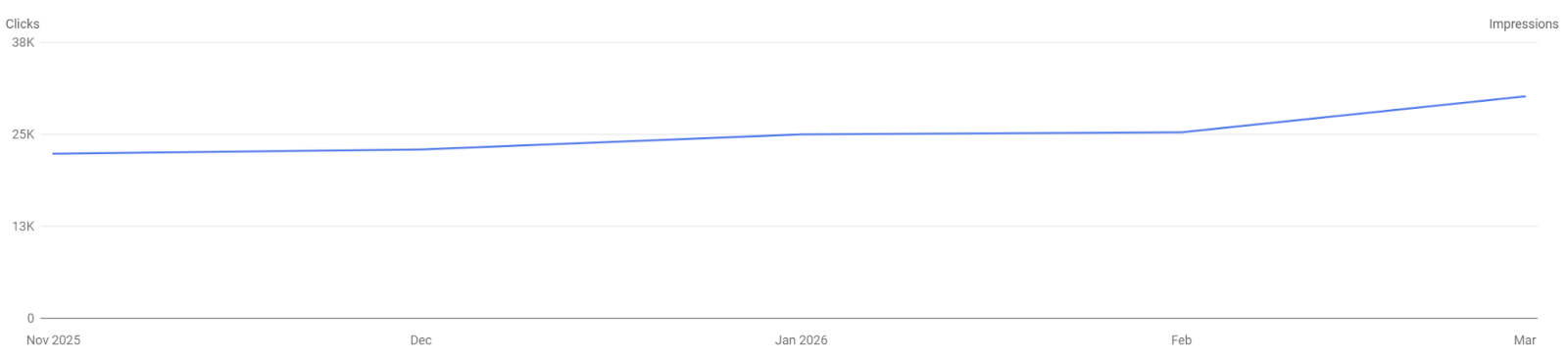
  • Monthly organic clicks increased from 22,391 to 30,167 (+7,776 clicks, +34.7%)


  • Monthly organic impressions increased from 1,053,619 to 2,129,001 (+102.1%)


  • GA4 revenue attribution corrected and validated across all traffic sources


Business Impact

An additional 7,776 organic visitors arriving every month is not a campaign result; it compounds. Each month, those visitors arrive without an incremental acquisition cost, and the ranking positions generating them are more durable than any paid placement.

The impression growth tells the reach story. Garrett now appears across more than twice the search queries it did six months ago, 2.1 million monthly impressions versus just over 1 million. That expanded visibility means more potential buyers encountering the brand before any paid channel touches them, at the top of a consideration process that often takes weeks.

Revenue attribution is now accurate across all traffic sources. That matters not because it changes what happened, but because it makes every future decision, which channels to invest in, which content to prioritize, which campaigns are working, something that can be answered with data rather than approximation.


Strategic Outcome

Six months ago, Garrett was a brand with years of accumulated authority and a domain that couldn’t access it. The migration had done what migrations often do when they go wrong: severed equity, buried content, and produced data that made the damage invisible.

That’s been reversed. Keyword coverage exceeds pre-migration levels. Page 1 and the top 3 rankings have grown substantially across both the hobbyist and security segments. The technical structure is intact and stable.                                                               

What changes now is what becomes possible. Growth initiatives, AI-focused search optimization, paid acquisition, and lifecycle marketing can be built on a foundation that accurately reflects Garrett’s authority and reliably measures the return on each investment. The recovery wasn’t the goal. It was the condition for everything else.   

Share on Social Media
Your AI Visibility Report Awaits