10 Minute Read

BigCommerce Blueprint to Stencil Migration Case Study — ElevatePackaging.com

How Optimum7 Modernized Elevate Packaging’s BigCommerce Storefront with a Conversion-Optimized Stencil Theme Built for Long-Term Growth

The Business

Elevate Packaging sells sustainable packaging solutions across both B2B and B2C, serving customers who care about how their products are presented and protected. Buying packaging is not a quick decision. Customers usually compare materials, product types, use cases, and quantities, often coming back more than once before placing an order. At the same time, they are weighing vendors against each other on price, product range, and credibility. Because of that, the storefront has to do more than just display products; it needs to help buyers find what they are looking for, understand the details that matter, and feel confident enough to move forward.

For years, Elevate Packaging operated on BigCommerce’s Blueprint framework. It worked in the early stages, but over time, it started to limit what the business could build. The theme structure was rigid; mobile performance no longer matched buyer expectations, and many features that support conversions were either missing or required costly workarounds. The business needed a more capable foundation to address these gaps, and they brought in Optimum7 to handle the transition to BigCommerce Stencil.

The Objective

The objective was to move Elevate Packaging off BigCommerce’s outdated Blueprint framework and onto a Stencil-based storefront that could support better conversion performance, a cleaner user experience, and easier long-term maintenance.

The project involved more than replacing one theme framework with another. The new storefront needed to improve how buyers moved through the catalog, interacted with key pages, and progressed toward purchase, while still reflecting the client’s visual direction and staying within the native structure of BigCommerce.

To achieve that, the project focused on several priorities:

  • Choosing a Stencil theme that fits the catalog structure, buyer browsing patterns, and visual requirements.
  • Reworking navigation around the way packaging buyers search, whether by product type, material, or application.
  • Bringing the storefront closer to the client’s reference sites without turning the project into a fully custom design engagement.
  • Improving mobile responsiveness across the key shopping and browsing pages.
  • Making the path to purchase clearer through stronger calls to action and fewer points of friction.
  • Adding trust-building elements where buyers are most likely to hesitate or need reassurance.
  • Keeping all changes within the Stencil framework so the storefront would remain maintainable, upgrade-safe, and aligned with BigCommerce standards.


Key Business Challenges

Elevate Packaging’s challenges were not isolated issues. They were built into the structure of the storefront itself, and each one affected the store’s ability to perform.

1. A Deprecated Platform with No Forward Path

Blueprint is an older BigCommerce framework that no longer receives feature updates, security improvements, or support for newer theme capabilities. Staying on Blueprint meant the store would continue to fall behind, both technically and competitively, and there was no practical way to change that without moving to Stencil.

2. A Mobile Experience That Couldn’t Be Fixed

Blueprint was not built for the kind of responsive, mobile-first experience that Stencil supports. Elevate Packaging’s mobile performance had fallen behind, and the problem was not limited to design tweaks or page-level adjustments. The limitation was built into the framework, which meant real improvement on mobile required a full migration.

3. Missing Conversion Infrastructure

The Blueprint storefront was missing several of the features that help turn product interest into purchases, including sticky CTAs, soft add-to-cart behavior, better-placed calls to action, and trust signals at the points where buyers tend to hesitate. These elements play a direct role in reducing friction during the purchase journey. Without them, even qualified visitors are more likely to leave without converting.

4. Visual Upgrade Without a Custom Design Budget

Elevate Packaging needed the storefront to look noticeably better, but without taking on the cost of a fully custom design project. That meant finding a way to work within a pre-built Stencil template while still bringing in the visual cues and styling direction the client wanted, and doing it in a way that felt intentional and consistent with the brand


The Strategic Challenge

Migrating to a new theme framework is one thing. Delivering a storefront that actually performs better for buyers is another. The real challenge here was doing both inside the natural boundaries of a pre-built Stencil template, without letting the scope drift into territory that would make the build fragile or hard to maintain after launch.

That required judgment at every step. Template selection mattered more than it might seem on paper, because the right starting point shaped everything that came after: how navigation could be structured, where conversion elements could live, and how close the final result could get to the client’s visual references. Once the foundation was set, the work focused on building conversion improvements into the parts of the storefront where buyers actually make decisions, rather than applying them as a surface layer on top.

Working carefully within the Stencil framework was not a limitation on what the project could achieve. It was the reason the finished store would hold up.

The Strategy

Optimum7 handled the upgrade in two connected phases. The first was getting the Stencil foundation right. The second was building conversion improvements into the parts of the storefront that mattered most during the buying process.


1. Template Selection and Foundation Architecture

Optimum7 worked with Elevate Packaging to review BigCommerce Stencil themes against the shape of the catalog, the way buyers move through it, and the visual direction the client wanted. Once the right template was selected, the team used it to set the foundation for the rest of the build, including navigation structure, page layout, and global styling settings. All of the work stayed within the native Stencil framework, which helped preserve maintainability, upgrade compatibility, and alignment with BigCommerce standards.


2. Navigation and Layout Customization

Navigation was set up around the client’s preferences, which mattered because packaging buyers often search by product type, material, and application. Layout and element placement were then adjusted to reflect the reference sites. Elevate Packaging shared, giving the storefront a more polished and brand-consistent feel without turning the project into a full custom design build.


3. Mobile Optimization

Every layout decision was evaluated against mobile performance. Stencil’s responsive architecture made this feasible in a way Blueprint never could. Key pages were built to perform reliably across screen sizes, with visual hierarchy, interaction patterns, and content structure calibrated for buyers who research and evaluate packaging products on mobile devices. Mobile was treated as a primary context throughout the build, with each layout decision made for that environment from the start.


4. Conversion Infrastructure

Optimum7 implemented the conversion-focused elements the Blueprint storefront had been missing, strengthening the path from product discovery to purchase without making the experience feel heavier or more complicated.

  • Sticky CTAs and soft add-to-cart functionality that kept purchase actions visible while allowing buyers to continue browsing without interruption


  • Primary and secondary calls to action are positioned at key points in the purchase journey where hesitation typically appears


  • Trust-building elements, including customer reviews and trust badges, are integrated at critical decision points to reinforce confidence and reduce abandonment


Results

Key Outcomes

  • BigCommerce Stencil theme selected and implemented, replacing Blueprint with a modern, actively supported framework
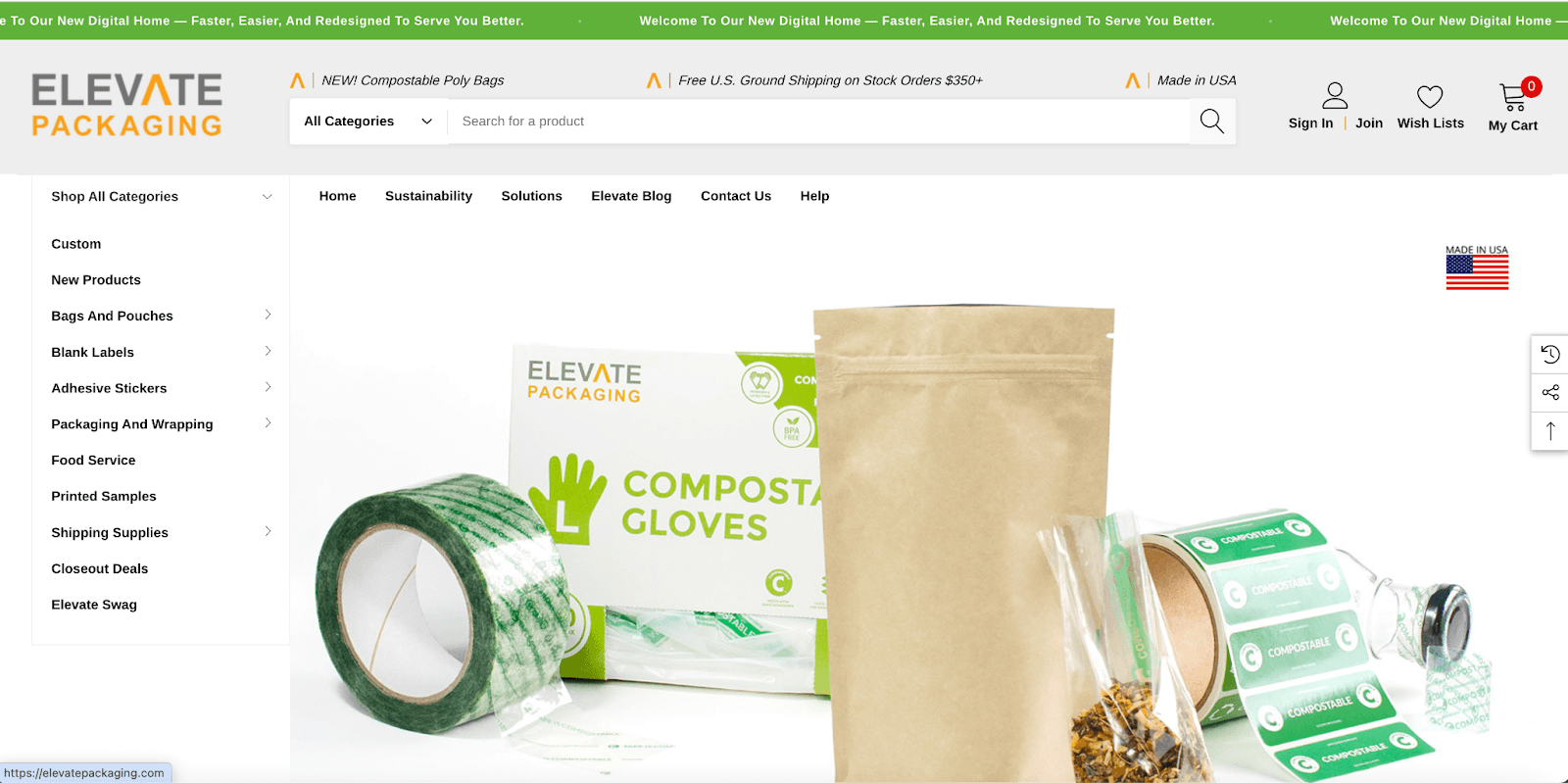
  • Navigation was configured to match the client’s preferences, making it easier for buyers to move through Elevate Packaging’s catalog.
  • Layout and visual styling were brought in line with the client’s reference sites, creating a design that felt more consistent with the brand while staying within the Stencil framework.
  • Mobile-optimized experience across all key pages, addressing the core performance gap left by Blueprint
  • Complete conversion stack implemented: sticky CTAs, primary and secondary calls to action, and soft add-to-cart working together across the storefront
  • Trust-building elements integrated at key decision points throughout the buyer journey

Business Impact

Elevate Packaging now operates on a storefront that is better suited to where the business is today and where it plans to go next. Buyers on both desktop and mobile have a clearer path from product discovery to purchase, with fewer points where the experience breaks down or loses momentum. The conversion improvements across the site work together to support that path, helping more qualified visitors stay engaged instead of dropping off. The move to Stencil also gives the business access to ongoing BigCommerce updates, built-in theme controls, and a more practical foundation for future development than Blueprint could offer.

Strategic Outcome

The new storefront gives Elevate Packaging a stronger BigCommerce foundation, built to support how the business sells today and flexible enough to grow with it. Conversion improvements were built into the buying experience from the beginning, so the site is not relying on patchwork fixes or add-ons after the fact. With Stencil in place, the business has room to expand the catalog, run promotions, and introduce new functionality without running into the same structural limits that came with Blueprint.

Optimum7 kept the project focused and delivered a storefront that works better for the business without making the build more complex than it needed to be. The result is a store that Elevate Packaging can actually own going forward, not just launch and hand off to a developer every time something needs to change.

Share on Social Media
Your AI Visibility Report Awaits