10 Minute Read

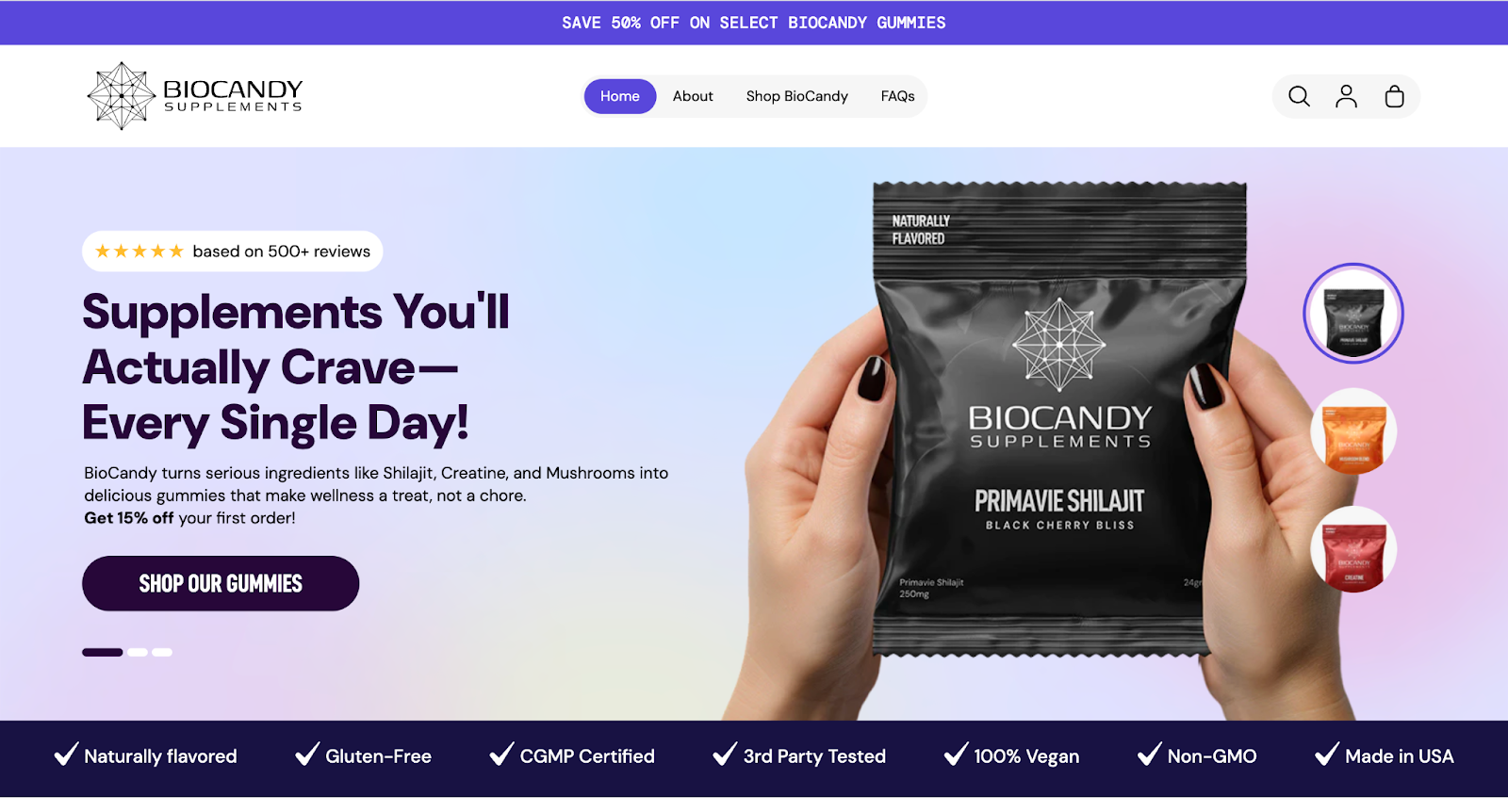
Shopify Redesign & Custom Development Case Study – BioCandy.com

How Optimum7 Rebuilt BioCandy’s Storefront with a Custom Design Built for Merchandising Agility and Scalable eCommerce Performance

The Business

BioCandy is a digitally native eCommerce brand with a distinct visual identity and a growing customer base. As the brand evolved, its expectations for how it should look, feel, and function online matured as well. The Shopify storefront was operational, but it was constrained by the limits of a pre-built theme.

The store could support transactions, but it could not fully support brand expression, merchandising flexibility, or rapid campaign execution. Layout adjustments required workarounds. Promotional launches demanded developer involvement. Structural consistency depended on manual control rather than system logic.

For a brand preparing to scale, this created friction.

BioCandy did not need a cosmetic redesign. It needed a storefront engineered as infrastructure, something that could preserve design integrity while supporting growth, iteration, and operational independence.

Optimum7 was engaged to design and implement a fully custom Shopify storefront grounded in a custom design and translated into a stable, modular production build inside Shopify’s native framework.

The Objective

The objective was to translate BioCandy’s approved designs into a production-ready Shopify storefront that preserves high visual fidelity across core templates, maintains intentional responsiveness across devices, and establishes a clean structural foundation that supports ongoing growth.

​​The build needed to accomplish five outcomes simultaneously:

  • Preserve pixel-level design fidelity across homepage, collection, product, and content templates
  • Maintain consistent responsiveness across all breakpoints
  • Enable internal merchandising and campaign updates without relying on recurring development.
  • Support long-term scalability without structural fragility
  • Integrate SEO and performance readiness at the template level


The goal was to create a storefront architecture that can evolve without repeated rebuilds.


Key Business Challenges

1. Theme Limitations Were Constraining Brand Expression

BioCandy’s previous Shopify theme allowed for limited layout variation and visual hierarchy control. As the brand’s creative standards rose, the storefront began to feel constrained rather than expressive.

The experience lacked the cohesion and intentional structure expected from a growing eCommerce brand.

2. Routine Changes Required Developer Intervention

Campaign banners, layout shifts, promotional blocks, and merchandising updates risked turning into technical tickets. That dependency slowed execution and increased operational cost.

The internal team needed autonomy within guardrails.

3. High-Fidelity Design Risked Becoming a Fragile Build

Translating detailed designs into Shopify can introduce long-term maintenance risks if not engineered carefully. A visually accurate build is not automatically scalable.

BioCandy required a structure that balances creative precision with long-term stability.

4. Responsiveness Could Not Be an Afterthought

The storefront needed to behave intentionally across devices. Desktop layouts that compress on mobile without considering user behavior degrade the quality of the experience.

Mobile interactions, hierarchy, and readability required engineered attention.

5. Flexibility Without Chaos

Reusable sections increase flexibility, but without disciplined architecture, they create inconsistency. BioCandy needed modularity without losing brand control or structural cohesion.


The Strategic Challenge

The tension in this project was structural. Push too far toward customization, and the site becomes brittle, difficult to update, and expensive to maintain. Stay too close to a standard theme, and the brand remains visually and functionally constrained.

The solution required a system-level mindset. Optimum7’s responsibility was to:

  • Translate creative direction into structured components
  • Engineer modularity without sacrificing governance
  • Build within Shopify’s native framework to preserve performance and compatibility
  • Create a storefront that feels custom but behaves predictably


This was a design engineering project, not a cosmetic redesign.

The Strategy

Optimum7 executed the rebuild across four coordinated layers: design development, modular Shopify architecture, responsive engineering, and operational enablement.

1. Custom Design Development

Rather than designing isolated screens, Optimum7 developed a cohesive design framework that defined:

  • Spacing rules and grid behavior
  • Typography hierarchy
  • Button and interaction patterns
  • Visual rhythm across content blocks
  • Standardized layout compositions


Core templates were created for:

  • Homepage
  • Collection pages
  • Product detail pages
  • Blog layouts
  • FAQ and About sections


Each template followed shared structural logic to ensure consistency across the storefront. This approach reduced ambiguity during development and ensured scalable pattern reuse.


2. High-Fidelity Shopify Template Implementation

Approved designs were translated into Shopify, and the implementation emphasized:

  • Semantic markup for improved accessibility and search interpretability
  • Clean template separation to prevent cross-page conflicts
  • Maintainable code structure aligned with Shopify best practices
  • Controlled interactive states for hover, focus, and mobile gestures
  • Performance-conscious asset loading


Where platform constraints required adaptation, modifications were applied surgically rather than altering design intent.

The result was a production-ready storefront engineered within Shopify’s ecosystem rather than layered on top of it.


3. Modular Widget Architecture

Instead of hardcoding layouts, Optimum7 constructed configurable Shopify sections that allow internal teams to:

  • Rearrange homepage blocks without code edits
  • Swap promotional elements for campaign launches
  • Reuse proven layouts across templates
  • Introduce new content modules while preserving visual standards


Each module was designed with guardrails, flexible within boundaries, so brand consistency remains intact.

This transformed the storefront from a static layout to a structured control system.


4. Responsive Engineering and Conversion Support

Breakpoints were deliberately engineered, not automatically inherited. Key considerations included:

  • Mobile-first interaction flows
  • Adjustable spacing logic at tablet widths
  • Button sizing optimized for touch
  • Controlled stacking behavior for complex sections
  • Navigation behavior adapted for screen context

Rather than compressing the desktop into a mobile, the experience was recalibrated per device type.


5. Technical SEO and Structural Readiness

Search readiness and accessibility were incorporated during template development rather than applied post-launch.

Implementation included:

  • Clean heading hierarchies across templates
  • Schema markup for product and content clarity
  • Alt-text standards for images
  • Metadata structures prepared for scalable expansion
  • Page speed considerations during asset loading


This ensured that BioCandy launched on a technically coherent framework capable of supporting organic growth.


6. Trust and Social Proof Integration

Customer reviews and video testimonials were integrated within strategic storefront placements to reinforce credibility early in the browsing journey.

Rather than isolating social proof on secondary pages, these elements were woven into key sections to strengthen buyer confidence without interrupting product discovery flow.

Results

The outcome was not simply a redesigned storefront. It was a scalable Shopify design.

Key Outcomes

  • Implemented custom storefront templates directly from the approved designs across BioCandy’s highest-impact pages
  • Built a modular section system that makes layouts reusable, editable, and consistent across the site
  • Engineered responsive behavior across breakpoints to preserve hierarchy, readability, and usability on every device
  • Launched with an SEO-ready template foundation designed to support ongoing content and campaign growth without structural decay
  • Integrated reviews and video testimonials into the browsing journey to surface trust early without interrupting shopping flow


Operational Impact

BioCandy’s internal team can now execute merchandising and promotional adjustments without recurring development tickets.

Homepage refreshes, campaign swaps, and content expansions occur within defined modules that preserve visual cohesion.

The site supports iteration without accumulating technical clutter.


Customer Experience Impact

Visitors experience a storefront that feels cohesive from entry to checkout.

  • Visual hierarchy guides product discovery.
  • Content is structured for clarity.
  • Navigation flows naturally across device types.
  • Trust cues appear where decision-making occurs.


The experience reflects brand intention rather than theme limitation.


Strategic Outcome

Optimum7 delivered more than a storefront redesign. BioCandy now operates on a Shopify-native design engineered for expansion. The architecture supports:

  • Ongoing merchandising flexibility
  • Campaign agility without instability
  • Long-term scalability without rebuild cycles
  • Brand consistency across future growth phases


The storefront has shifted from a constrained template to a controlled, extensible digital environment built to evolve alongside the business.

Share on Social Media
Your AI Visibility Report Awaits