

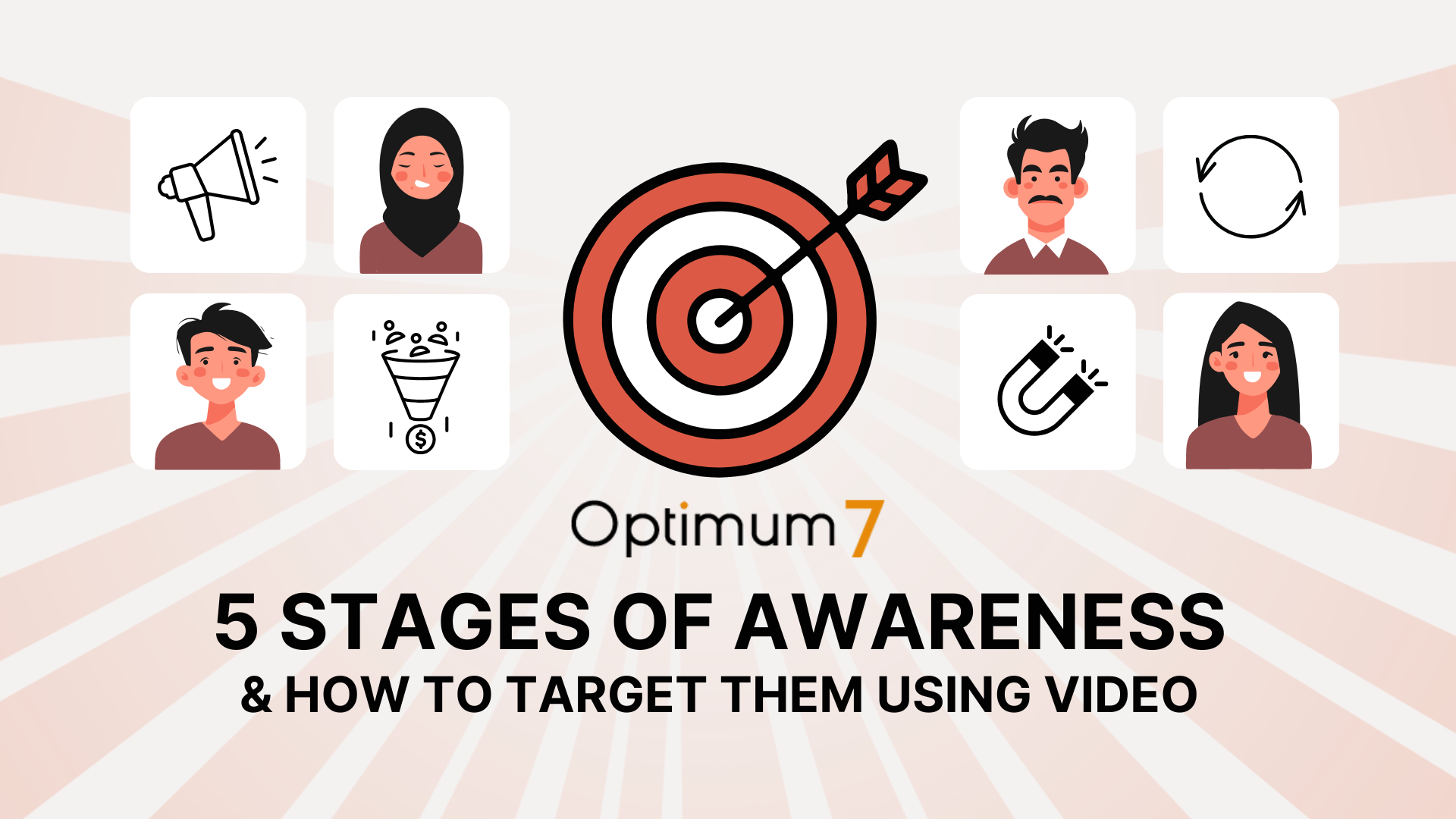
TL;DR: The five levels of customer awareness (Unaware, Problem Aware, Solution Aware, Product Aware, and Most Aware) describe how ready a prospect is to buy. This guide defines each stage, maps it to your funnel, shows the content and channel that fit, and walks through how to move buyers from one stage to the next without wasting budget.
Why do two people who see the same ad react in completely opposite ways? One buys within minutes. The other scrolls past without a second thought. The difference usually comes down to how much each person already knows about the problem, the available solutions, and your brand. That gap has a name: customer awareness.
Copywriter Eugene Schwartz mapped it in his 1966 book Breakthrough Advertising. He identified five levels of awareness every buyer passes through before a purchase, from someone who does not yet know they have a problem to someone ready to act the moment they see your offer. Match your message to the level and it lands; miss the level and even a strong product gets ignored.
This guide defines all five levels of customer awareness, maps them to the marketing funnel, shows the content and channel that fits each one, and walks through how to move a prospect from Unaware to Most Aware without spending on the wrong message at the wrong time.
What Are the 5 Levels of Customer Awareness?
The five levels of customer awareness, sometimes called the levels of market awareness, describe the distance between a prospect and a purchase. Someone at the top does not know they have a problem yet. Someone at the bottom is one nudge away from checkout. The stage a buyer sits in decides what you should say, how you should say it, and where they need to hear it.
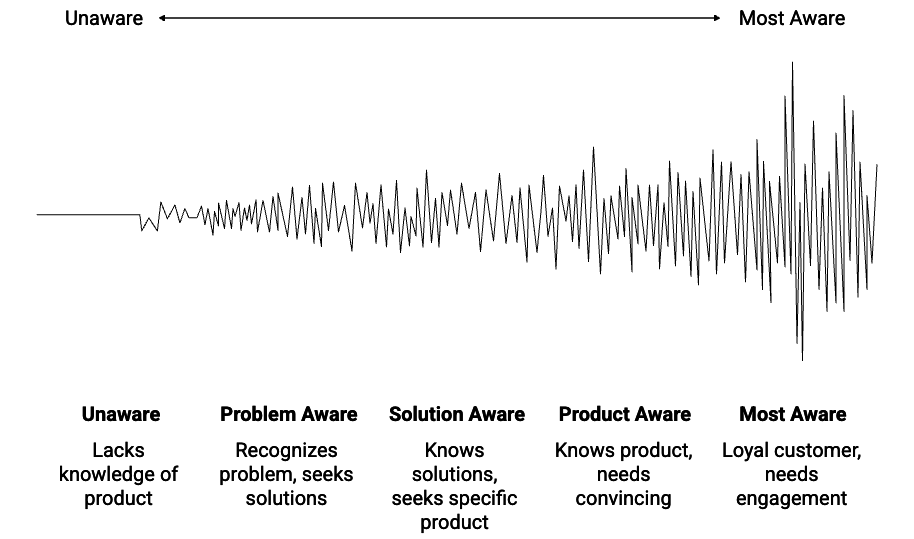
1. Unaware
The buyer has no sense that they have a problem you can solve. Nothing about your product is on their radar yet, because the need has not surfaced in their mind. The goal at the Unaware stage is to make the problem visible, never to pitch the product. Messaging leads entirely with a pain point or a benefit, and it works best on passive channels people browse for entertainment. Skip this stage and you cede every future buyer to whoever reaches them first.
2. Problem Aware
The buyer feels the problem but does not know a fix exists. A Problem Aware prospect is searching symptoms, describing frustrations, and asking peers for advice. Educational content earns attention here: name the problem precisely, validate that it is worth solving, and introduce the idea that a solution category exists. Hold the product back. A hard sell at this stage reads as noise to someone still trying to understand what is wrong.
3. Solution Aware
The buyer knows solution types exist but has not heard of your brand. A Solution Aware prospect is comparing categories, reading roundups, and weighing approaches against each other. The goal is to enter their consideration set with comparison guides, category pages, and content that shows where your approach fits among the options they already know. You are earning a spot on the shortlist, not closing the deal.
4. Product Aware
The buyer knows your product and carries specific objections: price, trust, fit, or a competitor they also like. A Product Aware prospect needs proof, not education. Case studies, testimonials, side-by-side comparisons, and demos remove the exact barrier standing between interest and purchase. The job here is to answer the one question keeping them from buying, which is rarely the same question across two different prospects.
5. Most Aware
The buyer wants your product and needs a reason to act now. A Most Aware prospect responds to a clear offer: a discount, a guarantee, free shipping, or a deadline. Keep the message simple, state the offer, and remove every point of friction between the click and the checkout. Overselling here backfires; this buyer has already decided, and a long pitch only introduces new reasons to hesitate.

| Stage | What the buyer knows | Content that fits | Where to reach them |
|---|---|---|---|
| Unaware | No sense of the problem yet | Short social video, brand storytelling, benefit-led hooks | TikTok, Instagram, YouTube pre-roll |
| Problem Aware | Feels the problem, not the fix | How-to guides, educational blog posts, explainer video | Organic search, YouTube search, email newsletters |
| Solution Aware | Knows solution types, not your brand | Comparison guides, category pages, roundups | Organic search, review sites, podcasts |
| Product Aware | Knows your product, has doubts | Case studies, testimonials, demos, retargeting | Retargeting ads, email nurture, product pages |
| Most Aware | Ready to buy on the right nudge | Clear offers, guarantees, cart recovery | Branded search, email, SMS, checkout |
How the 5 Awareness Levels Map to Your Marketing Funnel
Awareness and the marketing funnel describe two different things that line up neatly. Awareness is what a buyer knows; the funnel is where they sit in your marketing. The two top stages, Unaware and Problem Aware, live at the top of the funnel, where the job is to create demand. Solution Aware sits in the middle, where you build consideration. Product Aware and Most Aware sit at the bottom, where you convert. Mapping the two together tells you what to say, which team owns the message, and how to measure it.

One point of confusion is worth clearing up. Awareness levels are separate from what Schwartz called market sophistication, which measures how many competing claims a market has already heard. Awareness is about the individual buyer’s knowledge; sophistication is about how tired the whole market is of the same pitch. You can have a highly aware buyer in an unsophisticated market, or the reverse, and each calls for a different angle.
Why Targeting Only the Bottom of the Funnel Costs You
Marketing teams pour budget into the last two stages because those buyers convert fast and the return is easy to measure in a dashboard. The Product Aware and Most Aware stages are also the smallest and most competitive slice of any market, where every rival is bidding on the same branded terms and retargeting the same shoppers. The buyers who become loyal customers were reached earlier, while they were still figuring out the problem.
Covering the full funnel takes patience, and the payoff compounds. A prospect you introduce to the problem while they are Unaware arrives at the buying stage already trusting your brand, which means less price shopping and shorter sales cycles. That long game shows up clearly in results Optimum7 has documented.
The same logic applies to a store: reaching buyers earlier across every stage means far less price competition by the time they convert at the bottom of the funnel.
How to Move Buyers From Unaware to Most Aware
Moving a buyer up the awareness ladder means changing the message at each step, not repeating the same pitch louder. Think about the last thing you bought after weeks of research: did the first thing you saw try to close the sale, or did something make you realize you had a problem worth solving? Three principles keep the progression working.


The clearest way to see this is to watch one message evolve across all five stages. Take a mattress brand. An Unaware buyer does not respond to coil counts or foam density, because they have not decided they need a new mattress at all. As awareness grows, the same brand shifts from surfacing a problem, to naming its cause, to comparing options, to proving results, and finally to making an offer.

At the top of the funnel, the mattress brand opens with a benefit: “most adults wake up more tired than they went to bed.” It never mentions the product. Only at the Solution Aware stage does the conversation turn to mattress types, and only at Most Aware does price enter. The pattern holds in any category. A project management tool for an Unaware team might open with “your team ships slower every quarter and no one can say why,” then earn the sale months later with a side-by-side comparison and a free trial.
Give the early-stage buyer one perspective on the problem, then another, before you ever mention price or features. Do the same across a category and the effect compounds. Buyers rarely move in a straight line: they loop through research and comparison for weeks, and increasingly they ask AI engines for the answer, so getting cited in AI-driven answer engines is now part of staying on the shortlist until they reach out already recognizing your brand.
How to Tell Which Awareness Stage a Customer Is In
You cannot match a message to a stage until you can read the stage. The signals are already in your analytics and your sales calls; you just have to look for them. Four sources tell you where a buyer sits.
- Search intent. The exact words a visitor searched reveal their stage. Symptom queries (“why am I always tired”) signal Problem Aware; category queries (“best hybrid mattress”) signal Solution Aware; branded queries (” mattress reviews”) signal Product Aware. Capturing those searches at all depends on how organic search works.
- Traffic source. A visitor from a TikTok hook is usually earlier in awareness than one who clicked a branded Google ad. The channel a person arrives through is a rough map of how much they already know.
- On-site behavior. Someone reading an introductory blog post is earlier than someone comparing pricing tiers or sitting on a product page. The pages a visitor chooses show what question they are trying to answer.
- Sales conversations. The first questions a prospect asks on a call place them instantly. “What does this even do?” is Solution Aware; “how are you different from ?” is Product Aware; “can you match their price?” is Most Aware.
No single signal is decisive, and buyers move between stages as they learn. Read them together, and let the picture update as behavior changes.
Common Mistakes When Targeting Awareness Stages
Awareness-stage marketing usually fails for a handful of repeatable reasons. Each one comes from treating every buyer as if they already know what you know.

| Mistake | Why it backfires | Do this instead |
|---|---|---|
| Pitching the product to Unaware buyers | They have no context for why it matters, so they scroll past | Open with the problem or a benefit; hold the product back |
| Spending only on branded search and retargeting | You harvest existing demand and create none, so growth stalls | Fund top-of-funnel content that fills the pipeline months out |
| Using one message for the whole audience | It fits no one, because each stage needs a different angle | Segment by stage and write a distinct hook for each |
| Judging top-funnel content by direct sales | Awareness content rarely converts on first touch, so it looks like a loss | Measure reach, assisted conversions, and branded search lift |
Using Video to Reach Every Awareness Stage
Video carries a stage-specific message faster than text, which is why it works so well across the awareness levels. The average online viewer gives a browsing feed about seven seconds. Optimum7’s own bottom-funnel videos, aimed at buyers who already know the brand, hold an average watch time of 45 seconds, and concept videos that explain an idea in depth hold attention for four to five minutes. That retention comes from matching each clip to the viewer’s stage.
The efficient way to produce this is one shoot, edited into several stage-specific clips. Optimum7’s video production and editing process turns a single 15-minute session into assets for the whole funnel, so the SEO, paid, and social teams each work from footage matched to the audience they reach.
Frequently Asked Questions
What are the 5 levels of customer awareness?
The five levels are Unaware, Problem Aware, Solution Aware, Product Aware, and Most Aware. Defined by Eugene Schwartz in Breakthrough Advertising (1966), they describe every step a buyer takes from not knowing they have a problem to being ready to purchase a specific solution. Each stage needs its own message, format, and channel.
What are the 5 stages of awareness in marketing?
The 5 stages of awareness in marketing, also called the 5 stages of customer awareness, are the same five levels: Unaware, Problem Aware, Solution Aware, Product Aware, and Most Aware. Marketers use them to decide what to say at each point in the buying journey, so a message reaches a prospect who is ready to hear it.
Who created the 5 levels of awareness?
Copywriter Eugene Schwartz introduced the framework in his 1966 book Breakthrough Advertising. It remains a standard model in direct response and content marketing because it maps messaging to a prospect’s state of mind instead of to a product feature list. Decades later, marketers still use the same five stages to plan campaigns and structure content.
What is the difference between problem aware and solution aware?
A Problem Aware buyer knows they have a problem but does not yet know a solution exists. A Solution Aware buyer knows solution types are available but has not heard of your specific brand. Problem Aware content names the problem; Solution Aware content differentiates your approach from the alternatives.
How do you move customers from unaware to most aware?
Change the message at each step. Lead with the problem for Unaware buyers, introduce solutions for Problem Aware buyers, differentiate your brand for Solution Aware buyers, remove objections for Product Aware buyers, and make a clear offer to Most Aware buyers. Consistent presence across channels carries them from one stage to the next.
How do the 5 awareness levels relate to the marketing funnel?
Unaware and Problem Aware buyers sit at the top of the funnel, where the goal is creating demand. Solution Aware buyers sit in the middle, where you build consideration. Product Aware and Most Aware buyers sit at the bottom, where you convert. Awareness describes what the buyer knows; the funnel describes where they sit in your marketing.
Which awareness stage should I target first?
Start where your evidence is strongest. Teams usually already reach the Product Aware and Most Aware buyers, so the fastest growth tends to come from building content for the Problem Aware and Solution Aware stages, where buyers are searching but have not chosen a brand. Reaching Unaware audiences pays off over a longer horizon.
What is the difference between customer awareness and market sophistication?
Customer awareness measures what an individual buyer knows about their problem and your product. Market sophistication, another Schwartz concept, measures how many similar claims the whole market has already heard. A tired, sophisticated market needs a fresh angle even when buyers are highly aware, so the two ideas guide different parts of your messaging.
Putting the Framework to Work
The five levels of customer awareness turn marketing from a guess into a map. Once you know which stage a buyer sits in, the message, the format, and the channel all follow from it. Skipping the top of the funnel leaves the buyers who become loyal customers to a competitor who reached them first.
Awareness mapping works best when it is tied to the store and the platform behind it. If that foundation is still open, it helps to compare the major ecommerce platforms before you build campaigns on top of one. To map your current marketing against the five stages and find where your funnel is losing buyers, talk to the Optimum7 team.
About the author: Duran Inci is the CEO and Co-Founder of Optimum7, an ecommerce development and digital marketing agency. He helps mid-market and enterprise brands scale revenue through conversion optimization, SEO, and custom ecommerce solutions.