
A digital marketing strategy is the path to profitability. Optimum7 can help you set the right goals, offer and implement creative and technical strategies, and use data and analytics to review and improve your business’s performance.

The client is a national health and wellness brand built around a coach-supported nutrition program, selling directly to consumers who want structure and accountability alongside the products themselves.
Over years of organic growth, the brand had earned one of the strongest search footprints in its category: roughly 114,000 organic visits a month, an estimated $157,000 in monthly traffic value, and more than 2,000 referring domains pointing at its site.
Most of the brand’s highest-value visitors already knew the name. They arrived after a personal referral or word of mouth and searched the brand directly to research it before buying. Those branded and research queries were the moment a curious prospect decided to trust the brand, which made visibility on them the most valuable thing the old domain held.
That value sat on a narrow base. Close to 87% of organic traffic entered through just three URLs, and 99% through the top ten. The brand also carried mixed sentiment in search and AI answers, so the move had to carry the positive equity forward while leaving the negative associations behind.
The company had committed to a full rebrand and the domain migration that comes with it: a new name, a new domain, and a repositioning from weight loss toward a broader metabolic-health story, all landing at once. A domain migration is the highest-risk moment in organic search, where years of authority either transfer cleanly or vanish. Changing the brand’s category story at the same time raised the degree of difficulty on both sides, since the pages carrying the old rankings were also the pages being renamed, restructured, and moved to a new address.

Pre-migration audit: authority concentrated in a small set of top URLs.
The engagement had one governing rule: nothing the old domain had earned would be lost in the move unless the brand chose to leave it behind. To hold that line, the work was scoped into four phases, each with a defined objective.
Establish a complete baseline of what the old domain had earned and where it was exposed, across technical health, content and URL inventory, backlinks and authority, competitive position, AI visibility, and brand sentiment. Nothing could be protected until it was measured.
Rebuild the keyword and content architecture around the new metabolic-health positioning while defending the branded and existing demand the business already ran on, so the new brand could reach further while keeping the ground it already held.
Produce a page-level plan that moved every URL and its accumulated equity to the new domain safely, with redirect and canonical rules, a future-state URL architecture, schema, and a developer-ready handoff with validation and rollback steps.
Equip the internal team with the KPIs, reporting templates, QA model, and playbooks to watch the migration hold after launch and act quickly on any drop, so the protection outlasted the engagement.
87% of organic traffic entered through just three URLs, 93% through the top five, and 99% through the top ten. The most valuable of those visits landed on branded and research pages, so any redirect error carried existential risk. The plan had to treat a short list of pages as critical infrastructure and verify them harder than anything else on the site.
The brand was moving its story from weight loss toward metabolic health while protecting 2,519 mapped queries of existing demand. The metabolic opportunity was real but almost entirely unowned: the brand ranked for just 23 queries in that territory at the start, against an expansion layer of more than 500 queries carrying over 2.7 million in monthly search volume. The new architecture had to reach for that upside while keeping its grip on the demand already converting.
The brand held 2,027 referring domains, but only 625 sat at DR 31 or above, and more than half of all linking domains fell at DR 10 or below. The audit corrected an assumption: less ranking authority was portable than the team expected. That finding sharpened the plan onto the assets that could genuinely move and set realistic expectations for the rest.
The crawl flagged 1,014 URLs: roughly 400 returning errors, 291 on temporary redirects, and hundreds more slow or buried too deep to crawl well. A single platform quirk spun 98 parameter URLs into more than 7,000 duplicate crawl paths, and 22% of pages loaded slower than 1.8 seconds. Migrating that debt untouched would compound it on the new domain, so every issue was cataloged and fed into the migration plan.
We ran the work in four phases, each building on the last, moving from a full diagnostic baseline to a migration the client’s own developers could execute and monitor.

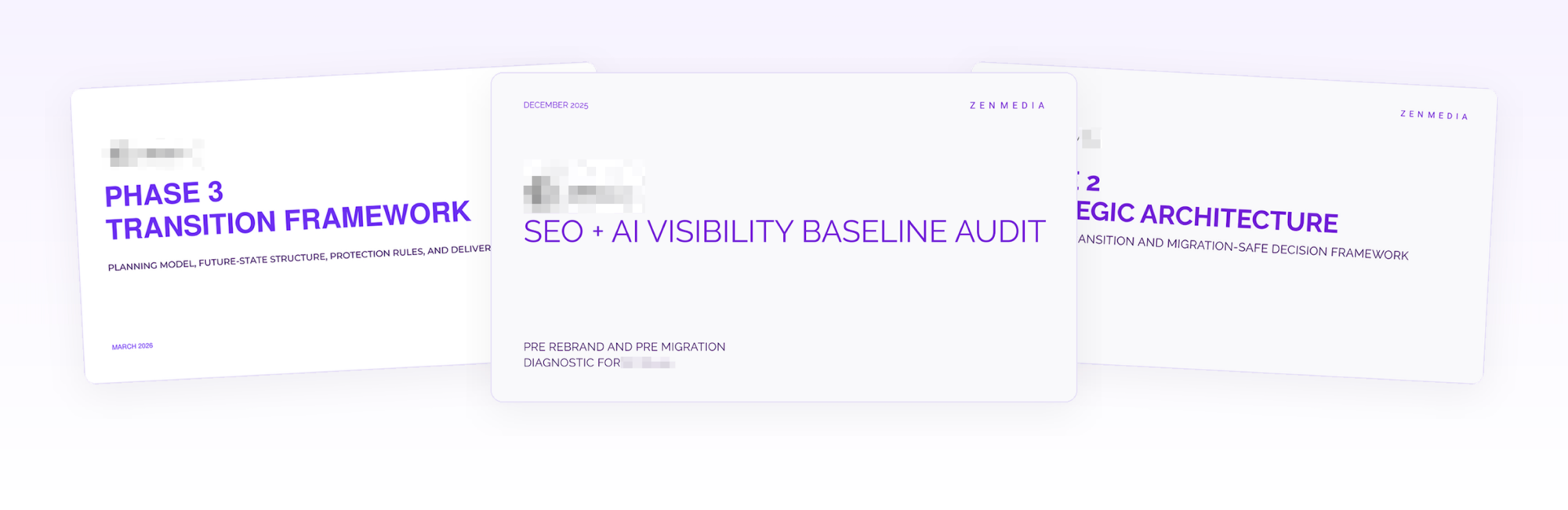
The engagement’s strategy decks: diagnostic baseline, content architecture, and migration framework.
We opened with a comprehensive technical, content, backlink, competitive, AI-visibility, and sentiment audit, a 59-page baseline that documented what the old domain had earned and where it was exposed. The technical debt was heavy: 1,014 URLs flagged in the crawl, 98 parameters generating over 7,000 duplicate paths, slow pages, structured-data gaps, and on-page signal problems such as missing headings and duplicate titles. It also measured the brand across 1,000 AI prompts and more than 1,500 brand mentions, mapped the authority spread across referring domains, and set the concentration risk in hard numbers. Every later decision traced back to this baseline.

Crawl-health baseline: over 1,000 URLs flagged for errors, redirects, depth, and speed.
With the repositioning in view, we mapped a demand universe of 2,519 queries across the brand’s existing categories and the new metabolic-health territory, then organized it into content pillars, an editorial taxonomy, and a set of cornerstone pages. The design defended the demand already converting while opening a clear path into the 500-plus query metabolic opportunity the brand had barely touched.

Demand universe mapped and concentrated into content pillars.
This phase protected the equity. We built a page-level URL mapping blueprint for all 1,015 URLs, classifying each as preserve, consolidate, retire, or redirect and weighting it by the authority data from Phase 1. On top sat a redirect and canonical rule set, a future-state URL architecture aligned to the new pillars, a link-equity and migration-risk model that flagged the 52 highest-authority pages for protection, a schema strategy for products, FAQs, editorial, and brand entities, and a developer handoff pack with pre-launch validation and rollback planning. The concentrated, high-value pages were mapped first and verified hardest.

Every URL classified preserve, consolidate, retire, or redirect.
A migration is only safe if someone can watch it hold. We delivered a KPI framework of 15 metrics across five categories, equity retention, traffic continuity, ranking stability, AI answer inclusion, and brand sentiment, each with a success threshold and an alert condition, plus reporting templates, a QA and governance operating model, standard operating procedures, and team training. The client left able to run and defend the migration itself.
The rebrand and domain migration went live, and the brand’s organic equity carried across to the new domain. The redirect from the old domain held, and the branded and research searches that mattered most transferred intact.
On the metrics that survive a domain change cleanly, the signals were strong. Returning organic users nearly doubled, from 11,915 to 23,237 (+95%), the clearest evidence that engaged audiences followed the brand to its new home, and overall organic sessions grew 27%. The branded queries that had driven most discovery held their volume through the transition, exactly what a referral-led, branded footprint most needs from a migration.
The new domain established its own footprint fast. Within about three weeks of launch it was ranking for 339 organic keywords, 319 of them on page one and 138 in the top three (Ahrefs), and it recaptured the top of page one for the brand’s legacy name, so searches for the old name now land on the new site. Link equity moved with it: 761 backlinks resolved to the new domain through the redirect map, including 301 redirects from the old domain’s highest-authority pages.
The technical baseline turned into a plan the developers could execute. All 1,015 URLs moved on a documented map, the 52 highest-authority pages were protected first, and the redirect and canonical rules gave the client’s developers a clean path to launch on. The move was controlled and sequenced, with the riskiest pages verified before anything went live.
The team also left equipped to defend the result. The 15-KPI governance framework gave them a defined way to watch equity retention, ranking stability, and AI answer inclusion in the weeks after launch, so any problem would surface as an early alert they could act on. With the migration secured, the new domain was positioned to grow into the metabolic-health demand the old brand had never reached.
Measurement ran across two tool sets. On the agency side we used Ahrefs for equity, backlinks, and rankings. On the client side, GA4 and Search Console held traffic and query data. The GA4 property tracked through the rebrand, so the pre- and post-launch comparisons above are like-for-like on the same property, and every baseline was locked from the Phase 1 audit and the pre-launch window before the domain changed.
A domain change resets analytics cookies, so a share of returning visitors is counted as new the first time they reach the new address. We report returning-user and session trends because they reflect genuine retained engagement.
Concentration is the hidden risk in a strong organic footprint. The better a small set of pages performs, the more a rebrand or migration puts at stake, and a domain migration handled without a page-level equity plan is one of the fastest ways to erase years of SEO value. The same move, planned properly, becomes controlled: it protects the brand’s most valuable queries and sets up the new domain to grow.
This engagement covered a full rebrand from diagnosis to post-launch governance. The framework applies to any brand facing a domain change, a replatform, or a consolidation, where the goal is to move without losing what the current domain has already earned.
Facing a rebrand, replatform, or domain migration? Talk to Optimum7 to protect your organic equity before you move.
Fill out the form to request a Custom Marketing or Conversion Optimization Strategy for your Website.